


Comprehensive Guide to ZL105 and ZL105A High Strength Casting Aluminum Alloys: Composition System, Heat Treatment Process, Performance Comparison and Engineering Applications
Article Catalog[Hidden]
- ZL105 / ZL105A Corresponding Country Grade
- ZL105 / ZL105A Aluminum Alloy Composition Table
- ZL105 / ZL105A Physical and Mechanical Properties Parameter Table (Typical, T6 State)
- Performance Enhancement Pathways and Technology Grading
- Corresponding international grades
- ZL105 / ZL105A in the foundry industry
- ZL105 / ZL105A Aluminum Alloy FAQs
As a Chinese national standard (GB/T 1173) in theAluminum-silicon-copper-magnesium high-strength casting alloyThe representative grade of theZL105 (ZAlSi5Cu1Mg) and its high-purity version ZL105A (ZAlSi5Cu1MgA) by means ofHigher strength, good castability and excellent heat treatment responseand is known for. This pair of alloys is made byMedium silicon content (4.5-5.51 TP3T) guarantees casting fluidity, reinforced by a combination of copper (Cu) and magnesium (Mg).After T5 or T6 heat treatment, it can obtain the mechanical level close to ZL201 and other high-strength alloys, and at the same time, it retains better casting processability than aluminum-copper alloys, which is the best way to makeComplex castings subjected to high static and medium dynamic loadsIt is the ideal material for a wide range of applications in the fields of aviation, aerospace, automotive and power machinery.
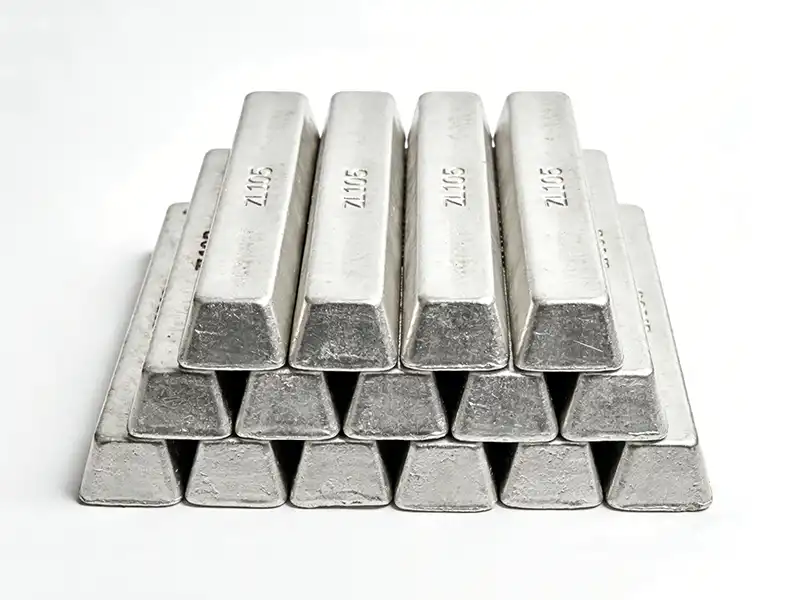
ZL105 / ZL105A Corresponding Country Grade
- National Standard Grade: According to GB/T 1173, its grade is ZAlSi5Cu1Mg(corresponding to ZL105) and ZAlSi5Cu1MgA(corresponds to ZL105A). The suffix “A” stands for the high purity version.
- Industry/Enterprise Code:ZL105 respond in singing ZL105A It is a widely used code in foundry industry drawings, manuals and enterprise standards.
- Core features:
- ZL105Basic Al-Si-Cu-Mg tetrameric alloy with relatively loose control of impurity iron (Fe) (≤0.5%), excellent comprehensive performance and high cost performance.
- ZL105A:high purityThe heat treatments are strictly limited to iron (Fe) and other impurities (≤0.15%), and other trace elements are optimized to obtain aHigher strength, better plasticity and more stable overall mechanical properties, is an upgrade option for high-end fields such as aviation and aerospace.
ZL105 / ZL105A Aluminum Alloy Composition Table
| elemental | ZL105 Content range (wt%) | ZL105A Content range (wt%) | functional role |
|---|---|---|---|
| Silicon (Si) | 4.5-5.5 | 4.5-5.5 | Main alloying elements. Provides casting fluidity and forms a Mg₂Si strengthening phase with magnesium. |
| Copper (Cu) | 1.0-1.5 | 1.0-1.5 | Core Strengthening Elements. Formation of Al₂Cu and complex polystrengthened phases significantly improves room and high temperature strength. |
| Magnesium (Mg) | 0.4-0.6 | 0.4-0.6 | Key Enhancement Elements. Formation of Mg₂Si with silicon and synergistic composite strengthening effect with copper. |
| Iron (Fe) | ≤ 0.5 | ≤ 0.15 | The most critical point of difference in impuritiesThe iron is a brittle phase, which reduces plasticity and fatigue properties. Iron forms brittle phases that reduce plasticity and fatigue properties.The tight iron limitation of ZL105A is at the heart of the performance jump. |
| Manganese (Mn) | 0.3-0.5 | 0.3-0.5 (can be added) | Neutralizes the harmful effects of iron and improves heat resistance. |
| Titanium (Ti) | 0.1-0.2 (can be added) | 0.1-0.2 (usually added) | Grain refiner. |
| Zinc (Zn) | ≤ 0.3 | ≤ 0.1 | Impurities. |
| Aluminum (Al) | tolerance (i.e. allowed error) | tolerance (i.e. allowed error) | Substrate material. |
ZL105 / ZL105A Physical and Mechanical Properties Parameter Table (Typical, T6 State)
| Performance indicators | ZL105-T6 | ZL105A-T6 | Comparative Analysis and Advantage Interpretation |
|---|---|---|---|
| intensity | 2.68-2.70 g/cm³ | 2.68-2.70 g/cm³ | Similar. |
| Tensile strength (Rm) | 280-320 MPa | 330-370 MPa | ZL105A is significantly higherIt reaches the level of high-strength cast aluminum. |
| Yield strength (Rp0.2) | 210-250 MPa | 260-300 MPa | The yield strength of ZL105A is significantly higher and the load carrying capacity is stronger. |
| Elongation (A) | 1.5-3.0% | 3.0-5.0% | The plasticity (elongation) advantage of ZL105A is extremely outstanding., nearly double that of ZL105. |
| Brinell hardness (HB) | 90-105 | 100-115 | ZL105A has higher hardness and better wear resistance. |
| High Temperature Strength (250°C) | favorable | talented | The addition of copper gives both good high temperature performance, with ZL105A being superior. |
| fatigue strength | favorable | talented | Impurity control resulted in a significant improvement in fatigue resistance of ZL105A. |
| Casting mobility | favorable | favorable | Similarly, the same silicon content determines comparable fluidity. |
| Heat treatment responsiveness | favorable | excellent | Fewer impurities result in fuller precipitation of reinforcing phases and more uniform organization of ZL105A. |
Performance Enhancement Pathways and Technology Grading
The core difference between the ZL105 and the ZL105A is “Purity Upgrade”The qualitative change in performance brought about by the
- Multiple composite reinforcement: The synergistic action of the three elements, silicon, copper and magnesium, forms Mg₂Si, Al₂Cu, and multifaceted complex compounds, so that the alloy obtains a heat-treatedHigher strength level than ZL104The casting properties of the product are very good, while maintaining good casting properties.
- Purity determines performance ceilings: Iron (Fe) is the main harmful impurity. ZL105A reduces the Fe content from ≤0.5% to ≤0.15%, which drastically reduces the volume fraction of brittle phases and makes theDoubled elongation and improved fatigue performanceIt is capable of meeting high reliability requirements such as aerospace.
- Heat Treatment as a Performance Engine: Both need to be passedT5 (artificial aging) or T6 (solid solution + artificial aging) The T6 treatment gives peak strength but requires attention to quench distortion, while the T5 treatment gives considerable strengthening with less distortion.
- The Cost vs. Performance Ladder: ZL105 is “High-performance cost-effective choice”, which provides superior strength to ZL104 at a manageable cost; and ZL105A, which is “Aerospace grade upgrade”, paying a premium for high-end applications in exchange for greater strength, toughness and reliability.
Corresponding international grades
ZL105/ZL105A can be found internationally as an alloy with similar properties, but subtle differences in compositional systems should be noted:
- Chinese national standard:ZAlSi5Cu1Mg (ZL105),ZAlSi5Cu1MgA (ZL105A) (GB/T 1173)
- American Standard:: In conjunction with the A319.0 (Al-Si6Cu4) and A355.0 There are similarities, but A319 has a higher copper content, while ZL105 has a well-defined magnesium content; the closest is the 354.0 (Al-Si9Cu2Mg) or 355.2 (high-purity version), but the composition still varies.
- EU standard:EN AC-45400 (Al-Si8Cu3) is high in copper content;EN AC-42200 (Al-Si7Mg) No copper, different performance system.
- Russian Standard:AЛ5 The composition is close to ZL105.
ZL105 / ZL105A in the foundry industry
based on itsHigh strength, good castability and gradable selectioncharacteristics, this pair of alloys is mainly used in the following areas:
- Aerospace and Defense (ZL105A-based)
- Aircraft structural parts: Stressed joints, supports, frames, hatch rails.
- Engine Accessories: Pressurizer receiver, accessory drive housing, fuel pump housing.
- Missiles and spacecraft: Instrument pod holders, attachment rings.
- Automobile and Power Machinery (ZL105 and ZL105A combined)
- Engine components: Cylinder head (non-high heat load area), intake manifold, oil sump , timing gear chamber.
- transmission system: Transmission housing, clutch housing.
- Compressor components: Crankcase, cylinder block.
- General machinery and heavy equipment
- Pump and valve housings: High-pressure oil pumps, hydraulic valve bodies (high strength and pressure resistance required).
- transmission part: Large reduction gearboxes, Industrial Gearboxes .
- construction machinery: Hydraulic cylinder end caps, connecting brackets.
ZL105 / ZL105A Aluminum Alloy FAQs
Q1: What is the main difference between ZL105 and ZL104? How to select the model?
- This is the most common comparison:
- ZL105:Contains copper (Cu 1.0-1.5%) and has a high magnesium content, reinforced with Al₂Cu and Mg₂Si composite.Higher strength (especially yield strength) and better high-temperature performanceThe elongation and corrosion resistance of ZL104 is slightly lower than that of ZL104.
- ZL104:copper-free, reinforced only with Mg₂Si.Better corrosion resistance, slightly higher plasticitybut the strength (especially high temperature strength) is lower than ZL105.
- selection: RequiredHigher strength, higher operating temperatures or higher hardness requirementsfashionableZL105Yes.High corrosion resistance and moderate strength requirementsfashionableZL104.
Q2: How much more expensive is the ZL105A than the ZL105? Is the performance increase worth it?
- Costs are usually higher20-30%, mainly stemming from stricter requirements for primary aluminum purity, melting process control and testing.
- whether it's worthwhileDepending on the application: for general industrial machinery, the performance of ZL105 is sufficient, and the extra cost of 30% in exchange for the performance increase may beuneconomicalBut for aerospace, motorsports, and other industries that have a high demand forReliability and fatigue life are demandingoccasions, the ZL105A's performance gains aremust haveThe.
Q3: What are the general parameters of heat treatment process for ZL105?
- Typical T6 process (for reference only, needs to be adjusted according to the casting):
- solid solution treatment: 515-525°C × 6-12 hours.Warm water (60-80°C) quenching(Note: too high a temperature makes it easy to overcook).
- artificial time limit: 160-180°C × 6-10 hours, air-cooled.
- The T5 process (direct artificial aging in the cast state) can also be used, with a slightly lower strength gain, but with less risk of deformation.
Q4: What are the casting properties of ZL105 and ZL105A?
- favorableThe silicon content is 4.5-5.51 TP3T. With a silicon content of 4.5-5.51 TP3T, the fluidity is not as good as high silicon alloys (e.g. ZL102), but is sufficient to cope with most castings of moderate complexity. Compared with ZL104, the fluidity is slightly inferior, but better than aluminum-copper alloys (e.g. ZL201). Care should be taken to optimize the pouring system when designing thin-walled parts.
Q5: What is the welding repair performance of ZL105 and ZL105A?
- moderate. Due to the copper content, the tendency to weld hot cracking is higher than that of ZL104 without copper. When performing argon arc welding filler welding, it is necessary toPreheating (150-200°C)The selection of suitable filler materials and post-weldstress reliefThe following are some examples of the types of welding that should be done. For critical load-bearing parts, make-up welding should be minimized.
Q6: What is the corrosion resistance of ZL105A? Does it need surface treatment?
- moderate. Due to the copper content, its corrosion resistance is not as good as that of copper-free ZL101A/ZL104. used outdoors or in humid environments.Effective surface protection is necessarySuch as anodizing (film layer may be grayish), painting, etc.