


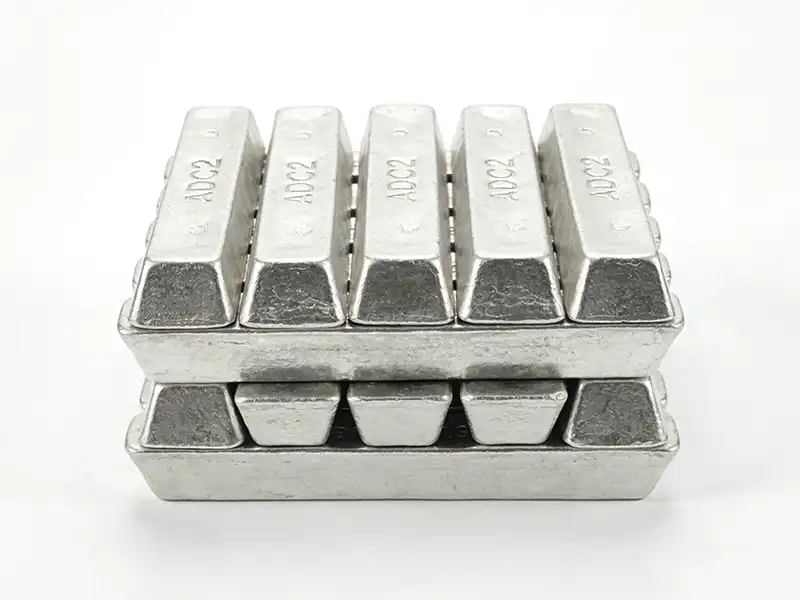
ADC2 die-casting aluminum alloy: aluminum-silicon-magnesium heat-treatable reinforced alloy, resolving the balance between its high strength, good toughness and casting performance.
Article Catalog[Hidden]
- ADC2 Standards and Grades
- ADC2 Aluminum Alloy Composition Table (based on JIS H 5302 typical requirements)
- ADC2 Physical and Mechanical Properties Parameter Table (die-cast state, typical values)
- ADC2 in the die casting industry
- ADC2 Aluminum Alloy Frequently Asked Questions
- 📊 Extended column: ADC2 vs. ADC1, ADC12 comparative analysis
As part of the Japanese Industrial Standards (JIS)Aluminum-silicon-magnesium heat-treatable reinforced die-cast aluminum alloysThe representative grade of theADC2 by means ofGood casting fluidity, excellent heat treatment responsiveness and high overall mechanical propertiesis known for. The alloy passesSilicon (Si) guarantees casting performance, magnesium (Mg) provides the basis for precipitation strengtheningAfter the T5 heat treatment, the strength and hardness can be significantly improved, and the balance of strength and toughness is realized while maintaining good die-casting processability, which is a good way to produceModerately complex die castings requiring high strength, good toughness and heat treatability.It is the ideal material for the automobile, motorcycle, general machinery and other fields.
ADC2 Standards and Grades
- JIS Standard Grades: According to the Japanese Industrial Standard JIS H 5302, the grade is ADC2“ADC” stands for “Aluminum Die Casting”. “ADC” stands for "Aluminum Die Casting" and "2" is the number of the alloy in the series with specific composition and properties.
- Core features:Medium silicon content (9.0-10.01 TP3T) Ensures good casting flow and air tightness;Defined magnesium content (0.4-0.61 TP3T) give itExplicit heat treatment enhancement capabilities;Strict control of copper content (≤0.2%) Ensure good corrosion resistance; after T5 artificial aging can be obtained after the balance of high strength and good toughness, is a rare die-casting aluminum alloyHeat-treatable reinforced typeMaterial.
ADC2 Aluminum Alloy Composition Table (based on JIS H 5302 typical requirements)
| elemental | Content range (wt%) | functional role |
|---|---|---|
| Silicon (Si) | 9.0-10.0 | Main alloying elements. Provides good casting fluidity, resistance to thermal cracking and airtightness. |
| Magnesium (Mg) | 0.4-0.6 | Core Strengthening Elements. Formation of Mg₂Si phase with Si and significant precipitation strengthening by T5 heat treatment. |
| Copper (Cu) | ≤ 0.2 | Tightly controlled impurities. Low copper content ensures good corrosion resistance and toughness. |
| Iron (Fe) | ≤ 1.0 | Prevents mold sticking during die casting, but needs to be controlled to ensure mechanical properties. |
| Manganese (Mn) | ≤ 0.3 | Neutralizes the harmful effects of iron. |
| Zinc (Zn) | ≤ 0.5 | Impurity elements. |
| Titanium (Ti) | 0.1-0.2 (can be added) | Grain refiner. |
| Aluminum (Al) | tolerance (i.e. allowed error) | Substrate material. |
ADC2 Physical and Mechanical Properties Parameter Table (die-cast state, typical values)
| Performance indicators | Die-cast (F) | T5 aging state | Comparative analysis and advantages |
|---|---|---|---|
| intensity | 2.65-2.68 g/cm³ | - | - |
| Tensile strength (Rm) | 220-260 MPa | 280-320 MPa | 25-30% strength increase after heat treatment, reaching high intensity levels. |
| Yield strength (Rp0.2) | 130-160 MPa | 200-240 MPa | The yield strength has increased significantly and the load carrying capacity has increased significantly. |
| Elongation (A) | 3.0-5.0% | 2.5-4.0% | Highlighting Advantages: Good plasticity after heat treatment and excellent balance of strength and toughness. |
| Brinell hardness (HB) | 60-70 | 80-95 | Significantly higher hardness and good abrasion resistance. |
| corrosion resistance | favorable | favorable | The low copper design provides better corrosion resistance than the ADC12. |
| Casting mobility | favorable | - | Medium silicon content ensures good mold filling ability. |
| Heat treatment responsiveness | - | excellent | Highly sensitive to T5 processing with significant performance gains. |
Performance Enhancement Pathways and Technical Characteristics
ADC2 was designed with the concept of “Heat-treatable reinforcement for processability”:
- Magnesium precipitation enhancement: The magnesium content of 0.4-0.61 TP3T led to the precipitation of a diffuse Mg₂Si strengthened phase after artificial aging at T5 (4-8 h holding time at 150-180°C).Tensile strength can be increased by 25-30%This is the core advantage of ADC2 over non-heat treatable alloys such as ADC1 and ADC10.
- Low copper design: The copper content is strictly controlled at ≤0.2% to ensure that theGood corrosion resistanceThis makes it suitable for applications where corrosion resistance is required.
- Optimization of silicon content: The silicon content of 9-10% is in the sub-eutectic interval, which ensures good casting fluidity and avoids the incipient silicon problem of per-eutectic alloys, while providing an adequate silicon source for Mg₂Si formation.
- Simple heat treatment process: Unlike alloys that require solid solution treatment (T6), ADC2 primarily usesT5 manual agingIt avoids the risk of distortion and blistering that may be caused by solid solution quenching, and has a wide process window, making it suitable for mass production of die castings.
Corresponding international grades
ADC2 has a clear international counterpart as a heat-treatable reinforced die-cast aluminum alloy:
| (an official) standard | grades | note |
|---|---|---|
| Japan JIS | ADC2 | - |
| ASTM, USA | A360.0 | Highly consistent composition (Si 9-10%, Mg 0.4-0.6%) |
| China GB | YL104 (YZAlSi9Mg) 或 YL102 | YL104 is close in composition and comparable in performance |
| EU EN | EN AC-45200 (AlSi9Mg) | Composition close to ADC2 |
| Korea KS | ADC2 | identical brand |
ADC2 in the die casting industry
based on itsHeat treatable for strengthening, good toughness, good corrosion resistancecharacteristics of ADC2, ADC2 is mainly used in the following areas:
- Auto Parts
- structural member: Engine mounts, suspension mounts, steering housing, seat adjuster components.
- Shell type: ECU housing, sensor housing, fuel pump housing, water pump housing.
- safety part: Airbag housings, seat belt retractor components (high strength and toughness requirements).
- Motorcycles and General Dynamics
- Engine components: Cylinder head covers, crankcase covers, gearbox housings.
- structural member: Frame connectors, pedal brackets.
- electrical and electronics
- Thermal components: LED heat sinks, power module housings.
- communications equipment: Base station housing, router housing (need to take into account the strength and heat dissipation).
- General Machinery
- Hydraulics and Pneumatics: Valve body, pump housing, cylinder end caps.
- Motor Casing: Servo motor housing, generator end caps.
ADC2 Aluminum Alloy Frequently Asked Questions
Q1: What is the main difference between ADC2 and ADC12? How to select the type?
- Here's the core comparison:
- ADC2:Containing magnesium (0.4-0.6%), low copper (≤0.2%).T5 heat treatableThe strength can be increased to 280-320 MPa after heat treatment.Better toughness and corrosion resistance.
- ADC12:Contains copper (1.5-3.5%), no magnesium or trace amounts.Not heat treatableThe cast strength is high (280-310 MPa), but theLow elongation, poor corrosion resistance.
- selection: RequirementsCombination of high strength and good toughness, corrosion resistance requirementsSelected when the heat treatment process is acceptable.ADC2Pursuits.Highest cast strength, cost sensitive, no corrosion resistance requiredfashionableADC12.
Q2: What are the heat treatment process parameters for ADC2?
- Typical T5 process: 150-180°C × 4-8 hours, air-cooled.
- specificities: No solution treatment (T6) is required, avoiding the risk of blistering common to die castings. Simple process and good dimensional stability. The tensile strength can be increased by 25-30% after heat treatment, and the yield strength can be increased by about 40-50%.
Q3: What is the casting performance of ADC2? How does it compare with ADC12?
- Good, slightly inferior to ADC12. the silicon content of ADC2 (9-101 TP3T) is slightly lower than that of ADC12 (9.6-121 TP3T), thusSlightly less liquidThe ADC12 is a good filler, but adequate for most die castings of moderate complexity. For very thin-walled or ultra-complex structures, ADC12 has slightly better filling capabilities.
Q4: What is the corrosion resistance of ADC2?
- favorableIt is suitable for outdoor environment and humidity. As the copper content is strictly controlled at ≤0.2%, its corrosion resistance is significantly better than that of ADC10 and ADC12, which have high copper content. it performs stably under general atmospheric and humid conditions, and is suitable for outdoor equipment, automobile engine compartments and other application scenarios.
Q5: What is the welding repair performance of ADC2?
- favorable. The low copper content gives it a low tendency to weld hot cracks. It can be repaired by argon arc welding (TIG), using homogeneous wires or Al-Si-Mg system wires, and localized stress relief treatment is recommended after welding.
Q6: Can ADC2 be T6 heat treated?
- not recommended. Although higher strength can theoretically be obtained with T6, the presence of tiny pores inside the die casting and the high temperatures of the solution treatment (about 540°C) tend to cause thesuperficial foaming, and quenching may cause distortion. As a result, ADC2 is often artificially aged to T5 only, avoiding the risks while achieving significant performance gains.
📊 Extended column: ADC2 vs. ADC1, ADC12 comparative analysis
| comparison dimension | ADC2 (heat treatable) | ADC1 (High Silicon) | ADC12 (High Copper) |
|---|---|---|---|
| Silicon (Si)% | 9.0-10.0 | 11.0-13.0 | 9.6-12.0 |
| Magnesium (Mg)% | 0.4-0.6 | ≤0.3 | ≤0.3 |
| Copper (Cu)% | ≤0.2 | 0.5-1.5 | 1.5-3.5 |
| hot treatment (e.g. of metal) | Enhanceable T5 | Not heat treatable | Not heat treatable |
| Tensile strength (cast) | 220-260 MPa | 230-280 MPa | 280-310 MPa |
| Tensile strength (T5) | 280-320 MPa | - | - |
| Elongation (cast) | 3.0-5.0% | 1.5-3.0% | 1.5-3.0% |
| Elongation (T5) | 2.5-4.0% | - | - |
| corrosion resistance | favorable | general | mediocre |
| Casting mobility | favorable | excellent | talented |
| Typical Costs | moderate | lower (one's head) | moderate |
Selection Quick Guide:
- Select ADC2: RequirementsCombination of high strength and good toughness, corrosion resistance requirementsand acceptable for heat treatment processes (automotive structural parts, safety components, outdoor equipment).
- Select ADC1: The QuestExtreme castability, lowest costThe most important thing is that it is a thin-walled, complex part that does not require a high degree of strength.
- Select ADC12: RequiredMaximum cast strengthThe die castings are general-purpose die castings that do not require high corrosion resistance and are not subject to heat treatment.