


Comprehensive guide to ZL116 casting aluminum alloy: composition system, heat treatment process, international corresponding grades and typical applications
Article Catalog[Hidden]
- ZL116 Aluminum Alloy Composition Table (based on GB/T 1173 typical requirements)
- ZL116 Physical and Mechanical Properties Parameter Table (metal mold casting, typical values)
- Performance Enhancement Pathways and Technical Characteristics
- Corresponding international grades
- Application of ZL116 in foundry industry
- 📊 Extended column: ZL116 and related alloys comparative analysis
As a Chinese national standard (GB/T 1173) in theAluminum-silicon-magnesium casting alloys containing berylliumThe quintessential representative of theZL116 (ZAlSi7MgBe) by means ofExcellent casting fluidity, excellent air tightness, good heat resistance and high overall mechanical propertiesis known for. The alloy passesSilicon (Si) guarantees casting performance, magnesium (Mg) provides precipitation strengthening, and trace beryllium (Be) is added.Significantly improve the melt oxidation resistance, grain refinement and improve high temperature performance, after T6 heat treatment can obtain a balance of high strength and good plasticity, is the manufacture ofComplex and thin-walled key castings requiring airtightness and heat resistance in high-end fields such as aerospace, instrumentation, optics, etc.The ideal material for the
The national grade for ZL116 is ZAlSi7MgBe.
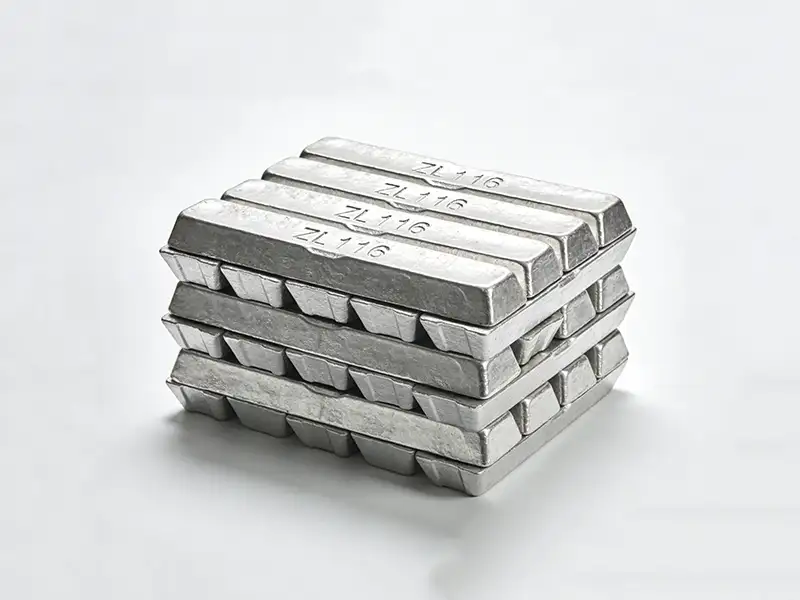
- National Standard Grade: According to GB/T 1173, its grade isZAlSi7MgBe. The name directly reflects its core alloy system: silicon (Si), magnesium (Mg), and beryllium (Be).
- Industry/Enterprise Code:ZL116 It is a widely used code for this material in foundry industry drawings, manuals and enterprise standards.
- Core features: Medium silicon content (6.5-7.51 TP3T) ensures good castability; magnesium (0.35-0.551 TP3T) provides precipitation strengthening;Trace beryllium (0.15-0.40%) additionIts most important feature is that it can significantly improve the oxidation resistance of the melt, refine the grain, improve the fluidity and enhance the strength at high temperatures; at the same time, it has excellent gas tightness.
ZL116 Aluminum Alloy Composition Table (based on GB/T 1173 typical requirements)
| elemental | Content range (wt%) | functional role |
|---|---|---|
| Silicon (Si) | 6.5-7.5 | Main alloying element. Provides good casting fluidity, resistance to hot cracking and forms the basis for the Mg₂Si strengthening phase. |
| Magnesium (Mg) | 0.35-0.55 | Key strengthening element. Forms Mg₂Si with Si, which is precipitation strengthened by T6 heat treatment. |
| Beryllium (Be) | 0.15-0.40 | Featured Elements. Significantly improves melt oxidation resistance, refines grain size, improves fluidity and enhances high temperature performance. |
| Iron (Fe) | ≤ 0.5 | Impurity Element. Needs to be controlled, but tolerated moderately. |
| Copper (Cu) | ≤ 0.1 | Impurities. Strictly controlled to maintain corrosion resistance. |
| Manganese (Mn) | ≤ 0.1 | Impurities. |
| Zinc (Zn) | ≤ 0.1 | Impurities. |
| Titanium (Ti) | 0.1-0.2 (can be added) | Grain refiner. |
| Aluminum (Al) | tolerance (i.e. allowed error) | Substrate material. |
ZL116 Physical and Mechanical Properties Parameter Table (metal mold casting, typical values)
| Performance indicators | Cast (F) | T6 solid solution + aging state | Performance Positioning and Interpretation |
|---|---|---|---|
| intensity | 2.66-2.68 g/cm³ | -- | -- |
| Tensile strength (Rm) | 180-220 MPa | 290-340 MPa | Excellent strength in T6 stateThe level of high-strength cast aluminum has been achieved. |
| Yield strength (Rp0.2) | 100-130 MPa | 230-270 MPa | The yield strength is significantly increased after heat treatment and the load carrying capacity is enhanced. |
| Elongation (A) | 3.0-6.0% | 2.0-5.0% | Maintains good plasticity, strong and balanced. |
| Brinell hardness (HB) | 60-70 | 85-105 | Moderate hardness and good workability. |
| Casting mobility | talented | -- | The addition of beryllium further improves flowability and is suitable for complex thin-walled parts. |
| airtight | excellent | excellent | Core AdvantagesBeryllium refines the organization and improves the densification, suitable for pressure casting. |
| heat resistance | favorable | talented | Core AdvantagesBeryllium improves high temperature strength and tissue stability. |
| corrosion resistance | favorable | favorable | Copper free, good corrosion resistance. |
Performance Enhancement Pathways and Technical Characteristics
The ZL116“s superior performance stems from the "Silicon and Magnesium Base Reinforcement + The Magic of Trace Beryllium”:
- Silicon and magnesium base reinforcement: 6.5-7.51 TP3T of silicon ensures good castability, magnesium content of 0.35-0.551 TP3T provides an adequate base for Mg₂Si precipitation strengthening, and high strength is obtained after T6 heat treatment.
- Multiple roles of trace beryllium:
- antioxidant: Beryllium forms a dense oxide film on the melt surface, which significantly reduces oxidative burnout and outgassing during the melting process and improves the purity of the melt.
- Refinement of grains: Beryllium can refine α-Al grains and eutectic silicon, improve tissue uniformity and enhance mechanical properties.
- Improving mobility: Refinement of the organization while reducing the surface tension, so that the melt filling capacity is stronger, suitable for thin-walled complex castings.
- Improved heat resistance: Compounds formed from beryllium are stabilized at high temperatures, enhancing the alloy's high-temperature strength and creep resistance.
- Precision T6 heat treatment:
- solid solution treatment: 535±5°C × 6-12 h, water quenching (40-60°C).
- artificial time limit: 160-180°C × 4-10 hours, air-cooled.
- The presence of beryllium results in a more stable heat-treated organization and better consistency of properties.
Corresponding international grades
The beryllium-containing properties of ZL116 have specific international counterparts:
| (an official) standard | grades | note |
|---|---|---|
| China GB/T 1173 | ZL116 (ZAlSi7MgBe) | - |
| ASTM, USA | A357.0 | Beryllium-containing Al-Si7Mg0.6 alloy with a composition close to the |
| EU EN | EN AC-42200 (AlSi7Mg0.6) | Beryllium-free, but properties can be process-adjusted to be closer |
| France NF | A-S7G | Some beryllium-containing versions |
| ISO 3522 | AlSi7MgBe | Corresponding grades are available |
Application of ZL116 in foundry industry
based on itsExcellent flowability, high air tightness, good heat resistance and comprehensive mechanical propertiesZL116 is mainly used in the following fields:
- aerospace
- Complex thin-walled parts: Instrument housings, hydraulic valve bodies, fuel system components, optical instrument mounts.
- pressure-bearing component: Pneumatic system valve bodies, pressure accumulator housings, line fittings.
- precision instruments
- High-precision equipment: Gyroscope housings, sensor housings, navigation system structural components.
- optical instrument: Telescope mounts, camera housings, measuring equipment bases.
- automobile industry
- pressurization system: Turbocharger pressurizer housing, intercooler lines.
- Engine components: EGR valve body, sensor bracket, vacuum pump housing.
- electrical and electronics
- Heat sinks: High power LED heat sink housing, IGBT module substrate.
- sealing device: Sealed junction boxes, waveguide elements, RF shields.
- defense equipment
- Fuzing components, optical targeting system housings, guidance system structural components.
ZL116 Aluminum Alloy Frequently Asked Questions
Q1: What is the function of beryllium in ZL116? Is it OK to leave it out?
- Beryllium is a multifunctional element: ① Significantly reduce the melt oxidation, improve the purity of the melt; ② refine the grain, improve the organization; ③ improve the fluidity, conducive to thin-walled castings; ④ enhance the high-temperature performance. Alloys without beryllium (such as ZL101A) are also commonly used, but in the case of theDemanding requirements for airtightness, thin-wall molding and heat resistanceThe ZL116 is irreplaceable for the occasion.
Q2: What is the difference between ZL116 and ZL101A and ZL114A?
- ZL101A: Basic high strength and toughness alloy, cost effective and widely used, but does not contain beryllium.
- ZL114A: High magnesium version for greater strength, excellent toughness, beryllium free, high performance through purity and heat treatment.
- ZL116: Beryllium-containing alloys.Better castability, airtightness, heat resistanceZL114A is suitable for complex thin-walled, pressurized and medium-temperature working parts. The strength is between ZL101A and ZL114A, but the special performance is outstanding.
Q3: What are the special requirements for the heat treatment process of ZL116?
- Basic and ZL101A similar, but because of the beryllium content, the organization is more stable, heat treatment window is slightly wider. Solid solution temperature 535 ± 5 ℃, quenching water temperature of 40-60 ℃ is appropriate to avoid overcooling caused by deformation. Aging temperature 160-180 ℃, can be adjusted according to performance requirements.
Q4:How is the casting performance of ZL116? What are the advantages when designing thin-walled parts?
- Excellent casting performanceIt has good fluidity, excellent airtightness, low tendency to thermal cracking, and is particularly suitable forComplex thin-walled castings with a wall thickness of 1.5-4mm. The addition of beryllium further improves form-filling capabilities, allowing the molding of fine structures that are difficult to fill with other alloys.
Q5: What is the welding repair performance of ZL116?
- Good. Contains no copper and has a low tendency to weld hot cracks. It can be repaired by argon arc welding, using homogeneous wire or Al-Si-Mg system wire, and stress relief treatment is required after welding. For important castings, X-ray inspection should be carried out after repair welding.
Q6: What is the corrosion resistance of ZL116? Does it need surface treatment?
- Good. Copper-free, resistant to atmospheric and general media corrosion. Can be anodized in harsh environments with a uniform and dense film layer, suitable for high decorative requirements.
Q7: What is the cost of the ZL116? Is it worth to choose?
- Because of the beryllium content, the material cost is higher than ordinary alloys such as ZL101A. However, when it is necessary toHigh airtightness, complex thin-walled, heat-resistantIts excellent moldability and reliability reduce the scrap rate and the overall cost is often better when it comes to special performance, such as that of a molded product. It is suitable for applications with stringent requirements for performance and reliability.
📊 Extended column: ZL116 and related alloys comparative analysis
| comparison dimension | ZL116 (with Be) | ZL101A (no Be) | ZL114A (high Mg) | A357.0 (AFSL with Be) |
|---|---|---|---|---|
| Silicon (Si)% | 6.5-7.5 | 6.5-7.5 | 6.5-7.5 | 6.5-7.5 |
| Magnesium (Mg)% | 0.35-0.55 | 0.25-0.45 | 0.45-0.75 | 0.45-0.70 |
| Beryllium(Be)% | 0.15-0.40 | not have | not have | 0.04-0.07 |
| Tensile strength (T6) | 290-340 MPa | 290-330 MPa | 320-370 MPa | 320-360 MPa |
| Yield strength (T6) | 230-270 MPa | 220-260 MPa | 260-300 MPa | 250-290 MPa |
| Elongation (T6) | 2.0-5.0% | 3.0-6.0% | 5.0-10.0% | 3.0-8.0% |
| Casting mobility | talented | favorable | favorable | Good (with beryllium improvement) |
| airtight | excellent | favorable | favorable | talented |
| heat resistance | talented | favorable | favorable | talented |
| Typical Costs | high | mid-to-high-end | high-end | high-end |
Selection Quick Guide:
- Select ZL116: When the part requiresHigh airtightness, complex thin walls, medium heat resistanceWhen, for example, aerospace hydraulic housings, precision instruments.
- Select ZL101A: Conventional high-performance structural components in pursuit of cost-effectiveness.
- Select ZL114A: RequirementsUltimate strength and toughnessand when casting is moderately difficult.
- Option A357.0: International projects may require direct benchmarking to American Standard beryllium-containing alloys.