


ADC5 die-casting aluminum alloy: high thermal conductivity and corrosion resistant weldable alloy, resolving its excellent heat dissipation, good corrosion resistance and welding performance.
Article Catalog[Hidden]
- ADC5 Standards and Grades
- ADC5 Aluminum Alloy Composition Table (based on JIS H 5302 typical requirements)
- ADC5 Physical and Mechanical Properties Parameter Table (Die-Cast State, Typical Values)
- ADC5 Performance Enhancement Path and Technical Characteristics
- Application of ADC5 in die casting industry
- ADC5 Aluminum Alloy Frequently Asked Questions
- 📊 Extended column: ADC5 vs. ADC3, ADC12 comparative analysis
As part of the Japanese Industrial Standards (JIS)Aluminum-magnesium high thermal conductivity and corrosion resistant die-casting aluminum alloyThe quintessential representative of theADC5 by means ofExcellent thermal and electrical conductivity, good corrosion resistance, excellent weldability and medium strength levelsis known for. The alloy passesMagnesium (Mg) as a major alloying element(math.) genusStrict limits on silicon (Si) and copper (Cu) contentThe thermal conductivity and corrosion resistance close to that of pure aluminum is achieved while maintaining good die-casting workmanship, and it is the best way to manufactureMedium-strength die castings with high requirements for heat dissipation, electromagnetic shielding and corrosion resistance, and requiring welded connectionsIt is an ideal material for electronic communication, automobile heat dissipation, lighting equipment and other fields with unique application value.
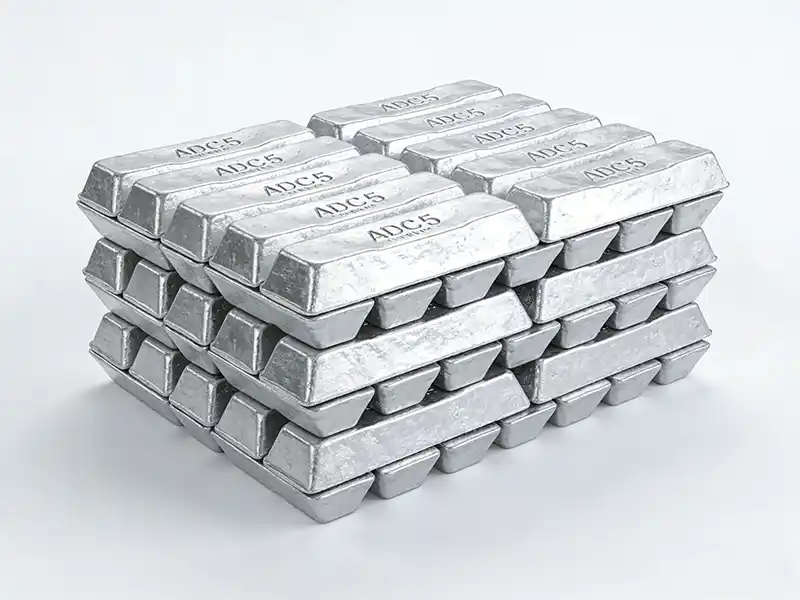
ADC5 Standards and Grades
- JIS Standard Grades: According to the Japanese Industrial Standard JIS H 5302, the grade is ADC5The “ADC” stands for “Aluminum Die Casting”. “ADC” stands for "Aluminum Die Casting" and "5" is the number of the alloy in the series with specific composition and properties.
- Core features:Low to medium silicon content (≤0.5%) Making its thermal and electrical conductivity close to pure aluminum;Magnesium (4.0-8.5%) as the main alloying element, providing solid solution strengthening and some age strengthening capability;Strict control of copper (≤0.2%), iron (≤1.0%) and other impuritiesThe product is designed to ensure excellent corrosion resistance and weldability;Heat treatableThe strength can be further improved by T5 or T6 treatment.
ADC5 AluminumAlloy composition table (based on JIS H 5302 typical requirements)
| elemental | Content range (wt%) | functional role |
|---|---|---|
| Magnesium (Mg) | 4.0-8.5 | core element.. Provides solid solution strengthening and aging strengthening, a source of strength for the alloy, while improving corrosion resistance. |
| Silicon (Si) | ≤ 0.5 | Tightly controlled impurities.. Low silicon content is key to obtaining high thermal/electrical conductivity and avoiding compromising thermal performance. |
| Copper (Cu) | ≤ 0.2 | Tightly controlled impurities. Low copper content ensures excellent corrosion resistance. |
| Iron (Fe) | ≤ 1.0 | Prevents die sticking during die casting, but needs to be controlled to ensure toughness and corrosion resistance. |
| Manganese (Mn) | ≤ 0.3 | Neutralizes some of the harmful effects of iron. |
| Zinc (Zn) | ≤ 0.5 | Impurity elements. |
| Nickel (Ni) | ≤ 0.3 | Impurity elements. |
| Aluminum (Al) | tolerance (i.e. allowed error) | High purity matrix, the basis for excellent thermal conductivity. |
ADC5 Physical and Mechanical Properties Parameter Table (Die-Cast State, Typical Values)
| Performance indicators | Numerical range (die-cast state - F) | Comparative analysis (vs ADC12) | Core Advantages |
|---|---|---|---|
| intensity | 2.64-2.66 g/cm³ | Slightly lower than ADC12 | - |
| Tensile strength (Rm) | 180-240 MPa | Below ADC12 | Medium strength, meets the requirements of most heat dissipating structural components. |
| Yield strength (Rp0.2) | 90-130 MPa | Below ADC12 | - |
| Elongation (A) | 5.0-12.0% | Significantly higher than ADC12 | Core Advantages: Excellent plasticity and good toughness. |
| Brinell hardness (HB) | 50-60 | Below ADC12 | Lower hardness, easy to machine. |
| heat conductivity | Approx. 150-180 W/(m-K) | Far beyond ADC12 (~96) | Core Advantages: Excellent thermal conductivity and heat dissipation. |
| conductivity | Approx. 40-50% IACS | Far beyond ADC12 (~25%) | Core Advantages: Excellent electrical conductivity and good electromagnetic shielding effectiveness. |
| corrosion resistance | talented | Significantly better than ADC12 | Core Advantages: Low copper, high magnesium, resistant to marine atmospheric corrosion. |
| weldability | talented | Significantly better than ADC12 | Core Advantages: Low silicon, low copper, low tendency to weld hot cracks. |
| Casting mobility | moderate | Below ADC12 | The silicon content is very low and the fluidity is not as good as high silicon alloys. |
ADC5 Performance Enhancement Path and Technical Characteristics
The ADC5 was designed with the concept of “Functional performance oriented, processability guaranteed”:
High magnesium provides strengthening and corrosion resistance
- Magnesium, with its high magnesium content of 4.0-8.51 TP3T, is the primary source of strength for ADC5. Magnesium has a high solid solubility in aluminum and provides significantsolid solution strengtheningEffect.
- Magnesium also forms a dense surface oxide film thatSignificantly improved corrosion resistanceIt is particularly resistant to seawater and industrial atmospheric corrosion.
Very low silicon guarantees thermal/electrical conductivity
- Silicon content is controlled at ≤0.5% to minimize scattering of electrons and phonons (thermal vibrational quanta) transport by the solid solution atoms, making theThermal and electrical conductivity much higher than high silicon die casting alloys (e.g. ADC12), approaching pure aluminum levels.
Strict control of impurities to ensure weldability
- The low silicon and low copper design makes itExtremely low tendency to weld hot crackingIt can be joined and repaired using a variety of welding methods, making it ideal for complex structural parts that require welded assemblies.
Heat treatment further strengthens
- The ADC5 can be used by theT5 (artificial aging) or T6 (solution + aging) heat treatmentFurther enhancement of strength. Typical process: solution treatment 400-450°C, aging 150-200°C. Tensile strength can be increased to 220-280 MPa after heat treatment.
Corresponding international grades
ADC5 as an aluminum-magnesium die-casting alloy has a clear international correspondence:
| (an official) standard | grades | note |
|---|---|---|
| Japan JIS | ADC5 | - |
| ASTM, USA | A518.0 (Al-Mg system) | Consistent compositional system with similar magnesium content range |
| China GB | YL302 (YZAlMg5) | Composition close to ADC5 |
| EU EN | EN AC-51400 (AlMg5) | similar in composition |
| International ISO | AlMg5 | having a correspondence |
Application of ADC5 in die casting industry
based on itsHigh thermal conductivity, high electrical conductivity, excellent corrosion resistance, good weldabilityThe unique combination of the ADC5 is mainly used in the following areas:
Heat dissipation and thermal management components (core applications)
- LED lighting: High power LED street light, flood light, stage light radiator shell.
- power electronics: Inverter heat sink housing, power module substrate, inverter housing.
- communications equipment: 5G base station heat sinks, RF unit housings.
Electronic and electrical components
- electromagnetic shielding: Precision instrument housings, medical equipment housings, communication equipment shielding covers.
- Electrical housings: Circuit breaker housings, meter box bodies, junction boxes.
- Motor parts: Motor end caps, cooling fans.
Auto Parts
- new energy vehicle: Battery pack heat sink, motor controller housing, vehicle charger housing.
- conventional car: Oil sumps, engine mounts, gearbox housings (some applications).
Marine and Offshore Engineering
- Marine components: Outboard housings, seawater pump housings, offshore platform supports (utilizing their excellent seawater corrosion resistance).
ADC5 Aluminum Alloy Frequently Asked Questions
Q1: What is the main difference between ADC5 and ADC3, ADC12? How to select the type?
- Here's the core comparison:
- ADC5:magnesium-aluminum system, silicon ≤ 0.5%, magnesium 4.0-8.5%.Best thermal and electrical conductivity, best corrosion resistance, best weldabilityLibyan Arab JamahiriyaMedium strength, poor castability.
- ADC3:Aluminum, silicon and magnesium, Si 4-6%, Mg 0.3-0.6%.Good thermal conductivity, medium strength, better castability than ADC5, is a comprehensive and balanced choice.
- ADC12:Aluminum-silicon-copper system, silicon 9.6-12%, copper 1.5-3.5%.High strength and optimal castabilityLibyan Arab JamahiriyaPoor thermal conductivity, poor corrosion resistance, poor weldability.
- selection:Thermal/Electrical Conductivity/Corrosion Resistance/Welding Preferred选ADC5;Comprehensive performance balance选ADC3;Strength Priority选ADC12.
Q2: What is the casting performance of ADC5? What do I need to pay attention to when designing?
- medium level. Due to the extremely low silicon content (≤0.5%), its fluidity is much lower than that of high-silicon alloys (e.g. ADC12). Care needs to be taken when designing the casting system:
- Appropriately increase the size of the gate, increase the pouring temperature and mold temperature.
- Avoid excessively thin-walled structures (recommended minimum wall thickness ≥ 2.5 mm).
- Enhance the exhaust design to prevent porosity defects.
- Suitable for medium wall thickness castings with relatively simple shapes.
Q3: Why is the thermal conductivity of ADC5 so good?
- The root cause isVery low silicon content. Silicon atoms in an aluminum matrix strongly scatter phonons that conduct heat, significantly reducing thermal conductivity.ADC5 controls silicon to ≤0.51 TP3T, minimizing this scattering effect and making its thermal conductivity (150-180 W/(m-K)) close to that of pure aluminum (~220 W/(m-K)), and much higher than that of ADC12 (~96 W/(m-K)).
Q4: What are the soldering process requirements for ADC5?
- Excellent weldability, which can be used in a variety of ways:
- Argon arc welding (TIG/MIG): Use homogeneous welding wire (Al-Mg system), clean thoroughly before welding to remove oxide film.
- resistance spot welding: Suitable for thin plate connections.
- laser welding: For precision welding.
- Stress relief can be applied to important structural parts after welding.
Q5: How is the corrosion resistance of ADC5? Does it need surface treatment?
- talented. The high magnesium content allows it to form a dense, stable oxide film on the surface of the aluminum matrix.Excellent resistance to seawater and industrial atmospheric corrosion.In most environments, no additional surface treatment is required. No additional surface treatment is required in most environments. If high decorative properties are required, anodizing can be performed to obtain a uniform, bright oxide film.
Q6: Can ADC5 be heat treated? What is the effect?
- canADC5 can be further strengthened by heat treatment:
- T5 manual aging: 150-200°C × 4-8 hours for 10-20% strength gain.
- T6 solid solution + aging: Solid solution at 400-450°C, quenched in water, then aged. Higher strength can be obtained, but the risk of quenching distortion should be noted.
- Tensile strength can be increased from 180-240 MPa to 220-280 MPa after heat treatment.
Q7: What is the cutting and machinability of ADC5?
- favorable. Hardness is low (50-60 HB), cutting resistance is small. However, its toughness is good, the chip may be continuous, need to pay attention to chip removal. It is recommended to use sharp tools and higher cutting speeds.
📊 Extended column: ADC5 vs. ADC3, ADC12 comparative analysis
| comparison dimension | ADC5 (Al-Mg system) | ADC3 (Al-Si-Mg system) | ADC12 (Al-Si-Cu system) |
|---|---|---|---|
| Silicon (Si)% | ≤0.5 | 4.0-6.0 | 9.6-12.0 |
| Magnesium (Mg)% | 4.0-8.5 | 0.3-0.6 | ≤0.3 |
| Copper (Cu)% | ≤0.2 | ≤0.2 | 1.5-3.5 |
| tensile strength | 180-240 MPa | 220-260 MPa | 280-310 MPa |
| elongation | 5.0-12.0% | 4.0-7.0% | 1.5-3.0% |
| heat conductivity | 150-180 W/(m-K) | 180-200 W/(m-K) | 96 W/(m-K) |
| corrosion resistance | talented | talented | mediocre |
| weldability | talented | favorable | moderate |
| Casting mobility | moderate | moderate | talented |
| typical application | Radiators, marine components | Heat sinks, automotive parts | General purpose structural components |
Selection Quick Guide:
- Select ADC5: When the part requiresHigh thermal/electrical conductivity, excellent corrosion resistance, good weldabilityWhen, for example, heat sinks, marine components, electromagnetic shielding housings.
- Select ADC3: RequiredGood thermal conductivity, medium strength, good castabilityThe balanced parts of the
- Select ADC12: The QuestHighest cast strength, best castabilityThe product is a general-purpose part with no special requirements for thermal conductivity/corrosion resistance/welding.