


ADC11 Die-Cast Aluminum Alloy: A general-purpose alloy with high silicon and medium copper content, characterized by a balance of good strength, excellent castability, and overall performance
Excerpt:
As a typical representative of medium-silicon, medium-copper general-purpose die-casting aluminum alloys under the Japanese Industrial Standards (JIS), ADC11 is renowned for its good mechanical strength, excellent casting fluidity, moderate elongation, and outstanding overall balance of properties. This alloy utilizes silicon (Si) to ensure casting performance, while copper (Cu) serves as the primary strengthening element, enabling high strength and hardness in the as-cast condition while maintaining good die-casting processability. It represents a performance-balanced grade between ADC10 and ADC12. While maintaining high strength, it offers superior casting performance and toughness compared to ADC10. It is an ideal material for producing high-volume, complex-shaped die-cast parts with comprehensive requirements for strength and castability, and is widely used in the automotive, motorcycle, electronics and electrical, and general machinery industries.
Article Catalog[Hidden]
- Standards and Designations for the ADC11
- ADC11 Aluminum Alloy Composition Table (Based on Typical Requirements of JIS H 5302)
- ADC11 Physical and Mechanical Properties Table (Die-cast condition, typical values)
- Performance Enhancement Pathways and Technical Characteristics
- Corresponding international grades
- Applications of the ADC11 in the Die Casting Industry
- ADC11 Aluminum Alloy FAQ
- 📊 Related Section: Comparative Analysis of the ADC11, ADC10, and ADC12
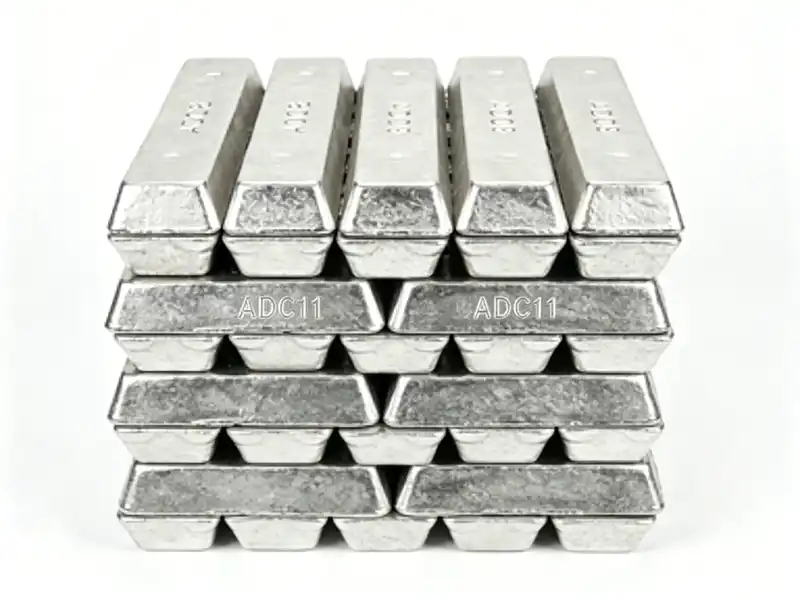
Standards and Designations for the ADC11
- JIS Standard Grades: According to the Japanese Industrial Standard JIS H 5302, the grade is ADC11“ADC” stands for “Aluminum Die Casting,” and “11” is the alloy number for a specific composition and set of properties within this series.
- Core features:High silicon content (9.0–11.01% by weight) Provides excellent casting fluidity and resistance to hot cracking;Medium copper content (1.5–3.01% Cu) Offers solution-strengthened properties, with a strength level between ADC10 and ADC12;Not heat treatable... Its performance depends entirely on the as-cast microstructure, emphasizing a balance between production efficiency and overall performance; it serves as a transitional grade between ADC10 and ADC12, combining the advantages of both.
ADC11 Aluminum Alloy Composition Table (Based on Typical Requirements of JIS H 5302)
| elemental | Content range (wt%) | Compare to ADC10 | Compared to the ADC12 | functional role |
|---|---|---|---|---|
| Silicon (Si) | 9.0-11.0 | 7.5-9.5 | 9.6-12.0 | Main alloying elements. It offers excellent casting fluidity, resistance to hot cracking, and gas tightness. |
| Copper (Cu) | 1.5-3.0 | 2.0-4.0 | 1.5-3.5 | Core Strengthening Elements. Formation of Al₂Cu reinforced phase significantly enhances cast strength and hardness. |
| Iron (Fe) | ≤ 1.3 | equal | equal | Prevents mold sticking during die casting, but needs to be controlled to ensure mechanical properties. |
| Magnesium (Mg) | ≤ 0.3 | equal | equal | Strictly controlled to maintain non-heat treatable properties. |
| Zinc (Zn) | ≤ 1.0 | equal | equal | Impurity elements that improve strength in trace amounts. |
| Manganese (Mn) | ≤ 0.5 | equal | equal | Neutralizes the harmful effects of iron. |
| Aluminum (Al) | tolerance (i.e. allowed error) | - | - | Substrate material. |
ADC11 Physical and Mechanical Properties Table (Die-cast condition, typical values)
| Performance indicators | ADC11 Measurement Range | ADC10 Value Range | ADC12 measurement range | Performance Positioning and Interpretation |
|---|---|---|---|---|
| intensity | 2.67–2.70 g/cm³ | 2.68-2.71 | 2.68-2.71 | Similar. |
| Tensile strength (Rm) | 260-300 MPa | 280-320 | 280-310 | Its performance is slightly lower than that of the ADC10/12, but it is sufficient for most applications. |
| Yield strength (Rp0.2) | 140-170 MPa | 150-180 | 150-180 | Good carrying capacity. |
| Elongation (A) | 2.0-3.5% | 1.5-3.0 | 1.5-3.0 | Core Advantages: The elongation is slightly higher than that of ADC10/12, and it offers better toughness. |
| Brinell hardness (HB) | 70-85 | 75-90 | 75-90 | Moderate hardness and good wear resistance. |
| corrosion resistance | general | mediocre | mediocre | Contains copper; offers average corrosion resistance, comparable to ADC10/12. |
| Casting mobility | talented | talented | excellent | Somewhere between the ADC10 and the ADC12. |
| machinability | general | general | general | Higher silicon content and medium tool wear. |
Performance Enhancement Pathways and Technical Characteristics
The design philosophy behind the ADC11 is “Striving for the optimal balance between strength and castability”:
- Optimized selection of silicon content: Silicon content of 9.0–11.01 TP3T, falling between ADC10 (7.5–9.51 TP3T) and ADC12 (9.6–12.01 TP3T). This optimization makes itIts casting fluidity is superior to that of ADC10 and comparable to that of ADC12....while avoiding the potential loss of toughness that can result from excessively high silicon content.
- Appropriate Control of Copper Content: Copper content: 1.5–3.01% by weight, which is narrower than that of ADC10 (2.0–4.01% by weight). The moderate copper content makes itWhile maintaining high strength, its elongation is slightly better than that of ADC10 and ADC12, offering more balanced overall mechanical properties.
- Not heat treatable: Like the ADC10 and ADC12, the ADC11 does not contain sufficient age-hardening elements such as magnesium,Unable to improve strength by T5/T6 heat treatment. This makes it a simplified production process, cost-controlled and suitable for mass production.
- Comprehensive performance balance: ADC11 achieves a balance between strength, castability, and toughnessA good balanceIt is neither as low in strength as ADC1 nor as slightly less ductile as ADC10, making it an extremely versatile die-casting alloy.
Corresponding international grades
ADC11, as a unique grade in the JIS standard, has corresponding equivalents internationally:
| (an official) standard | grades | note |
|---|---|---|
| Japan JIS | ADC11 | - |
| ASTM, USA | A383.0 或 A380.0 variant of | There is an overlap in the ingredient ranges |
| China GB | YL113 (YZAlSi11Cu3) | The composition is similar to that of ADC11 |
| EU EN | EN AC-46100 (AlSi11Cu3) | similar in composition |
| Korea KS | ADC11 | identical brand |
Applications of the ADC11 in the Die Casting Industry
based on itsGood strength, excellent castability, and well-balanced overall propertiesGiven these features, the ADC11 is primarily used in the following fields:
- Auto Parts
- Shell type: Transmission housing, clutch housing, oil pan, engine mounts.
- structural member: Steering gear housing, water pump housing, alternator bracket, sensor housing.
- interior components: Door lock housings, seat adjuster parts.
- Motorcycles and General Dynamics
- Engine components: Cylinder head covers, crankcase covers, carburetor housings.
- transmission part: Transmission housing, sprocket cover.
- electrical and electronics
- Shell type: Motor housings, power supply housings, junction boxes, circuit breaker housings.
- Thermal components: LED heat sinks, power module housings (combining strength and thermal management).
- General Machinery and Hardware
- Pump and valve housings: Oil pumps, water pumps, pneumatic valve bodies.
- power tool: Electric drill housings, angle grinder gearboxes.
- Furniture Hardware: Door handles, hinges, locks.
ADC11 Aluminum Alloy FAQ
Q1: What are the main differences between the ADC11, ADC10, and ADC12? How should I choose the right model?
- Here's the core comparison:
- ADC11: Silicon 9.0–11.01% (TP3T), Copper 1.5–3.01% (TP3T).The most well-rounded overall performance, moderate strength, good castability, and slightly better toughness.
- ADC10: Silicon 7.5-9.5%, Copper 2.0-4.0%.slightly higher, but it is slightly less malleable and has slightly lower toughness.
- ADC12: Silicon 9.6-12.0%, Copper 1.5-3.5%.Best for castingIt is the mainstream common grade in the current JIS standard.
- selection: The QuestWell-balanced overall performance, combining strength and castability选ADC11Pursuits.Maximum strength选ADC10Pursuits.Optimum castability选ADC12.
Q2: Can the ADC11 be used as a replacement for the ADC12?
- Yes, but it needs to be evaluated.. The maximum silicon content of ADC11 is slightly lower than that of ADC12, resulting in slightly inferior filling performance for extremely complex thin-walled parts. However, ADC11 has slightly better elongation than ADC12, making it a better choice for applications requiring slightly higher toughness. The two grades are often interchangeable, depending on the specific application requirements.
Q3: Why isn’t the ADC11 heat-treated?
- because ofVery low magnesium content (≤0.3%)...it is unable to form sufficient Mg₂Si strengthening phases. T6 solution treatment not only fails to significantly improve strength but may actually cause bubbling due to the expansion of internal pores. Therefore, the performance of ADC11 relies entirely on its as-cast microstructure, making the production process simple and costs manageable.
Q4: How corrosion-resistant is the ADC11? Does it require surface treatment?
- general. The presence of copper (1.5–3.01% Cu) makes it susceptible to electrochemical corrosion in humid environments, and its corrosion resistance is inferior to that of copper-free alloys. When used outdoors or in humid environments,Surface protection is recommendedsuch as painting, electrophoresis, and anodizing. No treatment is required in indoor dry environments.
Q5: How does the ADC11 perform in terms of solderability?
- moderate. It has a moderate copper content, and its susceptibility to hot cracking during welding is lower than that of ADC10 but higher than that of ADC12. When performing TIG welding repairs, it is recommended thatPreheating (100-150°C)The choice of suitable aluminum-silicon-copper welding wire, post-welding forstress reliefThe following are some examples of the types of welding that should be done. For critical load-bearing parts, make-up welding should be minimized.
Q6: How is the machinability of ADC11?
- general. The high silicon content (9.0–11.01 wt.%) forms hard silicon particles that cause abrasive wear on the cutting tools. Good results can be achieved by using coated carbide tools with high cutting speeds and moderate feed rates.
📊 Related Section: Comparative Analysis of the ADC11, ADC10, and ADC12
| comparison dimension | ADC11 (Balanced) | ADC10 (High-Strength Type) | ADC12 (High-castability grade) |
|---|---|---|---|
| Silicon (Si)% | 9.0-11.0 | 7.5-9.5 | 9.6-12.0 |
| Copper (Cu)% | 1.5-3.0 | 2.0-4.0 | 1.5-3.5 |
| tensile strength | 260-300 MPa | 280-320 MPa | 280-310 MPa |
| elongation | 2.0-3.5% | 1.5-3.0% | 1.5-3.0% |
| Casting mobility | talented | talented | excellent |
| corrosion resistance | general | mediocre | mediocre |
| Overall performance rating | ★★★★★ | ★★★★ | ★★★★ |
| typical application | General-purpose housings, components with comprehensive requirements | High-strength structural components | Complex thin-walled parts |
Selection Quick Guide:
- Select ADC11: When the part requiresA balance between strength, castability, and toughnessAt the time, he was an “all-around” player.
- Select ADC10: When the parts are alignedHighest strength requirements, and when the casting requirements are moderate.
- Select ADC12: When the parts are alignedThe most demanding casting requirements(extremely thin walls, highly complex structures), and when moderate strength is required.