Welcome to the official website of Ningbo Hexin! Tel: +86 18312962656 E-mail: hexinmosu@163.com

Aluminum Die Casting FactoryCreate the ultimate user experience with technology services
Global Service Hotline+86 18312962656
Production of aluminum casting productsProduction of aluminum casting products

Aluminum Casting Production

Aluminum casting is a metal forming process in which molten aluminum is poured or pressed into a mold cavity to form aluminum parts of the desired shape after cooling and solidifying.

What is (High Pressure Die Casting, Gravity Casting, Low Pressure Casting) Pressure Mold Making?

High Pressure Die CastingThe metal liquid is driven by the compression injection punch to fill the precision cavity at a high speed with the inner gate speed of 50~100m/s and the specific pressure of ≥70MPa, and the filling time is only 0.01~0.2 seconds, and after solidification, the high-precision thin-walled parts of CT4~6 grade are obtained; however, due to the difficulty of the cavity gas to be completely discharged, the castings are generally characterized by the presence of diffuse porosity, which makes it impossible to carry out the solution heat treatment, and the elongation rate of δ<5%.

Low-pressure castingDry compressed air (0.02~0.08MPa) acts on the liquid surface of the sealed crucible, driving the metal liquid through the ascending liquid pipe from bottom to top along the pouring system laminar flow filling, the filling speed can be controlled at 0.05~0.5m/s; the crystallization process applies the pressure preservation pressure (0.1~0.3MPa) in order to force the filling contraction, obtaining the casting of the organization of the dense, non-involved porosity, and it is possible to carry out the T6 heat treatment, the tensile strength ≥300MPa, elongation δ up to 7%~12%. Tensile strength ≥300MPa, elongation δ up to 7%~12%.

Gravitational castingMetal liquid only relies on the gravitational potential energy generated by the pouring ladle to fill the metal mold or resin sand mold, and the flow pattern is determined by the geometrical parameters of the pouring system; it realizes the sequential solidification and shrinkage through the setting of risers, and the tendency of shrinkage and loosening of the thick-walled parts is low, and the casting airtightness can be up to Grade Ⅰ (no leakage in 30 seconds of pressure holding at 0.02MPa), but the dimensional tolerances are usually only CT7~10, and the machining allowances are large.

Aluminum Alloy Casting Production Process

He Xin Molding possesses bothHigh-pressure die casting, low-pressure casting, gravity castingThe three mainstream aluminum alloy casting processes are capable of producing parts ranging from small precision components weighing a few dozen grams to medium- and large-sized structural components weighing tens of kilograms. These three processes differ fundamentally in terms of filling mechanisms, metallurgical quality, dimensional accuracy, and applicable scenarios—selecting the appropriate casting process directly determines the part’sInternal Density, Mechanical Properties, Machining Allowance, and Total Cost. The following provides a technical reference for engineering selection from three perspectives: process principles, key parameters, and application limits.

Selection Criteria:High-pressure die casting prioritizes efficiency and precision in thin-walled parts, low-pressure casting emphasizes dense microstructure and heat treatability, and gravity casting focuses on low cost and flexibility for small-batch production. There is no "optimal process"; rather, there is only the process solution that best meets the product’s requirements.

A Comparison of Three Casting Processes

High Pressure Die Casting (HPDC)

Filling Rate50–100 m/s
Filling Time0.01–0.2 s
Voltage per unit area≥70 MPa
Dimensional tolerancesCT Levels 4–6
Elongation δ< 5%
hot treatment (e.g. of metal)Not soluble in solid solution
Molten metal is injected at high speed into precision molds driven by an injection plunger, resulting in high-precision, thin-walled parts after solidification. However, because it is difficult to completely evacuate gases from the mold cavity, castings generally exhibit diffuse porosity, making them unsuitable for solution heat treatment and resulting in low elongation. This process is suitable for high-volume production of thin-walled, complex-shaped parts that do not require extreme mechanical properties.

Low-Pressure Casting (LPC)

Filling Rate0.05–0.5 m/s
Filling Pressure0.02–0.08 MPa
Hold Pressure0.1–0.3 MPa
tensile strength≥300 MPa
Elongation δ7%~12%
hot treatment (e.g. of metal)T6-treated
Dried compressed air drives the molten metal to fill the mold in a bottom-up laminar flow. The filling process is smooth and controllable, resulting in no entrained porosity. During the pressure-holding phase, forced shrinkage compensation ensures high-quality castings with a dense microstructure that are suitable for heat treatment. This process is suitable for safety components and structural parts that require high levels of airtightness, strength, and elongation.

Gravity Die Casting (GDC)

Rechargeable PowerGravitational Potential Energy
Mould TypeMetal Molds / Resin Sand Molds
Dimensional tolerancesCT Levels 7–10
airtightLevel I
Shrinkage Compensation MethodsSequential Solidification of the Risers
Mold Costlower (one's head)
Molten metal fills the mold cavity solely through the gravitational potential energy generated by tilting the pouring ladle, and the flow pattern is determined by the geometric parameters of the gating system. Sequential solidification and shrinkage compensation are achieved through risers, resulting in a low tendency for shrinkage porosity in thick-walled sections and excellent gas tightness. This process is suitable for small-batch castings, castings with significant variations in wall thickness, or castings with high aesthetic requirements.

Comprehensive Comparison of Process Parameters

comparison dimension High Pressure Die Casting (HPDC) Low-Pressure Casting (LPC) Gravity Die Casting (GDC)
Mechanism of FillingHigh-Speed Turbulent FillingLaminar Flow Bottom-Feed FillingGravity-fed Top-Fill/Bottom-Fill
Typical Wall Thickness1–6 mm3–15 mm4–30 mm
Internal poresDiffuse pores are unavoidableNon-entrapment poresA small amount; manageable
heat treatabilityNot Acceptable T6 (Pores and Blisters)T6/T7 compatibleT6/T7 compatible
Dimensional accuracyCT4–6 (maximum)CT5–7CT7–10
surface roughnessRa 3.2–6.3 μmRa 6.3–12.5 μmRa 12.5–25 μm
Tensile strength (A356-T6)— (Do not heat treat)≥300 MPa≥280 MPa
Elongation (A356-T6)-7%~12%5%~8%
Mold life80,000–150,000 cycles30,000–50,000 cycles20,000–100,000 cycles
Cost per Moldyour (honorific)centerLow to Medium
economic lot≥5,000 units per year≥1,000 units per year≥100 units per year
typical applicationThin-walled shells, connectorsWheels, cylinder heads, structural componentsManifolds, pump housings, thick-walled parts

The Entire Casting Production Process

Regardless of the casting process selected, Hexin’s casting production follows the standardized procedures outlined below, ensuring end-to-end quality control from mold design to delivery of the finished product:

1

Mold Design and Manufacturing

Perform 3D modeling and CAE mold flow analysis based on product drawings, optimize the gating system and venting layout, manufacture high-precision casting molds, and complete trial mold validation.

2

Melting and Pouring

Aluminum alloy ingots are charged according to grade and proportion, melted in an electric furnace with strict control of the molten aluminum temperature (±5°C), and after degassing and refining, cast or die-cast in accordance with process parameters.

3

Post-Processing and Cleanup

After the castings have cooled, the gates, risers, and flash are removed, and the castings undergo sandblasting or shot blasting to remove surface scale, providing a clean substrate for subsequent CNC machining or surface treatment.

4

quality control

Conduct visual inspections, dimensional inspections, X-ray testing (for safety-critical components), airtightness tests, and random sampling for mechanical properties;合格 products are then transferred to CNC machining or packaged and shipped.

He Xin Foundry Production Capacity

1

Low-Pressure Die Casting Production Line

Equipped with two low-pressure casting machines, the facility can produce aluminum alloy castings weighing 0.5 to 25 kg each. Its annual production capacity meets the demands of medium- to large-volume orders and supports grades such as A356, ZL101, and ZL104.

2

Gravity Casting Production Line

Equipped with 2 tilting gravity casting machines and 6 sand core machines, the facility can handle castings with complex internal cavities and supports both metal mold and resin sand mold solutions, flexibly accommodating small-batch and prototype production needs.

3

In-House Mold Manufacturing

We manufacture casting molds in-house using CNC machining centers and EDM (electrical discharge machining) machines. The mold development cycle is 15–25 days, and we support rapid mold repairs and design changes, reducing communication costs associated with outsourcing.

4

End-to-End Quality Control

From spectral analysis of incoming aluminum ingots, temperature records during the smelting process, and X-ray inspection of castings to full-dimension coordinate measuring machine inspections of finished products, data from key processes is traceable, meeting the quality system requirements of the automotive parts industry.

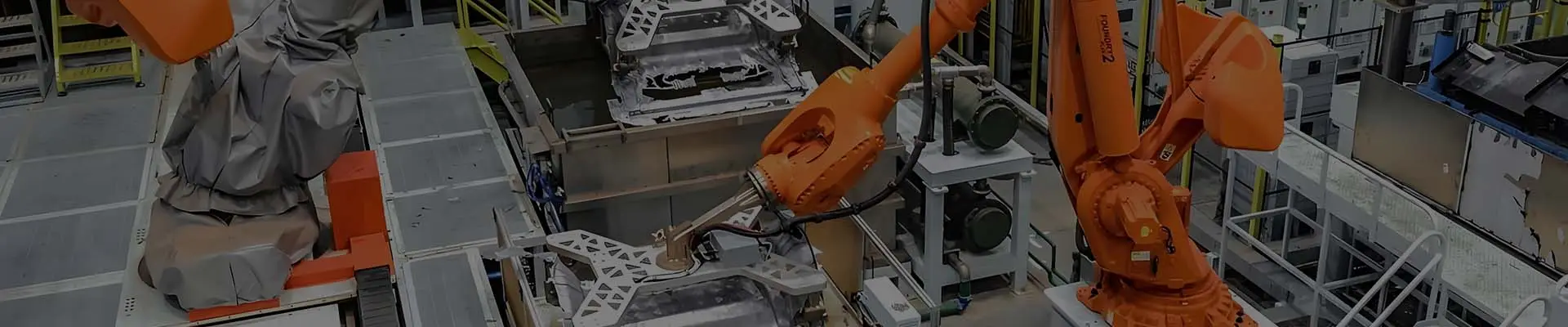
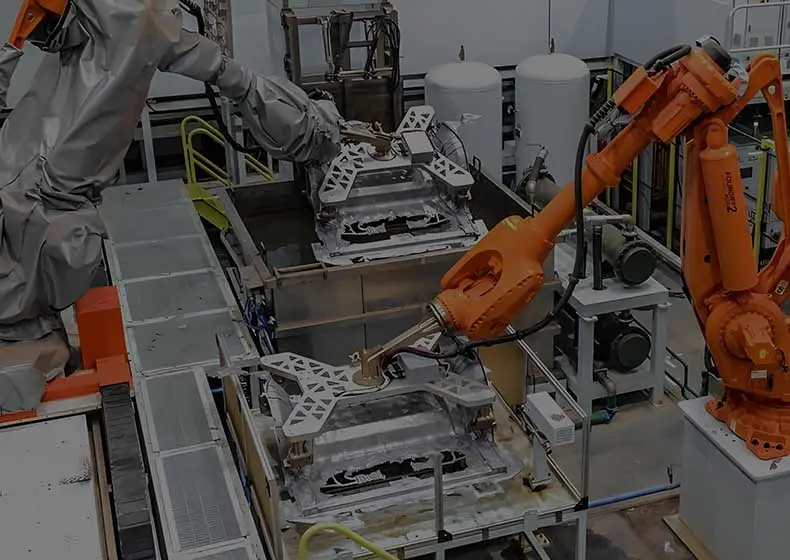
Aluminum Alloy Casting Production Floor—A low-pressure casting machine is pouring molten aluminum alloy; holding pressure and shrinkage compensation ensure dense castings.
At Hexin's low-pressure casting production site, molten aluminum fills the mold in a laminar flow from bottom to top, resulting in a dense, pore-free structure.

Common Technical Issues in Selecting Casting Processes

Q: How do you choose between high-pressure die casting and low-pressure die casting? Which one is cheaper?
In terms of unit cost, high-pressure die casting offers the greatest advantage for high-volume production (annual demand ≥ 5,000 units), with the lowest unit cost after mold amortization; low-pressure die casting has moderate mold costs and is suitable for scenarios with an annual demand of 1,000 to 5,000 units; Gravity casting has the lowest mold cost and is suitable for small-batch orders with an annual demand of 100–1,000 pieces. However, cost is not the only consideration—if a part requires T6 heat treatment to enhance mechanical properties, or if it is a safety-critical component with high airtightness requirements, only low-pressure die casting or gravity casting can be used, as high-pressure die casting cannot meet these requirements due to internal porosity.
Q: Why do low-pressure casting parts have higher strength than high-pressure die-cast parts?
There are two key differences: (1) Low-pressure die casting uses laminar flow filling, in which molten aluminum fills the mold smoothly from the bottom up without entrapping gas, resulting in castings free of internal porosity; (2) The pressure-holding and shrinkage-compensation mechanism in low-pressure die casting ensures that the casting is continuously replenished with molten aluminum during solidification, eliminating shrinkage porosity defects. In contrast, the high-speed turbulent filling in high-pressure die casting causes gases in the mold cavity to be entrained in the molten aluminum, forming diffuse porosity, and the castings cannot be strengthened through T6 heat treatment. Therefore, for materials of the same grade (such as A356), low-pressure die casting followed by T6 heat treatment can achieve a tensile strength of ≥300 MPa, whereas high-pressure die castings typically reach only 180–220 MPa.
Q: Castings produced by gravity casting have a rough surface finish. Can they be used directly as exterior components?
The surface roughness of gravity casting (especially sand casting) is typically in the range of Ra 12.5–25 μm, which is not ideal for use as a visible component. However, this can be improved in the following ways: ① Use metal molds instead of sand molds to reduce surface roughness to Ra 6.3–12.5 μm; ② Perform sandblasting or shot blasting after casting to achieve a uniform matte finish; ③ If a high-gloss finish is required, the castings can undergo CNC machining followed by polishing, anodizing, or electroplating. If the aesthetic requirements are extremely high and post-processing is not acceptable, it is recommended to evaluate low-pressure die casting as an alternative.
Q: Can Hexin handle both casting production and subsequent CNC machining?
Yes. Hexin’s foundry and CNC machining shops are located adjacent to one another, providing end-to-end integrated manufacturing capabilities covering the entire process from mold design → casting production → heat treatment → precision CNC machining → surface treatment → product packaging. Customers need only provide the final product drawings; there is no need to coordinate between separate casting and machining suppliers, thereby reducing communication costs and delivery risks. The CNC machining process ensures that the precision of critical mating surfaces meets IT7 grade (±0.015 mm).

Not sure which casting process is right for your product?

Send us your product drawings and technical specifications, and our engineers will complete a process feasibility assessment within 24 hours and recommend the optimal casting solution along with a quote.

Submit drawings to receive a manufacturing plan →


Telephone

Service hotline:
+86 18312962656

whatsapp
wechat
Connection

Email:hexinmosu@163.com