


A Comprehensive Analysis of Low-Pressure Casting Applications and Typical Uses
Excerpt:
As of 2025, the global low-pressure casting market has exceeded $10 billion, with applications primarily concentrated in the aerospace, automotive, and machinery manufacturing sectors. Low-pressure casting is in high demand because it can produce complex aluminum parts with few porosity defects and high density—such as automotive wheel hubs and engine blocks—and the yield rate of finished products is significantly higher than that of gravity casting. According to Ningbo Hexin, before selecting the right casting process, three key factors must be clarified. This article answers: Which parts are best suited for low-pressure casting? How does it differ from gravity casting and die casting? And what key parameters should be considered when selecting a process for different industries?
Article Catalog[Hidden]
- Key Points
- Key Highlights
- What Parts Are Suitable for Low-Pressure Die Casting? A One-Sentence Criteria for Determining Suitability
- What are the most typical applications of low-pressure casting in the automotive industry?
- Can Low-Pressure Die Casting Be Used for New Energy Vehicle “Three-Electric” Systems? Case Studies of Motor Housings and Battery Trays
- Applications of Low-Pressure Die Casting in the Aerospace and Home Appliance Energy Sectors
- How to Choose Between Low-Pressure Casting, High-Pressure Die Casting, and Gravity Casting? Comparison Chart
- Which Aluminum Alloy Should You Choose for Different Applications? A356 vs. Common Grades
- How Do Pinholes and Porosity Affect Yield and Cost? Practical Control Experience
- Frequently Asked Questions About Low-Pressure Casting Applications
- Summary and Selection Action List
Key Points
- The low-pressure casting market is projected to exceed $10 billion by 2025, with the automotive sector accounting for the largest share
- Three Self-Assessment Criteria: Airtightness, wall thickness of 1.5–50 mm, and mechanical strength threshold—if it meets two of these, go with it.
- A356.2 alloy is used for aluminum wheels, with a wall thickness of 8–20 mm and a yield rate of approximately 92%–96%.
- The low yield rate of cylinder heads is due to the large number of internal cavities; the gate is located at the thickest section, promoting sequential solidification.
- New energy motor housings and battery trays have high airtightness and are suitable for low-pressure die casting.
Key Highlights
- The global low-pressure casting market is projected to exceed $10 billion by 2025, with the automotive sector accounting for the largest share.
- The filling pressure in low-pressure casting is typically 0.02–0.06 MPa, which is much lower than the tens of MPa used in die casting.
- Aluminum alloy wheels are the largest single application, with each wheel weighing approximately 8–12 kilograms.
- The finished products have high density and mechanical properties superior to those of gravity casting, making them suitable for pressure-bearing components.
- Consider three factors when selecting a product: alloy type, wall thickness uniformity, and batch size.
What Parts Are Suitable for Low-Pressure Die Casting? A One-Sentence Criteria for Determining Suitability
Low-pressure die casting is suitable for medium- to large-sized aluminum alloy structural components with uniform wall thickness and high airtightness requirements. Process data indicates that it involves mold filling at a low pressure of 20,100 kPa (slightly higher than atmospheric pressure) and is suitable for complex castings with wall thicknesses ranging from 1.5 to 50 mm, such as automotive wheel hubs and cylinder heads. This means that the more a part requires internal density and the more susceptible it is to air leaks, the more suitable low-pressure die casting is for that application.
The following three self-check criteria will help you determine in 30 seconds whether a part is suitable.
- Check the airtightness requirements:For parts that must withstand pressure without leaking (such as cylinder blocks, battery cases, and oil pump housings), low-pressure die casting is the preferred method. Low-pressure die casting ensures a smooth filling process, minimizes entrapped air, and results in fewer internal porosity defects compared to gravity casting.
- Check the wall thickness and dimensions: Medium- to large-sized parts with wall thicknesses ranging from 1.5 to 50 mm and relatively uniform wall thickness are most suitable. Parts that are too thin (less than 1 mm) will not fill completely, while parts that are too thick or have significant variations in wall thickness are prone to shrinkage cavities.
- Consider the mechanical performance threshold: Load-bearing and impact-resistant structural components (steering knuckles, control arms) benefit significantly; low-pressure casting results in a dense structure, with strength and elongation superior to those of sand-cast parts.
Ningbo Hexin recommends that if two of the three criteria are met, low-pressure die casting should be included in the selection comparison. Conversely, for high-volume production of thin-walled small parts (such as 3C device housings), high-pressure die casting is often more cost-effective. A comparison table later in this document outlines how to weigh the merits of these three processes.

What are the most typical applications of low-pressure casting in the automotive industry?
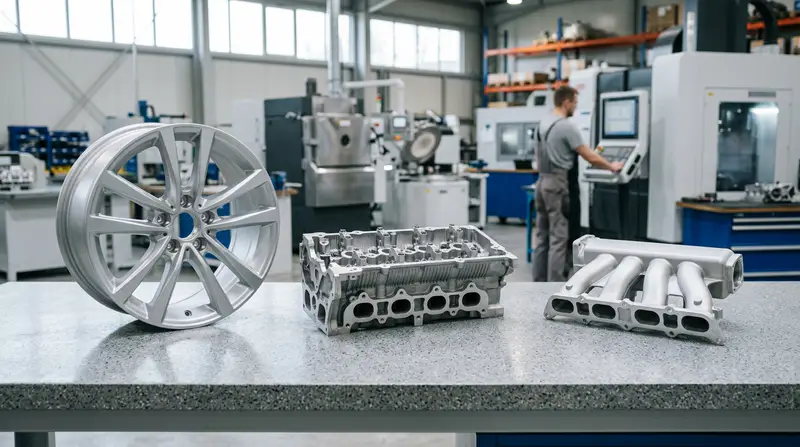
In the automotive industry, the three types of mass-produced parts where low-pressure die casting is most widely used are aluminum wheels, cylinder heads, and intake manifolds. These parts all require internal density and the ability to withstand pressure without air leakage. According to 2023 data from the aluminum die-casting industry, low-pressure and differential-pressure casting have been widely adopted for wheel rims, cylinder heads, and steering knuckles due to their high requirements for density and mechanical properties. This method is chosen to ensure that even complex parts with uneven wall thicknesses are fully filled and have minimal shrinkage cavities.
How are the alloy and process parameters determined for three types of mass-produced parts?
There are significant differences in the alloys and wall thicknesses of these three components. The wheel hub is designed for ductility and impact resistance; the cylinder head must withstand high temperatures and pressure; and the intake manifold needs to be lightweight and airtight. Below is a comparison of common configurations:
| parts | Common Alloy Grades | Wall thickness range | Typical Yield |
|---|---|---|---|
| Aluminum Wheels | A356.2 (AlSi7Mg) | 8–20 mm | 92%–96% |
| Cylinder Head | A356 / AlSi7Mg0.3 | 4–12 mm | 85%–90% |
| intake manifold | A356 / ADC12 Improvements | 3-6 mm | 88%–93% |
The low yield rate for cylinder heads is due to the presence of many internal cavities, such as the water jacket and oil passages; if gas cannot escape smoothly from the sand cores, gas pockets are likely to form. Ningbo Hexin’s recommendation for low-pressure mold design is as follows: First, conduct a product molding analysis and position the gate at the thickest section of the part to allow the metal to solidify sequentially from the bottom up. This approach will help stabilize the yield rates for all three categories of parts.
Can Low-Pressure Die Casting Be Used for New Energy Vehicle “Three-Electric” Systems? Case Studies of Motor Housings and Battery Trays
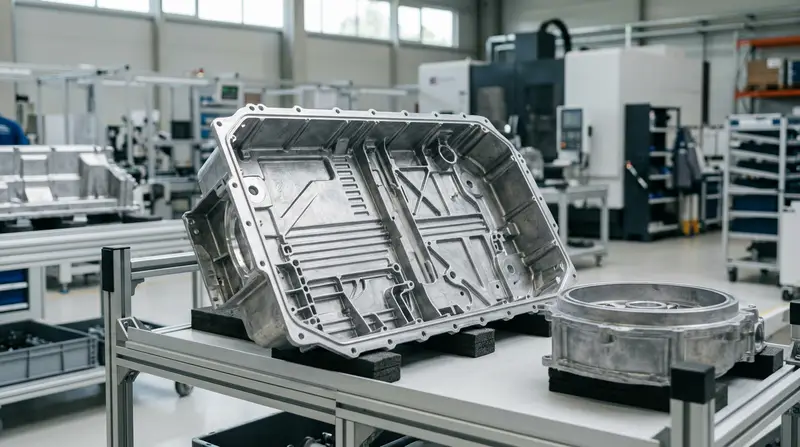
Yes, but you have to choose the right components. Among the “three electric components” of new energy vehicles—the electric motor, electronic control unit, and battery—the motor housing and battery tray have high requirements for airtightness and density, which are precisely the strengths of low-pressure die casting. According to industry data, the process pressure during battery pack housing production is typically controlled between 50 and 80 kPa to ensure the integrity of the 3.5 mm thin-walled structure. This means that for “three-electric” components—which are susceptible to fluid leakage and require heat dissipation—low-pressure die casting offers greater stability than gravity casting.
How does one determine what is suitable and what is not? Ningbo Hexin’s logic for making trade-offs in its expansion into the new energy sector is very straightforward:
- Motor Casing: The wall thickness is uniform; the interior must be dense to prevent leaks; there are few shrinkage cavities during low-pressure molding; suitable for low-pressure applications.
- Battery Tray: Large-sized, thin-walled (3–5 mm), requiring a completely leak-free seal and the ability to be tightly packed under low pressure; these are typical mating components.
- Small Electrically Controlled Bracket: Given the simple structure, large production volumes, thin wall thickness, and fast cycle time requirements, high-pressure die casting is more suitable and offers higher efficiency.
Rule of thumb: For parts requiring a dense, leak-proof structure and uniform wall thickness, choose low-pressure die casting; for small parts where high output and fast cycle times are priorities, opt for die casting. Ningbo Hexin possesses both low-pressure and high-pressure mold manufacturing capabilities and can match the process to the specific characteristics of the customer’s parts.
Applications of Low-Pressure Die Casting in the Aerospace and Home Appliance Energy Sectors
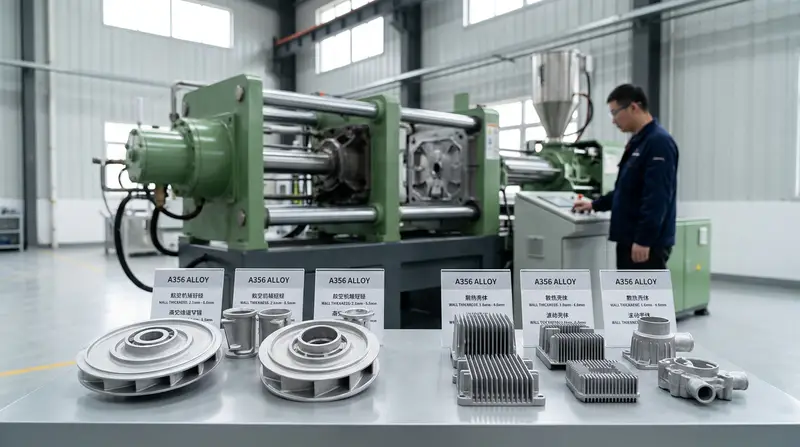
In the aerospace industry, low-pressure casting is used to ensure high density in A356/A357 aluminum alloys for load-bearing components, whereas in the home appliance sector, energy-related components prioritize thin walls and cost-effectiveness. Industry research from 2025 indicates that low-pressure casting is already being used to produce critical aerospace components such as engine blades and turbine discs to extend engine service life. Thus, while the process is the same, the trade-offs in these two industries are entirely different.
⚠️ Common Mistakes: When manufacturing cylinder heads using a gravity casting process, placing the gate in a thin-walled area resulted in trapped air pores in the water jacket and oil passage interiors, causing the yield rate to drop below approximately 85%. Cause: The metal failed to solidify sequentially from bottom to top, and air was trapped due to poor venting from the sand core. Remedy: First, conduct a molding analysis and position the gate at the thickest section to promote sequential solidification.
Why Do Aircraft Structural Components Insist on Achieving High Density in A356/A357?
Aviation components are subjected to alternating loads, and even a single internal porosity can trigger fatigue cracks. A356/A357 are aluminum-silicon-magnesium alloys (with magnesium added to enhance strength); after T6 heat treatment, their tensile strength can reach over 310 MPa. Low-pressure die casting ensures smooth filling at pressures of 20,100 kPa, resulting in minimal gas entrapment and making it easier to achieve Grade 1 density—as required by aviation standards—during X-ray inspection.
What Do Home Appliances and Energy Equipment Prioritize Most?
Components such as heat sinks and valve bodies are produced in large volumes at low unit prices, so the key focus is on thin-wall consistency and cost. Wall thickness is typically controlled at 2–4 mm, and low-pressure die casting is used to ensure uniform filling and prevent localized shrinkage porosity. In the production of low-pressure casting products, Ningbo Hexin typically employs multi-cavity molds for these valve bodies to reduce the unit cost—an approach that stands in direct contrast to the philosophy of achieving extreme density in individual aerospace components.
How to Choose Between Low-Pressure Casting, High-Pressure Die Casting, and Gravity Casting? Comparison Chart
Select the process based on part characteristics: Choose low-pressure casting for dense, airtight parts; choose high-pressure die casting for thin-walled parts with high production rates; and choose gravity casting for low-cost, small-batch production. According to 2024 process data, the filling pressure for low-pressure die casting is 20,100 kPa, making it suitable for pressure-bearing parts with wall thicknesses ranging from 1.5 to 50 mm. Therefore, low-pressure die casting is the most appropriate choice for structural parts with uneven wall thicknesses or those prone to air leaks.
| comparison dimension | Low-pressure casting | High Pressure Die Casting | Gravitational casting |
|---|---|---|---|
| Typical Wall Thickness | 1.5–50 mm | 0.8–4 mm thin-walled | Thick-walled, 3 mm or thicker |
| homogeneous density | High (heat-treatable) | Medium (including porous materials that are difficult to heat treat) | mid-to-high |
| Mold Cost | center | your (honorific) | lower (one's head) |
| Production Cycle Time | Medium (slower than die casting) | Fast (in seconds) | Slow (manual pouring) |
| Applicable Batch Size | Medium- to Large-Volume Pressure-Bearing Components | High-volume thin-walled parts | Small-batch prototypes |
The decision-making logic is straightforward: pressure-bearing components that require heat treatment, such as wheel hubs and cylinder heads, are produced using low-pressure die casting; thin-walled housings, such as smartphone frames, are produced using high-pressure die casting. Ningbo Hexin is capable of producing both molds and products using all three processes, allowing them to perform product forming analysis first before determining the process, thereby avoiding rework due to incorrect process selection.
Which Aluminum Alloy Should You Choose for Different Applications? A356 vs. Common Grades
A356 is used for wheel hubs, A357 for load-bearing aerospace components, and AlSi7Mg is commonly used for battery trays. The compositions of these three grades are similar; the differences lie in magnesium content and strength after heat treatment. A356 has a magnesium content of approximately 0.31 TP3T, while A357 ranges from 0.51 TP3T to 0.71 TP3T, offering higher strength but at a higher cost. According to 2023 data from the aluminum die-casting industry, components such as wheel hubs and steering knuckles, which require high density, are generally produced using low-pressure die casting with A356.
| grades | typical application | Tensile Strength After T6 Heat Treatment | (manufacturing, production etc) costs |
|---|---|---|---|
| A356 | Wheels, cylinder heads, motor housings | Approximately 260 MPa | standard of reference |
| A357 | Aviation Structural Components | Approximately 320 MPa | Approx. 15%–20% |
| AlSi7Mg | Battery trays, thin-walled parts | Approximately 250 MPa | Close to A356 |
Why is A356 the go-to choice for wheel hubs? It offers good fluidity and is easy to fill the mold; it can even fill the transition zone between thick and thin sections of a 60mm spoke. Furthermore, after T6 heat treatment (solution treatment + aging), its elongation can reach approximately 61% or more—exceeding that of TP3T—and it provides excellent impact resistance. Ningbo Hexin’s recommendation for material selection in low-pressure die casting applications is: prioritize A356 for mass-produced parts; only pay extra for A357 when higher strength is required for load-bearing aerospace components.
How Do Pinholes and Porosity Affect Yield and Cost? Practical Control Experience
Shrinkage cavities (voids left by volume contraction during metal solidification) and gas pores (small holes formed when gas becomes trapped inside castings) are the primary causes of scrap in low-pressure die casting, directly reducing yield rates and driving up unit costs. According to international case studies from 2022, replacing gravity casting with low-pressure casting for turbine housings can reduce the amount of material used in the gating system and lower the scrap rate. Therefore, effectively controlling these two factors is key to securing profits.
In which areas do defects occur most frequently?
Pitting most often occurs in thick, large hot spots, such as the corners where the wheel hub and spokes meet the rim; porosity, on the other hand, is concentrated at the end of the filling process and in dead corners where mold venting is poor. The transition zone where the wall thickness jumps from 3 mm to 15 mm is most prone to problems.
How to Manage It? Ningbo Hexin’s Trade-offs
- Mold Venting: Add a vent plug at the end to force the air out of the mold cavity, rather than relying on pressure to force it out.
- Pressure-Hold Curve: Extend the holding pressure time at the hot section to allow the shrinkage cavities to be filled and compacted; the trade-off is a slower cycle time.
- Mold life:H13 hot-work die steel used for low-pressure molds can achieve a service life of 80,000 to 100,000 cycles; after this period, surface cracking may introduce new porosity.
Frequently Asked Questions About Low-Pressure Casting Applications
Low-pressure casting can produce thin-walled parts, with mold lifespans reaching tens of thousands of cycles; it is generally cost-effective for small batches of 1,000 or more. These are the three most common questions asked by engineers and procurement professionals; below are verifiable answers to each one.
What is the thinnest wall thickness that can be achieved with low-pressure casting?
Wall thicknesses as thin as 1.5 mm can be achieved. According to 2024 process data, low-pressure die casting is suitable for wall thicknesses of 1.5–5.0 mm; battery pack housings commonly use pressures of 50–80 kPa to maintain wall thicknesses of 3.5 mm. However, thin-walled parts are more sensitive to filling speed and mold temperature control. When the wall thickness is less than 2 mm, stable molding requires equipment with a heating system thermal efficiency higher than 75–80%, otherwise cold shuts (gaps caused by poor metal bonding) are likely to occur.
What is the mold's service life in terms of cycles? Is it cost-effective for small-batch production?
The service life of aluminum alloy low-pressure die-casting molds generally ranges from 50,000 to 100,000 cycles. Whether low-volume production is cost-effective depends on whether the batch size can offset the mold-making costs. Since the investment per set of low-pressure die-casting molds is lower than that for high-pressure die-casting molds, low-pressure die-casting is more economical than high-pressure die-casting for small- to medium-volume runs of 1,000 to 5,000 pieces. This is also why Ningbo Hexin promotes low-pressure solutions in the new energy sector; for motor end caps and housing components with multiple variants and medium batch sizes, low-pressure casting effectively balances density requirements with tooling costs.
How can you assess a supplier's capabilities?
Consider three key points: First, check whether the mold and casting are integrated; manufacturers capable of independently developing molds have better control over porosity. Second, assess their product molding analysis capabilities; those capable of performing filling simulations in advance can reduce the number of trial runs. Third, evaluate their range of alloy grades; manufacturers capable of producing A356, A357, and AlSi7Mg offer broader compatibility.
Summary and Selection Action List
Before choosing low-pressure die casting, consider these three factors: alloy, wall thickness, and production volume. Aluminum alloy structural parts with a wall thickness of 1.5–50 mm that require a dense, leak-free interior and a production volume of 1,000 or more pieces are generally well-suited for low-pressure die casting. As of 2025, the global low-pressure die casting market has exceeded $10 billion, with the majority of demand concentrated in the automotive, aerospace, and machinery manufacturing sectors. The quick reference checklist below will help you make a preliminary assessment.
| Part Features | Recommended Processes | rationale |
|---|---|---|
| Uneven thickness, airtight and pressure-resistant (e.g., cylinder heads, motor housings) | Low-pressure casting | Low-pressure molding results in a dense fill and fewer shrinkage cavities. |
| Thin-walled, high-cycle, high-volume parts (such as structural brackets) | High Pressure Die Casting | Fast production speed, low unit cost |
| Small batches, cost-sensitive (e.g., prototypes, pilot production parts) | Gravitational casting | Molds are inexpensive, and the initial investment is low |
The list is just the starting point. Even a slight change in a part’s wall thickness or magnesium content can completely alter the optimal process. Ningbo Hexin recommends submitting the part’s 3D model to the foundry for evaluation before finalizing the design.Molding Analysis, Simulate the filling and solidification processes to identify potential shrinkage risk areas in advance. Ningbo Hexin’s services cover low-pressure, gravity, and high-pressure molds and products, and the company also provides mold structural analysis and product molding analysis—making it ideally suited to help you make practical decisions regarding mold selection for your low-pressure casting applications.