


Die Casting vs. Injection Molding: Key Differences
Excerpt:
Die casting and injection molding may both appear, at first glance, to involve "injecting molten material into a mold and then cooling it to form a part," but one uses metal at 700°C, while the other uses plastic at 200–300°C. This single difference in material sets off a domino effect, driving the mold design, pressure, precision, cost, and intended applications in entirely different directions. This article breaks down the key differences between the two into quantifiable dimensions, helping you instantly determine which process is right for your part.
Article Catalog[Hidden]
- 1. The bottom line: The quality of the materials determines everything.
- 2. Summary Table of Key Parameter Comparisons
- 3. A Detailed Explanation of the Five Key Differences
- 4. Costs and Production Volume: Break-Even Point
- 5. How to Choose: A Four-Step Decision-Making Method
- 6. Common Misconceptions
- 7. Frequently Asked Questions
1. The bottom line: The quality of the materials determines everything.
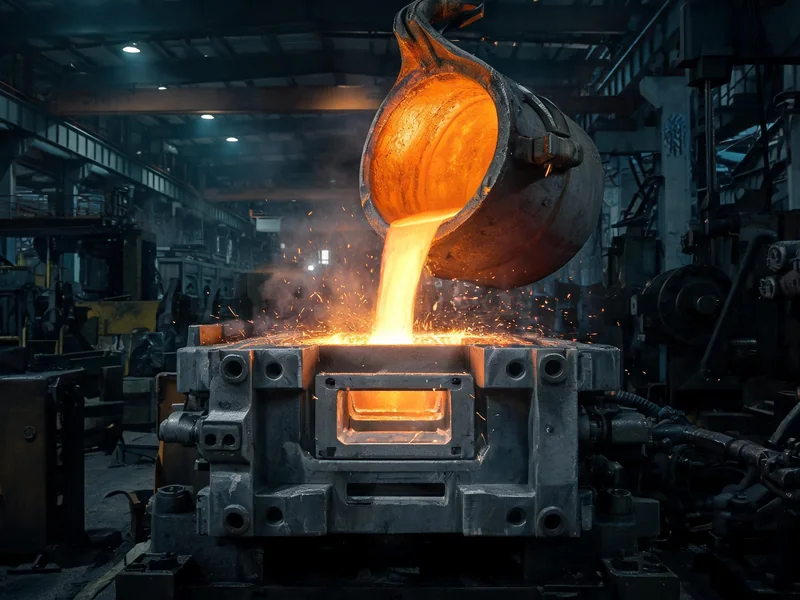
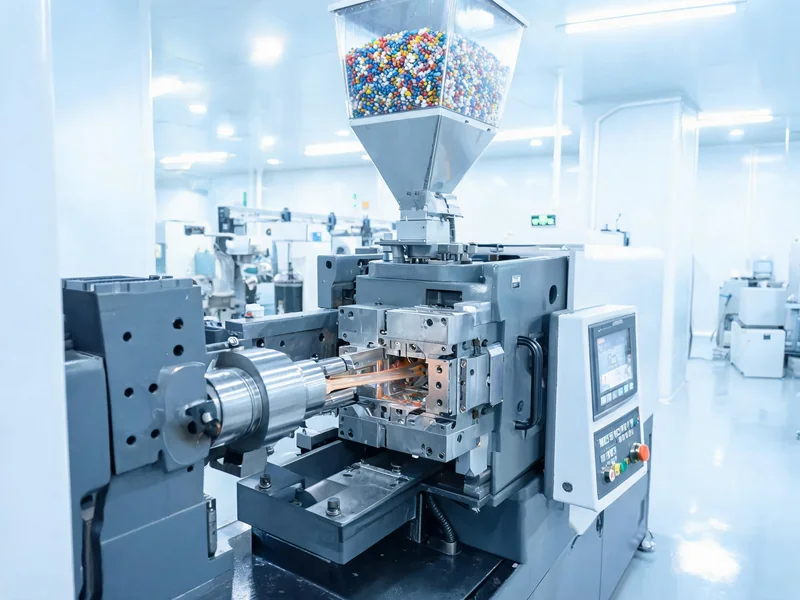
Injection molding involves forcing molten plastic into a steel mold, while die casting involves forcing molten metal into a steel mold. The molds and principles appear almost identical, but the properties of the materials determine all the differences that follow:
- temp : Aluminum melts at about 700°C, while polycarbonate (PC) is injection molded at 280–320°C—the high temperatures of metals require die-casting molds to be made of heat-resistant mold steel.
- Performance : The differences after molding are even more pronounced—the elastic modulus of the injection-molded part is only 1.3–2.4 GPa, while aluminum alloy die-cast parts can reach as high as 45–71 GPa.
- Follow-up : Plastic parts are often finished immediately after injection molding, whereas die-cast metal parts typically require additional machining—such as milling and grinding—to finish critical surfaces.
Therefore, the question of "die casting or injection molding" has never been a matter of process preference, but rather Material Requirements Determination Problem .
2. Summary Table of Key Parameter Comparisons
Let’s start by presenting the most concrete figures first; each section that follows will be based on this table:
| dimension (math.) | Die Casting | Injection Molding |
|---|---|---|
| Ingredients | Aluminum / Zinc / Magnesium Metal Ingots | Thermoplastic pellets |
| Melting temperature | 390–700°C (approximately 700°C for aluminum) | 180–400°C |
| injection pressure | 35–140 MPa | 60–180 MPa |
| Mold Temperature | 150–300°C | 20–150°C |
| Cycle Time | 20 to 60 seconds | 30 to 120 seconds |
| Minimum wall thickness | 1.0 mm | 0.5 mm |
| Dimensional accuracy | Approximately ±0.05 mm per 100 mm | Commercial: ±0.1 mm; Precision: ±0.025 mm |
| modulus of elasticity | 45–71 GPa | 1.3 to 2.4 GPa |
| Mold Materials | Heat-resistant die steel (H13, etc.) | Standard die steel (may be lower) |
3. A Detailed Explanation of the Five Key Differences
3.1 Temperature and Thermal Load: Die-casting molds must be able to withstand high temperatures"
This is the most fundamental difference. Die casting The molten aluminum, at approximately 700°C, repeatedly washes over the mold cavity. Since the mold must withstand high temperatures as well as thermal fatigue and thermal cracking, hot-work tool steel such as H13 is commonly used, in conjunction with a cooling system to maintain a mold temperature of 150–300°C. In injection molding, mold temperatures range from only 20–150°C, resulting in a much lower thermal load and less pressure on mold material selection.
3.2 Pressure and Filling: One high-pressure, high-speed cycle; one low-pressure, steady-flow cycle
The injection pressure in die casting can reach as high as 35–140 MPa...so that the molten metal can fill the mold cavity in a very short time and overcome rapid solidification; the injection pressure is 60–180 MPa...While the absolute pressure is higher, plastics have good flow properties and cool slowly; conversely, "lower pressure makes it easier to control complex shapes." The fundamental difference between the two pressures is that one addresses the high-temperature, rapid solidification of metals, while the other addresses the viscosity of plastics.
3.3 Mold Investment: Die casting is more expensive, but the logic behind service life is different
Die-cast Mold Manufacturing The costs are in completely different leagues compared to injection molding. Here’s a comparison: for the same part, an aluminum die-casting mold costs approximately $32,000, Nylon injection molds, approximately $18,000. The value of die-casting molds lies in their heat-resistant steel, surface treatment, and more complex ejection and cooling designs; however, they are geared toward the entirely different market of "high-volume metal parts production." For details on the structure of die-casting molds, please refer to Aluminum Die-Casting Mold Design An article.
3.4 Precision and Wall Thickness: Thinner and More Precise Injection Molding
In terms of "direct demolding" precision, injection molding actually has the edge: commercial injection molding achieves a tolerance of approximately ±0.1 mm, precision injection molding can reach ±0.025 mm, while die casting has a tolerance of approximately ±0.05 mm/100 mm. As for wall thickness, injection molding can go as thin as 0.5mm, Due to metal fluidity and solidification constraints in die casting, the minimum 1.0mm Getting started. But here’s a bit of industry truth: the critical surfaces of die-cast parts (sealing surfaces, assembly holes) usually still rely on CNC Machining With secondary trimming, the final precision is on par with that of injection molding.
3.5 Mechanical Properties: The strength of metals is a barrier that plastics cannot overcome
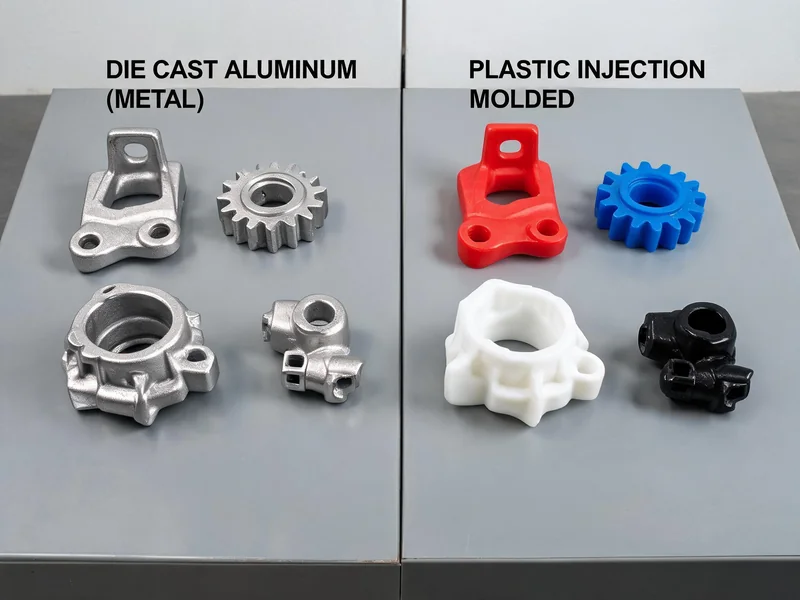
This is the most fundamental difference between the two. Aluminum alloy die-cast parts have a modulus of 45–71 GPa, while engineering plastics have a modulus of only 1.3–2.4 GPa—a difference of tens to hundreds of times. If your part needs to bear loads, withstand torsion, conduct heat or electricity, or withstand high temperatures, die casting is the only option; if the only requirements are "lightweight, inexpensive, and complex shapes," injection molding offers far better value for money.
4. Costs and Production Volume: Break-Even Point
The economics only make sense when viewed on a volume basis. Here’s a real-world comparison: For the same part, the aluminum die-cast version weighs 520 grams, with mold costs of $32,000 and unit costs of $5.20; the nylon injection-molded version has mold costs of $18,000 and unit costs of $2.80. Assuming an annual production of 2,000 units, the annual cost for the nylon version is $2,360, while for the die-cast aluminum version it is $42,400—at low production volumes, injection molding is the clear winner. The reason is that the higher upfront mold investment for die casting cannot be sufficiently amortized.
However, as production volume increases, this trend reverses: a significant portion of the unit cost for die-cast parts consists of materials and machining, whereas the cost of injection-molded parts relies heavily on mold amortization. Industry experience shows that die casting is generally not economical for runs of fewer than 10,000 units (unless specific metal properties are required), and the unit cost of die-cast parts only becomes competitive for runs of 50,000 units or more. This "break-even point" is higher than that for injection molding and represents a hurdle that must be carefully calculated before selecting a manufacturing process.
Decision-Making Guidelines:High volume, metal parts required, and willing to accept multiple manufacturing steps—choose die casting; high volume, plastic parts required, and need thin-walled precision parts—choose injection molding; low volume and complex geometries—don’t rush into tooling; first consider whether prototype parts or small-batch solutions are more cost-effective.
5. How to Choose: A Four-Step Decision-Making Method
- Required Materials:Does the part require the strength, thermal conductivity, electrical conductivity, or temperature resistance of metal? Yes → Consider die casting or sand casting; No → Consider injection molding.
- Batch query:What is the estimated annual production volume? For runs of fewer than 10,000 pieces—and provided they don’t have to be made of metal—injection molding or small-batch manufacturing is often more cost-effective.
- Question: Accuracy and Wall Thickness:If the wall thickness is ≤0.5 mm and fine detail is required, injection molding is the preferred method; for thick-walled, load-bearing metal parts, die casting is more suitable.
- Question regarding post-processing tolerance:Can die-cast parts undergo subsequent machining? If yes, the upper limit of die-casting precision is actually higher; if no, prioritize injection molding.
6. Common Misconceptions
Misconception 1: "Injection molding is always less precise than die casting."On the contrary, the tolerances for injection-molded parts that are removed directly from the mold are often tighter than those for die-cast parts (up to ±0.025 mm), whereas die-cast parts rely on subsequent machining to achieve the required precision.
Misconception #2: "Plastic is cheap, so injection molding must be more cost-effective."This is true for low-volume production, but for large-volume metal parts, the unit cost of die-casting may offer better value due to the "non-substitutability" required by performance specifications.
Misconception 3: "You can switch between the two processes at will." No. The mold structure, draft angle, wall thickness design, and material shrinkage are completely different; switching from injection molding to die casting is equivalent to redesigning the mold from scratch.
7. Frequently Asked Questions
Q1: What is the main difference between die casting and injection molding?
The key factor is the material: molten metal (approximately 700°C) is used in die casting, while molten plastic (180–400°C) is used in injection molding. This difference results in significant variations in the molds’ heat resistance, pressure resistance, precision, and cost.
Q2: Is die casting more expensive than injection molding?
Yes. Die casting requires energy-intensive melting and heat-resistant mold steel, and the castings also require subsequent machining, so the overall cost is higher; injection molding has lower energy consumption and a lower unit cost for high-volume production.
Q3: Can injection molding achieve the same level of precision as die casting?
Yes, and even more precise. For commercial injection molding, the tolerance is approximately ±0.1 mm; for precision injection molding, it is ±0.025 mm. For die casting, the tolerance is approximately ±0.05 mm per 100 mm, but critical surfaces can be further improved through secondary machining.
Q4: For what production volumes should die casting be chosen?
Orders of fewer than 10,000 units are generally not cost-effective (unless specific metal properties are required); die-casting becomes cost-competitive only for orders of 50,000 units or more, and the break-even point is higher than for injection molding.
Q5: Can injection molding replace die casting?
It depends on the application. Die casting is irreplaceable only when the strength, thermal conductivity, electrical conductivity, or temperature resistance of metal are strictly required; otherwise, high-performance engineering plastics can serve as a substitute in many scenarios.