


Die Casting Process Guide: A Comprehensive Analysis of Principles, Materials, Molds, and Plant Selection
Excerpt:
Die casting is currently one of the most efficient processes for mass-producing precision metal parts. From a front-line factory perspective, this article systematically explains the principles of die casting, the two main types (hot-chamber and cold-chamber), how to select material grades, common pitfalls to avoid in mold design, and—most importantly—how to assess a die-casting factory’s technical proficiency. Whether you’re a structural engineer, a procurement specialist, or a project manager, reading this will help you avoid unnecessary detours.
Article Catalog[Hidden]
- 1. What Is Die Casting?
- 2. Die-Casting Process (Detailed 6-Step Guide)
- 3. Hot-chamber die casting vs. cold-chamber die casting
- 4. Variations of the Die-Casting Process
- 5. Selection of Die-Casting Materials and Grades
- 6. Key Points in Die-Cast Part Design (Real-World Factory Experience)
- 7. Advantages and Disadvantages of Die Casting
- 8. Die-Casting Applications by Industry
- 9. Cost Structure and ROI Optimization
- 10. How to Choose a Reliable Die-Casting Factory
- 11. Frequently Asked Questions (FAQ)
1. What Is Die Casting?
Die CastingIt is a metal forming process in which molten non-ferrous metal is rapidly injected under high pressure into a cavity formed by two hardened tool steel dies; after cooling and solidification, this yields metal parts with high precision, complex geometries, and smooth surfaces. Unlike sand casting and gravity casting, the key characteristic of die casting is"High Pressure + High Speed + Reusable Steel Molds".
The history of die casting dates back to the mid-19th century. In 1849, a small manual machine used for the mechanical production of printing type was patented, an event widely recognized as the beginning of the modern die casting industry; by 1903, the carburetor bodies for Cadillac automobiles were already being produced using die casting. Since then, die casting has expanded rapidly alongside the rise of consumer products such as phonographs, typewriters, and automobiles. Today, driven by CAD/CAM and CAE simulation technologies, die casting has become an indispensable foundational process in high-end manufacturing sectors such as the automotive, electronics, and aerospace industries.
As a die-casting factory with deep roots in Ningbo, Hexin Molding offers services ranging from mold design to Full-Process Services for High-Pressure, Low-Pressure, and Gravity Die Casting, Many of the insights presented below are based on hands-on production experience from 2016.
2. Die-Casting Process (Detailed 6-Step Guide)
Hot-chamber and cold-chamber die casting differ in some details, but the core processes both follow the six steps outlined below. Only by understanding this closed-loop process can you identify at which stage issues with price, delivery time, and quality arise.
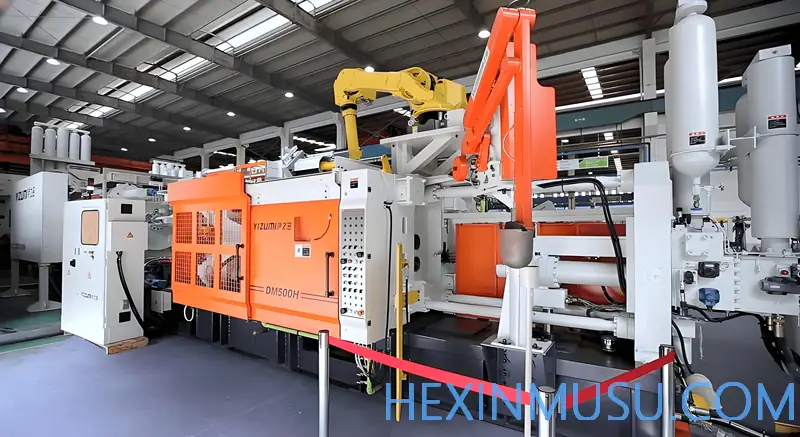
Step 1: Mold Preparation and Clamping
First, thoroughly clean the cavities of the two mold halves (fixed and moving) and spray them with a release agent or lubricant. The release agent controls the mold temperature and ensures that the casting can be easily removed from the mold later. Then, use the clamping force to press the two mold halves together. The quality of the mold manufacturing directly determines the success or failure of this step. Regarding The Complete Process of Die-Casting Mold Manufacturing ... For more information, please refer to the special section on our website.
Step 2: Melting and Injection
The metal is heated to a molten state inside the machine (hot chamber) or in a separate furnace (cold chamber). A plunger forces the molten metal into the mold cavity at high speed and high pressure (ranging from 1,000 psi to over 25,000 psi). This "high speed and high pressure" is the essence of die casting, ensuring that the metal fills all thin-walled and complex structures.
Step 3: Cooling and Setting
When molten metal at high temperatures comes into contact with the cold mold walls, it solidifies rapidly, precisely replicating the mold’s shape. During this process, the mold remains under high clamping pressure to counteract the internal stresses caused by solidification shrinkage and prevent porosity. Water or oil cooling channels are typically incorporated into the mold to accelerate cooling.
Step 4: Ejection (Demolding)
After the casting has solidified, the mold is opened, and the ejection mechanism (consisting of multiple ejector pins) gently pushes the casting out. Draft angles and release agents are critical at this stage; improper design can lead to sticking, scratches, or white marks.
Step 5: Trimming and Deburring
The part that is ejected is not yet the finished product—it is still attached to the gating system (main gate, runner, and sprue). The trimming process separates the part from the excess metal and can be performed manually, using a trimming die on a press, or in a trimming drum.
Step 6: Finishing and Post-Processing
Post-processing such as CNC machining (threaded holes, tight tolerances), shot blasting, sandblasting, anodizing, electroplating, and powder coating is performed as needed.
Key Process Parameters (First-Line Data):Injection pressure is typically controlled between 50 and 100 MPa; the mold temperature is stabilized between 150 and 300°C using a mold temperature controller; the molten metal temperature is maintained within ±5 °C; modern equipment can achieve mold plate parallelism of 0.1 mm/m and positional repeatability of ±0.1 mm. These parameters determine the difference in product yield rates between 92% and 98.5%.
3. Hot-chamber die casting vs. cold-chamber die casting
Die casting falls into two main categories, and the fundamental difference lies inThe Relationship Between Furnaces and Machines... The selection is determined by the alloy's melting point and chemical properties, which directly affect efficiency, equipment lifespan, and the range of materials that can be used.
hot cell die casting (metallurgy)
The "gooseneck" of the injection mechanism is immersed directly in the machine's built-in molten metal bath. When the plunger retracts, the metal automatically fills the gooseneck; when the plunger is pushed down, the metal is forced directly into the mold cavity. The advantage is thatExtremely fast production cycle (15+ times per minute), minimal oxidation, and low cost; the disadvantage is that high-temperature metal continuously erodes the feeding components, soSuitable only for low-melting-point alloys such as zinc, magnesium, lead, and tin. Typical applications: zippers, faucet parts, electronic connectors, and automotive interior components.
cold room die casting (metallurgy)
The furnace is separate from the machine; molten metal is ladled into the "cold chamber" (injection chamber) and then forced into the mold at high speed by a hydraulic plunger. The advantage is thatCapable of machining high-melting-point alloys (aluminum, copper, magnesium)...allowing for the production of larger, denser, and higher-strength parts; the drawback is a slower cycle time (due to an additional feeding step). Cold-chamber die casting is the preferred process for aluminum alloys and dominates the automotive industry.
| characterization | hot cell die casting (metallurgy) | cold room die casting (metallurgy) |
|---|---|---|
| Melting Point | Inside the Machine | Stand-alone Furnace |
| production cycle | Very fast (15+ times per minute) | Slower (including scooping ingredients) |
| Suitable Alloys | Zinc, magnesium, tin, lead (low melting point) | Aluminum, Copper, Magnesium (high melting point) |
| injection pressure | Lower (1,000–5,000 psi) | Extremely high (1,500–25,000+ psi) |
| Part Dimensions | Small and Medium-Sized | Large, Complex Parts |
| Core Advantages | Extremely efficient, with low unit costs | Flexible material, higher strength |
4. Variations of the Die-Casting Process
Beyond these two basic categories, the industry has developed a variety of specialized processes, each designed to address specific challenges—some focus on porosity, others on heat treatment, and still others on defect density. We’ll break them down one by one below to help you determine which process is truly the best fit for your parts.
4.1 High-Pressure Die Casting
High-pressure die casting is the most common method for producing aluminum alloys, and HPDC is the standard for nearly all cold-chamber machines. It involves extremely high filling pressures, typically reaching 1,000–25,000 psi (approx. 7–172 MPa)...The punch forces the metal into the mold cavity at high speeds ranging from 0.5 to 10 m/s, and the entire filling process is completed in just a few tens of milliseconds.
That is precisely why HPDC’s core strength isExtremely fast, with a very high cycle rate, capable of producing ultra-thin walls as thin as 0.5 mm...unit costs are minimized when producing in large batches. The downside is also most evident: high-speed filling can trap air, resulting in microscopic pores inside the castings,T6 solution heat treatment is generally not possible.(Internal gases expand and cause blistering at high temperatures.) If your part is a structural component or a pressure-bearing component that requires heat treatment, HPDC may not be the best solution.
4.2 Low-Pressure Casting
The filling pressure in low-pressure casting is only 0.08–0.1 MPa, which is significantly lower than that of HPDC. The molten metal is gently "pressed" into the mold cavity from the bottom up through the riser in a sealed crucible by gas pressure; this process is classified asLaminar Flow Molding, preventing high-speed gas from being drawn in during filling.
The result is a castingDense, low porosity, and capable of heat treatment (T6) for strengthening... and offers better overall mechanical properties. It is suitable for parts that require high levels of airtightness and pressure resistance, such as Aluminum castings such as automotive wheel rims, new energy battery trays, and motor housings . The trade-off is a slower cycle time than HPDC and a slightly higher unit cost.
4.3 Gravity Casting
Gravity casting does not rely on high pressure; instead, it relies onThe weight of the molten metal itselfIt flows into the mold cavity through the gate, resulting in simple equipment, low energy consumption, and minimal entrapped air. It is typically equipped with sand cores to form complex internal cavities.
Gravity casting is suitable for structural components with medium wall thicknesses, medium production volumes, and high internal quality requirements, such asEngine block, cylinder head, transmission housing, pump housingetc. While its precision and surface quality are slightly lower than those of die casting, it offers greater flexibility in terms of mold costs and equipment investment, making it a common choice for small- to medium-volume production.
4.4 Vacuum Die Casting
Vacuum die casting involves adding a vacuum-pumping step to the HPDC process: before the molten metal is injected into the mold, a multi-stage vacuum pump system is used to Evacuate the mold cavity to below 50 mbar within 2 seconds, reduce the gas content in the cavity by at least 90%, and then proceed with injection.
This fundamentally solves the long-standing problem of "air entrapment during high-speed filling." Vacuum die-cast partsDensity increases by 8–12%, tensile strength can reach over 300 MPa, and elongation increases to 8–15%... Its mechanical properties are comparable to those of forgings, and it can undergo heat treatment. Its applications have expanded from traditional engine blocks and transmission housings toNew energy battery trays and aircraft compressor housings with an airtightness requirement of ≤0.05 mbar·L/sand other high-end components. The trade-off is greater equipment complexity and higher costs.
4.5 Extrusion Die Casting (Liquid Die Forging)
Extrusion die casting can be understood as a combination of "die casting and forging": during the solidification and crystallization stage of the molten metal, pressure is applied 50–100 MPa apply high mechanical pressure and extend the holding time to 30–60 seconds, thereby achieving trueDensification in Liquid Die Forging.
The castings produced in this way have a dense and uniform microstructure,The porosity was reduced to below 0.1%, and the microstructural density exceeded 99.5%., with mechanical properties 30–50% higher than those of traditional die-casting; tensile strength can reach 350–400 MPa; it can undergo T6/T7 heat treatment; and its fatigue life is 3–5 times longer. It is particularly suitable forAutomotive steering knuckles, suspension control arms, and brake calipersFor safety-critical structural components, the use of "casting instead of forging" significantly reduces costs.
4.6 Semi-Solid Die Casting (Tactile Forming)
The key to semi-solid die casting is to first control the metal slurry at 40–601 TP3T Solid Phase Ratioin a "semi-solid" state, and then fills the mold cavity in a laminar flow. The low viscosity and smooth flow of the slurry fundamentally prevent air entrapment caused by turbulence.
The result isReduce the gas entrainment rate to 80% or less, reduce shrinkage defects by 60%, and control porosity to 0.5% or less, resulting in a fine-grained microstructure with spherical, non-dendritic grains (50–100 μm), which improves the material’s isotropy. When combined with vacuum treatment, the density can reach 99.9% or higher, making it suitable forHydraulic valve blocks, high-performance transmission housings...and other critical components that require high density and fatigue life.
5. Selection of Die-Casting Materials and Grades
The material directly determines a part’s mechanical properties, weight, corrosion resistance, and cost. Die casting primarily uses non-ferrous metals, with aluminum, zinc, and magnesium being the three dominant categories.
| makings | Common Grades | Key Features | typical application |
|---|---|---|---|
| aluminum | A380 / ADC12 | Offers the most balanced overall performance, excellent flow properties, and great value for the price | Engine mounts, transmission housings, electronic enclosures, power tools |
| A390 | Wear- and vibration-resistant, hard yet brittle, specifically developed for cylinder blocks | Automotive engine blocks, valve bodies, and pump housings | |
| A360 | Better corrosion resistance and pressure resistance, but slightly more difficult to cast | Marine components, telecommunications enclosures, components for corrosive environments | |
| zinc alloy | Zamak 3 / Zamak 5 | Most suitable for die casting; capable of producing extremely thin walls and intricate details; easy to plate | Consumer Electronics, Bathroom Hardware, Toys, Automotive Interiors |
| Zamak 2 / ZA-27 | High strength (ZA-27 tensile strength > 400 MPa) | High-strength components such as tool cores and bearing sleeves | |
| magnesium alloy | AZ91D | The lightest structural metal, with high specific strength and corrosion resistance | Laptop/phone cases, camera bodies, car steering wheels |
| AM60B | Good ductility and energy absorption; impact energy ≥ 6 J | Car Seat Frames, Dashboard Brackets |
For more information on the trade-offs in the properties of different alloys, please refer to A Comparison of Core Technologies in Zinc Die Casting and Aluminum Die Casting .
6. Key Points in Die-Cast Part Design (Real-World Factory Experience)
Problems created during the design phase will resurface during mass production in the form of "pores, deformation, and cracks." Below are four key points that the factory has repeatedly emphasized.
6.1 Draft Angle
A draft angle is the angle of inclination in the vertical direction of a mold, designed to facilitate part ejection. Generally, an angle of 1° to 2° is sufficient to improve ejection; for aluminum die casting, a draft angle of 2° on each side is recommended (to account for the abrasive nature of aluminum). Failure to include a draft angle can result in parts sticking to the mold during ejection, causing damage and potentially rendering the mold unusable.
6.2 Wall Thickness Uniformity
Sudden changes in wall thickness are the primary causes of shrinkage cavities, stress concentration, and deformation. Maintaining uniform wall thickness promotes even cooling and reduces defects. Die casting can produce very thin walls (as thin as 0.5 to 1.5 mm), but the transition between thick and thin sections must be gradual.
6.3 Fillet Radius
Stress concentrates at sharp corners. A minimum fillet radius of 0.4 mm is recommended; 0.8 mm is ideal. Excessively large fillets increase material usage and cost, while excessively small fillets do not provide sufficient stress relief.
6.4 Parting Lines and Undercuts
Parting lines should be as straight as possible, avoid functional surfaces, and be as inconspicuous as possible. Undercuts can significantly increase the cost of sliders and molds and should be avoided whenever possible. During the design phase, use CAE Simulation for Casting: Filling and Solidification Simulation ...allows you to predict the locations of porosity, shrinkage, and entrapped air before mold production, saving weeks of time and tens of thousands of yuan in costs compared to rework after mold testing.
7. Advantages and Disadvantages of Die Casting
| vantage | drawbacks |
|---|---|
| Extremely efficient: High level of automation, short production cycles, and extremely low unit costs for high-volume production | High mold costs: Small batches or prototypes are not cost-effective |
| Good accuracy and consistency: Tolerances can be as tight as ±0.1 mm, and there is strong interchangeability between batches | Risk of Pores: High-speed gas-injection molding typically hinders heat treatment |
| Strong capability in forming complex, thin-walled parts: Wall thickness as low as 0.5 mm | Non-ferrous metals only: Excessively high melting points of steel/iron shorten die life |
| Smooth surface: Ra 1–2.5 μm; no secondary machining required | Dimensions are limited by tonnage: Oversized items are limited by clamping force |
| Good mechanical properties: Rapid cooling results in a fine-grained microstructure | Difficulties in Modifying the Mold: Once a steel mold has been finalized, the cost of making major changes is extremely high. |
Reminder from Industry Professionals:"Pores + inability to undergo heat treatment" are the two major drawbacks of conventional high-pressure die casting. If your parts require airtightness or T6 heat treatment, be sure to specify this in advance and switch to vacuum die casting or extrusion die casting; otherwise, the scrap costs later on will far exceed the price difference between the molds. For more information on the causes of defects, seeAluminum die casting defects and their causes.
8. Die-Casting Applications by Industry
- Automotive (Largest Market): Engine blocks, transmission housings, oil pans, steering knuckles, and subframes; large, integrated battery trays and motor housings for new energy vehicles are driving the development of ultra-large-scale die-casting.
- Electronics/Telecommunications: Smartphone frames, laptop casings, camera bodies, 5G base station heat sinks, and shielding enclosures.
- aerospace: Requires a high strength-to-weight ratio; used in airframe structures, engine components, and interior parts.
- Healthcare: Surgical instruments, diagnostic equipment housings, and monitor stands.
- Construction/Hardware: Hinges, window frames, furniture hardware, etc.
9. Cost Structure and ROI Optimization
The "biggest cost" in die-casting lies in the mold, not the individual part. Take aluminum alloy die-casting molds as an example: a single-cavity mold costs approximately 36,000–144,000 yuan; a mold of medium complexity costs 180,000–288,000 yuan; and complex multi-cavity molds or automotive structural components can cost 360,000–1,440,000 yuan or more. Mold life ranges from 80,000 to 200,000 cycles, resulting in a cost per part of approximately 0.36 to 3.6 yuan.
Reference Cost Breakdown: Design fees 2–31 TP3T, manufacturing fees ≤201 TP3T, testing fees 1–21 TP3T, mold trial fees 1–21 TP3T (approximately 21 TP3T for molds over 800T), After-sales maintenance: 1–21 TP3T; Shipping: 0.5–1.51 TP3T.
Four Pillars of Cost Reduction:① Use DfM (Design for Manufacturability) Simplify the structure and reduce undercuts early on—this is the most fundamental way to cut costs; ② Use small partsMulti-cavity molds(Dual-chamber models cost approximately 1.4 to 1.6 times the unit price, and 4-chamber models cost approximately 2.5 to 3 times the unit price; both are significantly lower than the cost calculated based on the number of units); ③ Just enough materials will do., avoid over-engineering; ④ OptimizeGating SystemReduce scrap from tool shanks and trimming costs. For a complete cost calculation method, see Cost Accounting for Die-Cast Parts: How to Calculate the Price of Die-Cast Parts .
10. How to Choose a Reliable Die-Casting Factory
This is the most practical part that’s missing from all competing articles. As a professional in the field, here are the five key points to consider when evaluating a die-casting factory:
- Should we make the molds ourselves or outsource them?In a factory where mold manufacturing and die-casting are integrated, parameters are better aligned, responses are faster, and responsibility for issues is clearer.
- Do you have CAE simulation capabilities?Factories that use mold flow analysis can predict defects before the mold is opened, rather than relying on a "trial-and-error" approach to production.
- Is the quality inspection system complete?Does the facility have a coordinate measuring machine (CMM), X-ray flaw detection, airtightness testing, and random sampling for mechanical property testing? Can it issue an FAI first-article inspection report?
- Does the process meet your needs?Does it support high-pressure, low-pressure, and gravity casting simultaneously? Can it perform vacuum die casting or extrusion die casting (which determines whether your parts can undergo heat treatment)?
- Delivery and Response: Sample production lead time, 48-hour response time, and after-sales warranty terms.
He Xin Molding was established in 2010 (its predecessor, He Xin Mold Factory, was founded in 1995) and is equipped with 2 low-pressure casting machines, 2 tilting gravity casting machines, 6 sand core machines, high-speed CNC machines, and multiple EDM machines, providing services ranging from 3D design, Aluminum Casting Production A full-service process from CNC finishing to packaging and shipment.
11. Frequently Asked Questions (FAQ)
Q1: What is die casting?
Die casting is a metal forming process in which molten non-ferrous metal is injected into precision steel molds under high pressure and rapidly solidifies to form high-precision, complex parts. It is characterized by high pressure, high speed, and reusable molds.
Q2: What is the typical service life of a die-casting mold in terms of number of cycles?
Aluminum alloy die-casting molds typically last for 80,000 to 200,000 cycles, while zinc alloy molds can last for 300,000 to 500,000 cycles, depending on the mold steel grade (H13/SKD61), heat treatment hardness (HRC 46–52), and maintenance schedule.
Q3: What is the difference between hot-chamber and cold-chamber die casting?
The hot-chamber feeding system is immersed in the furnace, making it suitable for low-melting-point alloys such as zinc and magnesium, with a fast cycle time; the cold-chamber furnace is independent, making it suitable for high-melting-point alloys such as aluminum and copper, with higher pressure.
Q4: What are the most commonly used aluminum alloy grades for die casting?
A380 and ADC12 are the most commonly used; A390 is wear-resistant and used for cylinder blocks; A360 is corrosion-resistant and used in ships and telecommunications.
Q5: Do die-cast parts have porosity? Can they be heat-treated?
Conventional high-pressure die casting can trap air, resulting in porosity, and typically cannot undergo T6 heat treatment; if heat treatment is required, vacuum die casting or extrusion die casting must be used.
Q6: How much does a die-casting mold cost, approximately?
Single-cavity aluminum alloy molds: 36,000–144,000 yuan; medium-complexity molds: 180,000–288,000 yuan; complex multi-cavity molds or automotive parts: 360,000–1,440,000 yuan or more.
Data source:The process parameters and material grade data in this document are compiled from publicly available authoritative sources and Hexin Molding’s frontline production experience. Prices represent the reference range for the Chinese market in 2025–2026; specific prices are subject to agreements between customers and suppliers.