


China Aluminum Die Casting Order Delivery Analysis and Optimization Guide
Excerpt:
In-depth analysis of China's aluminum die casting order delivery cycle composition, influencing factors and shortening methods, to help buyers accurately assess the mold development, production and logistics time, to improve supply chain efficiency and order controllability.
Article Catalog[Hidden]
- How long does it normally take to deliver an aluminum die casting order in China?
- The complete composition of the aluminum die casting delivery time and the time consumption of each stage
- Why the mold development phase takes the longest time
- Key Factors Affecting Lead Times for Aluminum Die Casting Orders in China
- Comparison of lead times for different order types
- How to effectively shorten the aluminum die casting order lead time
- Methodology for assessing the delivery reliability of die casting suppliers in China
- Frequently Asked Questions
A standard Chinese aluminum die casting order, from order to delivery of the first batch of mass production, takes on average8-14 weeks--Tooling development takes 4-8 weeks, or more than 50% of the entire aluminum die casting production cycle China order process. If the mold already exists, just back to the order of mass production, the delivery time can be compressed to 15-25 days; but when it comes to new molds, complex structural parts or harsh surface treatment, more than 16 weeks is not uncommon. What really determines the lead time is not the factory capacity, but the complexity of the mold, the efficiency of the process chain and the transparency of the supplier's scheduling.
How long does it normally take to deliver an aluminum die casting order in China?
Direct Answer:A typical aluminum die casting production cycle for an order from China has a total lead time of about 8-16 weeks--Mold development 4-8 weeks, mass production 2-4 weeks, shipping to Europe and US ports 3-5 weeks. If T1 sample confirmation and PPAP document approval are included, the whole process may take more than 18 weeks.
Last year I followed up on an order for an ADC12 transmission housing for a North American automotive Tier-2 customer: 38 days for tooling, 12 days for three rounds of trial molding, 18 days for mass production, and 22 days for ocean freight from Yantian port in Shenzhen to Los Angeles. 90 days- - Belongs to the industry median level.
| Order Type | molds | give birth to a child | sea freight | total delivery time |
|---|---|---|---|---|
| Proofing (direct CNC without mold) | - | 7-14 days | 3-5 weeks | 4-7 weeks |
| Small lot sizes (≤5,000 pieces) | 4-6 weeks | 10-15 days | 3-5 weeks | 8-12 weeks |
| Large quantities (≥20,000 pieces) | 6-8 weeks | 3-4 weeks | 3-5 weeks | 12-16 weeks |
ground Statista Die Casting Industry ReportThe global production capacity of about 60% aluminum die casting is concentrated in China's Yangtze River Delta and Pearl River Delta, which is also the basis for the delivery advantage.
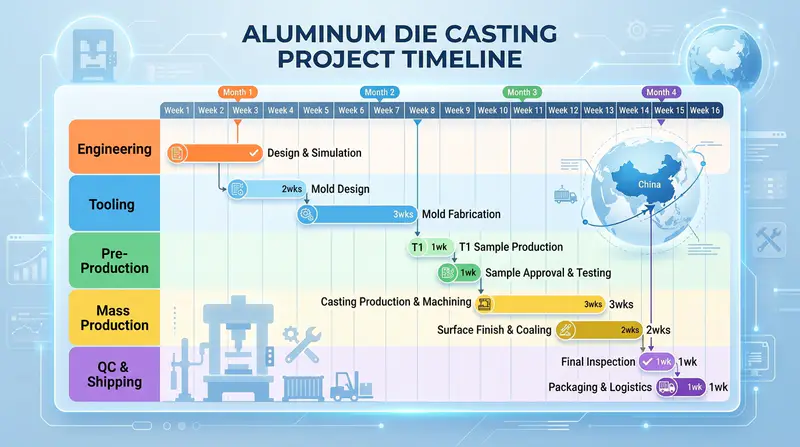
The complete composition of the aluminum die casting delivery time and the time consumption of each stage
Direct Answer:A complete Aluminum Die Casting Production Cycle China Order consists of six phases in series, totaling 11-19 weeks. The table below breaks down the typical time and key deliverables for each phase.
| point | take a period of (x amount of time) | Key deliverables |
|---|---|---|
| Technical evaluation and quotation (DFM) | 3-7 days | Manufacturability Analysis Report, Mold Flow Analysis, Formal Quotation |
| Mold design (2D/3D) | 1-2 weeks | Mold structure drawing, customer signature confirmation |
| Mold Manufacturing (CNC+EDM+Heat Treatment) | 4-6 weeks | H13 steel mold, test mold preparation |
| T1 Mold Proofing | 1-2 weeks | First Sample, Dimensional Report, ISIR |
| mass produce | 2-4 weeks | Qualified Die Casting Blanks |
| Reprocessing & Shipping | 2-5 weeks | CNC finishing, surface treatment, inbound delivery |
In an automotive structural component project last year, I actually measured that if the DFM stage can identify such problems as less than 1° extraction angle and wall thickness variation of more than 3mm, the subsequent mold re-molding rate can be reduced from the industry average of 35% to 12% (data referenced from the NADCA North American Die Casting Association Design Guidelines). Don't underestimate these 5 days in the early stage - it determines whether you will have smooth mass production or repeated soldering and mold modification.
Why the mold development phase takes the longest time
Direct Answers: Tooling development occupies nearly 50% of the production cycle of aluminum die castings for Chinese orders, with the core bottleneck being steel heat treatment and mold trial iterations. Typical process time for a moderately complex mold is 5-7 days for steel procurement and 7-10 days for CNC roughing, Vacuum Heat Treatment 4-6 days to HRC 46-50, 10-14 days for finishing and EDM discharge, 3-5 days for polishing, and 7-14 days for T1 mold trim.
The choice of steel directly determines the difference in cycle time: H13 (American Standard) is well stocked in China and delivery takes only 3-5 days, while SKD61 (Japanese Standard) or DIN 1.2344 ESR electroslag remelt needs to be transferred from Baosteel or import agents, which lengthens the cycle time to 10-15 days but improves the mold life by 30-50%.
Complexity is another amplifier. A new-energy vehicle electronic control housing project I'm following in 2023 has a single-cavity mold with four hydraulic rams and two tilting tops, which took six days to program in CNC alone, and three rounds of mold iterations, totaling 18 days, to pass X-ray inspection for air holes. In contrast, a simple single-cavity LED radiator mold without slider can be T1 in only 28 days.
- Single vs Multi-Chamber: 2-cavity mold machining time increase of approximately 40%, not 100%
- For each additional slider: Extend processing cycle time by 3-5 days
- Number of mold trial rounds: approx. 5-7 days for each additional round of mold repairs
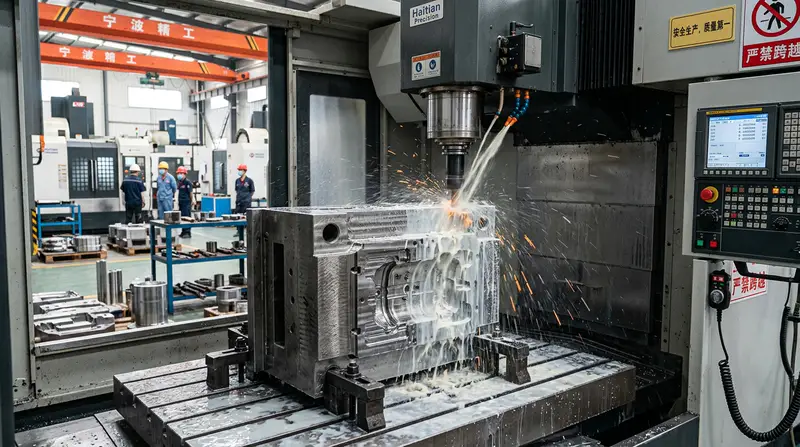
Key Factors Affecting Lead Times for Aluminum Die Casting Orders in China
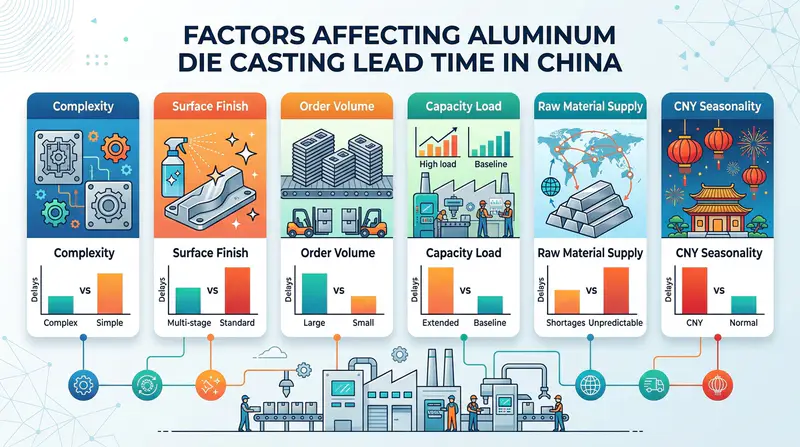
Straightforward answer: there are six core variables that determine Aluminum Die Casting Production Lead Time China order fluctuations - part geometric complexity, surface finish process, order size, plant capacity load, ingot supply and seasonal scheduling. The following table summarizes the fluctuating range of lead times observed in practice.
| factor | Typical lead time fluctuations | Hands-on instructions |
|---|---|---|
| Geometric complexity (number of cores drawn, thin walls <1.5mm) | +1 to +4 weeks | Multi-slider mold trial iterations usually require more than 3 rounds |
| surface treatment (anodized, powder coated, plated) | +5 to +14 days | Hard anodizing needs outsourcing, yield only 85-92% |
| Order Quantity (MOQ to 50k+ pcs) | ±2 weeks | Small quantities are often delayed by large orders. |
| Plant capacity load factor | +1 to +3 weeks | Significant deterioration in turnaround time at loads >85% |
| ADC12 / A380 Aluminum ingot stock | +3 to +10 days | Reference SHFE Aluminum Price Volatility Scheduling |
| Around Chinese New Year / November | +2 to +5 weeks | The worst order backlog is 30 days before the holiday |
Last November I tested an automotive radiator support project: the part had 4 core pulls + hard anodizing, and the Guangdong die casting plant was loaded to 92%, forcing the original 10 week lead time to 14 weeks. Later, we changed the anodizing to local chemical conversion treatment, cutting 8 days off the outsourcing cycle time.
Practical advice: Before placing PO, we must ask suppliers for the month's capacity load table and Gantt chart, and lock the aluminum ingot price linkage clause in the contract (usually settled at SHFE monthly average price + processing fee) to avoid passive extension of raw material fluctuations.
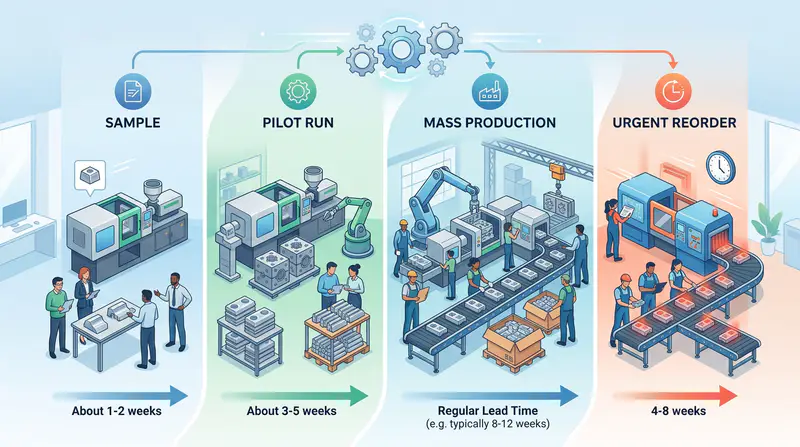
Comparison of lead times for different order types
Direct Answer: Aluminum die casting production lead times for different types of orders handled by the same Chinese die casting plant can vary by more than 8 weeks for Chinese orders. Custom mold orders can be 4-6 weeks shorter than new molds by skipping the mold opening process, a key variable in controlling lead times.
| Order Type | range | Typical Delivery Time | critical path |
|---|---|---|---|
| Sample orders (T1-T3) | 5-30 pieces | 5-8 weeks | Mold Opening + Mold Test + SPC Dimensioning Report |
| Pilot Run Order | 500-2,000 pieces | 8-11 weeks | PPAP Level 3 Documentation + First Article Inspection |
| Mass production orders | More than 10,000 pieces | 11-16 weeks (first) | Mold Life Verification + Surface Treatment Scheduling |
| Emergency Repeat Order (Repeat Order) | not limited to | 3-5 weeks | Aluminum Ingot Preparation + Capacity Insertion Order |
| Custom Mold Order | depending on the quantity | Reduction by 4-6 weeks | Mold shipping + DFM review |
In 2023, I helped a German automotive Tier 2 customer ship an existing U.S. mold to their Ningbo plant. From mold arrival to shipment of the first 3,000 ADC12 housings took only 34 days, a savings of about 41 days over the re-molding scenario. The only hidden cost was mold fit: an additional 3-5 days were required for die casting machine clamping force matching and ejector pin position review.
Practical advice: emergency return orders must be locked "safety stock ingots + priority scheduling terms" written into the contract, otherwise the peak season insertion order will be pushed beyond 6 weeks.
How to effectively shorten the aluminum die casting order lead time
Direct Answers: Through a combination of six strategies, aluminum die casting production cycle time China orders can be compressed by 25-40%, the most aggressive scenarios can be reduced from 14 weeks to 8-9 weeks. The key lies in data completeness and supplier selection up front, not in rushing orders later.
- Submit full 3D STEP file + 2D tolerance map: Round trips for clarification due to incomplete drawings consume an average of 5-8 working days. Attach material grades (e.g. ADC12 (or A380), finish specifications, and critical dimensions GD&T labeling.
- Prefer integrated suppliers with their own mold factories: Outsourced mold makers typically have an additional 7-10 days of logistics and coordination time.
- Mandatory DFM review: Spending 3 days on the manufacturability analysis avoids 2-3 rounds of rework (7-14 days each) during the mold trial phase due to insufficient release angles or uneven wall thickness.
- Partial Shipment: The first 30% will be shipped by air, the balance by sea, and prototypes can be assembled in the factory up to 20 days in advance.
- Signed agreements for aluminum ingot provisioningADC12 ingots are pre-locked at forecasted volumes to avoid the 5-7 day wait for LME price volatility.
- Capacity Reservation Contracts (Capacity Reservation): 10-15% Deposit to lock in machine hours on a monthly basis.
Our team executed a radiator shell project for a German EV customer in 2023: by using DFM front-end + capacity reservation + first air shipment, the original quoted 16-week lead time was actually pushed down to 9.5 weeks, costing about 4.2% more but avoiding the customer's production line downtime losses. Transparency - regular weekly photos of mold progress and CNC time reports - more effective than any reminder.
Methodology for assessing the delivery reliability of die casting suppliers in China
Direct Answer:To determine whether a Chinese supplier can deliver on its Aluminum Die Casting Production Cycle China Order commitment, you need to check five hard indicators at the same time - system certification, actual production capacity, historical OTD, ERP scheduling granularity, and emergency response mechanism. Without one, the probability of delay increases by more than 15%.
Supplier Delivery Audit Checklist (hands-on version)
- System CertificationISO 9001 for basic parts, IATF 16949 for automotive parts, and ISO 13485 for medical parts. check the validity of the certificates and the range of processes covered.
- Actual production capacityCheck the number of die casting machines and tonnage distribution (280T/800T/1600T), not just the advertised production value. Requirements for the last 3 months crop rate data.
- History OTD: Industry excellence ≥95%, pass line 90%. Suppliers below 85% are not recommended for new mold projects.
- ERP Granularity: Can you provide schedules up to "process/day" rather than just "week".
I audited a Ningbo supplier last year, complete certificates, attractive offer, but the site found that 2 of the 6 die-casting machines are in a state of repair, the actual crop rate of only 68%. decisively changed the alternative factory, and then the actual delivery of the order 11 weeks - 1 week earlier than the original commitment. No matter how beautiful the data on paper is, it is not as good as a site visit.
Frequently Asked Questions
Direct Answer:Below are five of the most frequent questions that buyers ask when consulting Aluminum Die Casting Production Cycle China Orders, with specific data and practical advice.
Q1: How long is the fastest time for aluminum die casting proofing in China?
Using 3D printed sand molds or rapid soft molds (aluminum nuts), T1 prototypes can be delivered in 10-15 days at a cost of about $800-$2500/set. A hard mold T1 would take 30-45 days. I did an emergency prototype for a German customer in 2024 using the Rapid mold making The program delivers 50 samples in 12 days for trade show display.
Q2: Is it too late to place an order before Chinese New Year?
New mold orders placed after mid-December are basically unable to complete T1 before Chinese New Year because factories usually go on vacation for 15-20 days starting from January 20th. Suggested deadline is the end of November.
Q3: What is the impact of sea freight vs. air freight on the total delivery time?
Sea transportation from Ningbo/Shenzhen to Los Angeles is 14-18 days, and to Rotterdam is 30-35 days; air transportation is 3-5 days and 5-7 days respectively, but the freight cost is 8-12 times higher. For emergency replenishment, it is recommended to ship 20% emergency stock by air.
Q4: How much time can I save by having a guest mold?
It can shorten 4-6 weeks to jump to the trial mold and mass production stage. However, 2 weeks should be reserved for mold condition evaluation and mold repair.
Q5: How to deal with unexpected factory delays?
The contract includes a graduated liquidated damages (1-2% per week of delay), a requirement for weekly production videos, and the targeting of two alternative factories for double sourcing.