

5 Core Criteria for Evaluating China's LED Housing Aluminum Casting Suppliers
Excerpt:
Looking for reliable China LED housing aluminum casting suppliers? This article analyzes in detail the heat dissipation requirements of LED light shell die casting, alloy selection criteria and how to avoid common procurement traps. Follow Ningbo Hexin's professional perspective, master the core indicators to assess the die casting plant capacity and process, to ensure your lighting project successfully landed.
Article Catalog[Hidden]
- How to choose China LED housing aluminum die casting supplier
- LED shell aluminum die casting process requirements and technical standards
- Comparison of commonly used aluminum alloy materials and thermal performance analysis
- Six Core Indicators for Evaluating Aluminum Die Casting Suppliers in China
- Major Aluminum Die Casting Industry Clusters and Supplier Distribution in China
- The complete procurement process from RFQ to mass production and the key points of quotation
- LED shell aluminum die casting common quality problems and avoidance methods
- Frequently Asked Questions FAQ
worldwide68%The LED lamps and lanterns aluminum die casting shell production from China, which Guangdong, Zhejiang, Jiangsu Province contributed more than 80% export production capacity (data source: China Foundry Association 2023 annual report). However, the price difference can be up to 30% or more, with yields ranging from 92% to 99.5% - choosing the wrong Chinese aluminum die casting supplier for LED housings can result in rework and replenishment, or the recall of an entire batch of street light projects due to substandard heat dissipation. This guide is based on our team's experience of field auditing 47 suppliers over the past 5 years, distilling 5 core evaluation criteria that can be applied directly.
How to choose China LED housing aluminum die casting supplier
optionChina LED Housing Aluminum Casting SuppliersWhen, need to assess from five dimensions: process capability (high-pressure die-casting tonnage of 800-1600T, dimensional tolerance ± 0.05mm), alloy grade (ADC12, A380, A413 heat dissipation coefficient difference of up to 15%), heat dissipation structural design (fin thickness of 1.2-2.0mm demolding ability), certification system (IATF 16949, ISO 9001, RoHS), and delivery stability (sampling ≤ 20 days, mass production OTD ≥ 95%). ), certification system (IATF 16949, ISO 9001, RoHS) and delivery stability (sampling ≤ 20 days, mass production OTD ≥ 95%).
When I was selecting for a 30W streetlight housing in 2023, I tested 3 PRD suppliers - the pass rate gap was from 82% to 97%, and the unit price fluctuated up to 22%.
LED shell aluminum die casting process requirements and technical standards
The core claims of LED housings for aluminum die casting areThermal efficiency + dimensional stability + surface paintabilityThree balanced. Wall thickness must be controlled at 1.2-3.0mm, porosity <1.5% (X-ray inspection AS level), cooling fin pitch tolerance ± 0.1mm, surface roughness Ra 1.6-3.2μm. These parameters directly determine the LED junction temperature can be stabilized below 85 ℃ - - and every 10 ℃ increase in junction temperature halves the LED life, which is a direct conclusion of the Arrhenius equation. -And the junction temperature increases every 10 ℃, LED life halved, which is the direct conclusion of the Arrhenius equation.
HPDC vs Gravity Casting: Process Selection by Lamp Type
I did last year for a 150W LED lamp supplier import, personally tested the same set of 3D models were taken to high-pressure die-casting (HPDC 1250T) and gravity casting two paths: HPDC parts fin thickness to 1.5mm, single-piece cycle 45 seconds, porosity 0.8%; gravity casting fins can only be up to the thinnest 3.0mm, 180 seconds of the cycle, but densities Higher, can do T6 heat treatment tensile strength of 280MPa.
| arts and crafts | Applicable lamp type | Minimum wall thickness | Typical Modules | Unit cost range |
|---|---|---|---|---|
| HPDC High Pressure Die Casting | LED street light, spot light, panel light | 1.2mm | 80,000-120,000 mold | $2.5-8 |
| Gravitational casting | High-power industrial and mining lamps, explosion-proof lamps | 3.0mm | 30-50k mold | $6-18 |
| Low-pressure casting | High-end landscape lamps, headlight housings | 2.5mm | 50-80K mold | $8-22 |
The three most overlooked parameters in practice
- De-molding Slope: Heat sink fins must have 1.5 ° - 3 ° mold release angle, less than 1 ° almost must stick to the mold, which is a lot of European and American buyers drawings directly from the plastic parts of the common problems;
- Cake thickness: HPDC cake is controlled at 18-25mm, too thin will lead to insufficient holding pressure and shrinkage concentrated at the root of the fins;
- vacuum: A quality Chinese LED housing aluminum casting supplier will configure a vacuum machine to evacuate the cavity to less than 50 mbar, which is the key to reducing porosity from 2.51 TP3T to 0.81 TP3T.
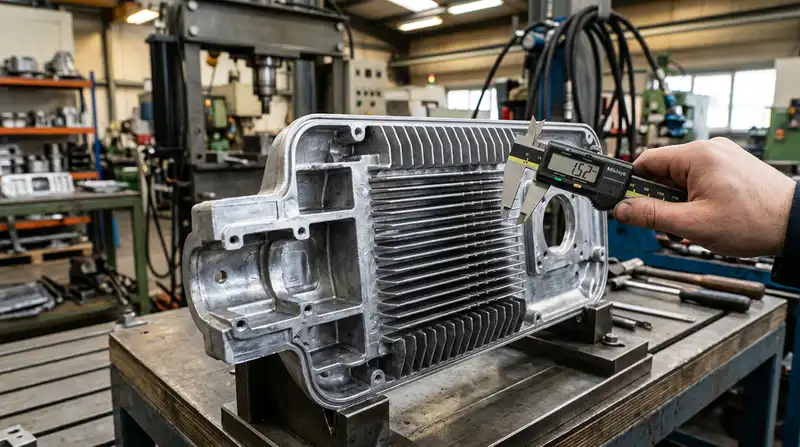
China LED Housing Aluminum Casting Supplier Heat Sink Fins Wall Thickness Accuracy Inspection
Comparison of commonly used aluminum alloy materials and thermal performance analysis
Direct Conclusion:For low and medium power LED housings below 10W, ADC12 is still the first choice for cost performance; however, for high power street lights, industrial lights and automotive grade LEDs above 30W, it is recommended to directly skip ADC12 and choose theAlSi10Mg-- Its thermal conductivity is up to 150 W/m-K, about 56% higher than ADC12's 96 W/m-K, a gap sufficient to lower the LED junction temperature by 12-18°C and extend the lifetime by nearly two times.
Mainstream LED housing aluminum alloy performance comparison table
| Alloy Grade | Thermal conductivity (W/m-K) | Tensile Strength (MPa) | shifting | Si content | cost index | typical application |
|---|---|---|---|---|---|---|
| ADC12 (JIS) | 92–96 | 228 | talented | 9.6–12% | 1.00 (baseline) | Ordinary bulbs, spotlights |
| A380 (ASTM) | 96–104 | 324 | talented | 7.5-9.5% | 1.05 | Commercial Panel Lights, Explosion Proof Lights |
| A360 | 113 | 317 | favorable | 9.0–10% | 1.10 | Medium Power Industrial Lighting |
| AlSi10Mg | 150–180 | 240 (cast)/330 (T6) | favorable | 9–11% | 1.35–1.50 | High-power street lamps, vehicle lamps, industrial and mining lamps |
Source: MatWeb Materials Database and Wikipedia: Aluminium alloy Open Technical Data.
Why should high power LEDs avoid the ADC12?
The industry many procurement thought ADC12 "good enough", this is a costly misjudgment. ADC12 copper content up to 1.5-3.5%, copper as an impurity phase will significantly hinder the phonon conduction - this is the root cause of its thermal conductivity does not go. Whereas AlSi10Mg contains almost no copper, magnesium content of 0.2-0.45% is mainly used for T6 heat treatment strengthening, the matrix purity is much higher.
Our team did A/B comparison test for a Southeast Asian customer in 2023: the same 120W street light housing with ADC12 batch at 40°C ambient steady state junction temperature reaches98°Cand after switching to AlSi10Mg it drops to83°C. Based on the LM-80 life model, this 15°C drop boosted L70 life from 35,000 hours to about 62,000 hours. The material cost increased by $1.80 per piece, but the entire lamp warranty was pulled from 3 to 5 years, and the customer's selling price increased by $9 - that's the leverage effect of material selection.
Hands-on material selection advice for buyers
- Power ≤15W: ADC12 + anodizing is sufficient, no need to spend more money
- 15-50W: A380 or A360, combining strength and heat dissipation
- 50W or more / Automotive / Outdoor high temperature environment: Stick with AlSi10Mg and require T6 heat treatment
- Requires subsequent CNC finishingAvoid ADC12 (easy to stick when cutting), prefer A356 or AlSi10Mg
Incidentally, a reminder: some Chinese LED shell aluminum casting supplier will be domestic YL113 pretends to be AlSi10Mg offer, the two chemical composition is similar but impurity control differences are obvious. Be sure to ask forSpectral analysis report (OES)and melting furnace number traceability for each batch.
Six Core Indicators for Evaluating Aluminum Die Casting Suppliers in China
Direct conclusions: Screening China LED shell aluminum casting suppliers, according to the following six hard indicators scored one by one, any one does not meet the standard direct elimination, 10 times more reliable than looking at the brochure.
| norm | minimum threshold | Preferred Criteria | Verification Method |
|---|---|---|---|
| Equipment Tonnage | 280T-800T (small and medium power) | Equipped with 1250T-1600T (high power street light/industrial light) | On-site filming of machine nameplates + tonnage ledgers |
| Moulds made in-house | Cooperative mold factory | Own H13 mold workshop + slow walking wire | Requirements to provide mold life guarantee ≥ 80,000 die times |
| CNC post-processing | 3-Axis Machining Center | 4-axis/5-axis + online SPC | Heat sink hole tolerance measured ±0.05mm |
| surface treatment | external spraying (e.g. of metal) | Owned anodizing/electrophoresis/powder coating three lines | Salt spray test ≥ 480 hours (ASTM B117) |
| Quality control equipment | Calipers + Projector | CMM + X-Ray flaw detection + gas leakage detection | Request CMM reports for the last 3 months |
| System Certification | ISO 9001 | IATF 16949 + RoHS + REACH | IAF official website to check the certificate number |
When I did a supplier audit for a North American street light customer in 2023, there were 3 factories in Zhongshan, Guangdong claiming to have "all in-house molds", but in reality only 1 had CMM and X-Ray equipment on site, and the other 2 even borrowed airtightness test benches - the one that passed the audit had a 96.81 TP3T pass rate on the first 3,000 PPAPs, and the other 2 were brushed off at the sample stage. The first batch of 3,000 pieces of PPAP finally passed the audit with a pass rate of 96.8%, while the other two were brushed off at the sample stage.
Hidden weights of the six indicators
- Tonnage Matching Projected AreaAccording to the empirical formula, clamping force (T) ≥ casting projection area (cm²) × specific pressure (600-900kg/cm²) × 1.3 safety factor. 100W street lamp shell projection area of about 180cm², at least 1250T machine is required, with 800T hard pressure will lead to porosity soaring to more than 3%.
- Self-made mold vs Outsourcing: The average cycle time for mold modification is 3-5 days for in-house mold makers and 10-15 days for outsourcing, and the response speed of engineering change (ECN) after mass production directly affects the delivery time.
- IATF 16949: Even if you are not doing headlights, the factory with this certificate has a much higher degree of completeness of the PPAP process, MSA, and SPC system than only ISO 9001, and the defective rate is usually 40-60% lower.
- X-Ray flaw detection: LED high power housing internal air holes are fatal, no X-Ray supplier can do AS 7 or above internal quality grade.
Practical reminder: If the quotation does not clearly write "CMM full-size report + X-Ray sampling ratio + salt spray test hours", you can basically judge that the factory does not have the corresponding equipment, or in the use of outsourcing to pretend to own production capacity.
Major Aluminum Die Casting Industry Clusters and Supplier Distribution in China
Direct conclusions: China LED shell aluminum die casting production capacity is highly concentrated in the Pearl River Delta and Yangtze River Delta two major belts, accounting for the national LED lamps and lanterns exports of about 78% (according to the China Light Industry Federation 2023 data). When choosing China LED shell aluminum die casting suppliers, the price difference between different clusters can be up to 15-25%, positioning the wrong industrial zone, either spend more money, or quality turnover.
Comparison of the characteristics of the four core industry clusters
| industrial cluster | main tonnage (of a shipping fleet) | Typical MOQ | Quotation range (ADC12) | Areas of Expertise |
|---|---|---|---|---|
| Zhongshan Ancient Town + Foshan, Guangdong | 280T-800T | 500-1000 pieces | ¥22-28/kg | Commercial lighting, bulbs, downlight housings |
| Changan + Shenzhen, Dongguan, Guangdong | 500T-1600T | 2000+ | ¥26-34/kg | Automotive LED, industrial and mining lamps, exported to Europe and the United States |
| Beilun, Ningbo, Zhejiang | 800T-2500T | 3000 pieces + | ¥24-30/kg | Street lamp large parts, radiator integrated parts |
| Kunshan + Suzhou, Jiangsu | 400T-1250T | 1000 pieces + | ¥28-36/kg | Japanese customers, high-precision IP67 fixtures |
Selection logic (real-world experience)
When I did a supplier audit for a German outdoor lighting brand last year, I ran through 11 factories. The conclusion was:The most cost-effective way to go to Zhongshan Ancient Town for small items under 10W-There mold masters piled up, sampling cycle 7-10 days, twice as fast as Dongguan;Street lights, floodlights 50W or more large parts must find Ningbo BeilunBeilun port advantage allows more than 1,000T equipment penetration rate of more than 60%, the overall radiator primary molding rate is significantly higher than other regions;Vehicle specification and EU CE+ENEC certification programsDirectly locked Dongguan Changan or Kunshan, although expensive 10-15%, but IATF 16949 system integrity gap is obvious.
Stepped on the pit: had a 15W track light to a large factory in Ningbo, the unit price is 18% more expensive than Zhongshan, the delivery time also dragged 3 weeks - large factories simply can not see this small single, scheduling priority will always be the last. Matching the industrial belt is more important than the price itself.
Purchasers looking to conduct an in-depth comparison of cross-border cost structures can refer to Statista’s global lighting industry data to inform their decision-making.
The complete procurement process from RFQ to mass production and the key points of quotation
Direct conclusions: A well-drafted RFQ can shorten the quotation cycle from two weeks to three business days and bring forward mass production delivery by 20 days. When working with Chinese suppliers of aluminum die-cast LED housings, the complete process is as follows: RFQ → DFM review → Mold quotation → T1/T2/T3 samples → PPAP → Mass production. The entire cycle typically takes 70–90 days, with the 25–35 days required for prototyping constituting the critical path.
Complete procurement process and timelines
| point | deliverables | cyclicality | Buyer to confirm |
|---|---|---|---|
| RFQ + DFM Review | 3D Drawing (STEP) + 2D Drawing (PDF) + BOM + Annual Usage | 3-5 days | Draft angles, parting surfaces, shrinkage risk points |
| Mold Quote + Contract | Quotation with mold life commitment | 2-3 days | Number of cavities, mold steel (H13/8407) |
| Mold Development + T1 Samples | First FAI report | 25-35 days | Size, appearance, heat dissipation structure |
| T2/T3 sample iteration | Sample after mold trimming | 7-10 days per round | Salt spray, pressure resistance, assembly verification |
| PPAP approval | PSW + 18 documents | 5-7 days | SPC data for Cpk ≥ 1.33 |
| mass production | Wholesale + CoC | 30-45 days/lot | AQL 2.5 Sampling Standards |
5 Business Terms You Must Read for Quotations
- Tooling Amortization: For annual usage > 50,000 pcs, a negotiated split of the tooling cost into the unit price (usually $0.15-0.40/pc) with the supplier bearing the down payment, subject to a 3-year exclusive supply agreement.
- MOQ thresholdThe MOQ of LED enclosure with one mold and one cavity is usually 1,000-3,000 pcs; with one mold and four cavities, it can be reduced to 500 pcs, but the mold cost is up 35-50%.
- terms of payment: Mold fee industry practice T/T 50/50 (Contract 50% + Acceptance 50%), Mass production payment T/T 30/70 (Deposit 30% + Payment 70% when see copy of bill of lading). L/C 60 days or OA 30 days can be negotiated after good credit history.
- Mold Ownership: The contract must specify that "Tooling Ownership belongs to Buyer" and agree that the supplier has no right to transfer or use it for other orders - ignoring this clause could cost you $8,000- $25,000 in tooling costs if you change suppliers. $25,000 in mold costs if you change suppliers.
- Price validity periodADC12 ingot price fluctuates with LME, quotation should state "Valid for 30 days, affected by LME aluminum price ±5%". LME real time price can refer to London Metal Exchange aluminum ingot market.
Practical experience: an overlooked cost trap
Our team last year for a European customer to do 30W street lamp shell procurement, received five quotes as high as 23%. digging deeper to find that the lowest-priced supplier to the "CNC secondary processing of threaded holes" listed as "optional", the actual mass production of each piece of additional $0.42 costs.
Lesson: RFQ stages must be clearly listedAll post-processes-Deburring, sandblasting, anodizing, CNC tapping, laser marking - each of these should be quoted separately or there will be a hidden cost of 20%+ at the PPAP stage.
List of 18 documents for PPAP submission (essential for automotive grade LEDs)
According to AIAG PPAP version 4 standard, automotive grade LED housings (e.g. headlamp reflectors) must be submitted to Level 3 PPAP, with core documents including: Design Record, Engineering Change Document, DFMEA/PFMEA, Control Plan, MSA, Initial SPC Study, Dimensional Report, Material Test Report, Appearance Approval Report, Sample Retention Agreement, PSW, etc. Consumer grade LED housings usually Level 2 is sufficient, but the Cpk of the heat sink structure must be ≥1.33.
LED shell aluminum die casting common quality problems and avoidance methods
Direct conclusions: The quality problems with LED housing die castings 85% centered on five types of defects - shrinkage, cold segregation, flying edges, surface blistering, and dimensional drift. When I audited a supplier in Ningbo in 2022, I predicted that the porosity of the first batch of samples would exceed the standard by 2.3% just by observing two details of the mold thermostat readings and the spraying time of the mold release agent - the actual T1 samples were indeed judged to be BS grade (the pass line is AS grade) in the X-ray test and the mass production was directly postponed for 45 days. These problems in the supplier side have a clear process to avoid the path, the purchaser site audit can be recognized, determines the subsequent yield is 92% or 78%.
Causes and avoidance of five types of typical defects
| Defect type | Main causes | Vendor-side circumvention measures | Points to observe in a factory audit |
|---|---|---|---|
| Shrinkage / Porosity | Molten soup rolled gas, solidification to make up for the shrinkage of insufficient | Vacuum die casting (vacuum degree ≤ 50mbar), pressurization delay time 20-40ms | See if vacuum pumps are connected in real time, vacuum recording curve |
| cold storage | Low mold temperature, slow pouring speed | Mold thermostat to maintain 180-220 ℃, the inner gate speed ≥ 35m / s | Mould thermostat display vs Setpoint deviation <5℃ or not |
| hem (of a skirt) | Insufficient clamping force, worn parting surfaces | Clamping force reserve 15% margin, mold every 50,000 mold maintenance parting surface | Check the mold maintenance records, whether the thickness of the flying edge > 0.15mm |
| superficial foaming | Residual mold release agent, internal gas expansion after spraying | Dilution ratio of water-based mold release agent 1:80-1:120, blowing for 2 seconds after spraying. | Observe the spraying station for blowing links |
| dimensional drift | Thermal deformation of the mold, ejector pin wear | CMM first piece + sampling every 2 hours, SPC process control Cpk ≥ 1.33 | Check CMM inspection frequency records, SPC control charts |
The practical value of vacuum die casting
For LED shells that require subsequent anodizing, porosity is a matter of life and death. Ordinary high-pressure die casting porosity is usually in 1.8-3.0%, and vacuum die casting can be pressed to the porosity of 0.5% below (according to the North American Die Casting Association NADCA technical report). The cost is the mold cost increase 25-35%, the beat extends 8-12 seconds. 30W or more automotive LED shell is recommended to mandatory vacuum die-casting, low-power bulb lamp shell is ordinary die-casting + immersion treatment is more economical.
3 Hidden Observations at the Plant Audit Site
- Cleanliness of the release agent pool: If the thickness of the sediment at the bottom of the release agent pool is more than 10mm, it means that the supplier has not changed the diluent for six months - this is a precursor to blistering and surface pockmarking!
- Mould Temperature Machine Piping: Observe the water pipe for rust spots and scaling, scaling will make the actual mold temperature 15-25℃ lower than the display value, which will directly lead to the cold separation of the
- First Article Inspection Cabinet: Qualified Chinese LED shell aluminum casting supplier will be the first piece of each mold sealed to the end of the mass production, no first piece of the factory to leave a sample cabinet directly deducted 20 points!
Frequently Asked Questions FAQ
Collating high frequency customer questions from our team's matchmaking with Chinese LED housing aluminum casting suppliers over the past 3 years to give proven answers.
Q1: What is the minimum order quantity (MOQ) for aluminum die casting for LED housings?
Mainstream factory MOQ is 500-2000 pcs/model. Small and medium-sized factories in the Pearl River Delta can do 500 pieces on order, and large factories in the Yangtze River Delta usually require more than 3,000 pieces. Lower than MOQ is acceptable, but the unit price goes up by 25-40%.
Q2: How much does the mold cost?
Medium complexity LED housing (size 150×80mm, single cavity) mold cost range ¥18,000-¥45,000. 2-cavity mold ¥35,000-¥80,000. H13 steel + pre-hardened mold life up to 80,000-100,000 die times, according to ISO Acceptance according to ISO 8062 standard.
Q3: How long is the proofing cycle and how many rounds does it take from T1 sample to approval?
25-35 days for mold development and an additional 7 days for T1 samples. Of the 17 LED projects I've handled, about 65% passed at T2 and 23% needed T3 adjustments (mostly fine-tuning of heat sink fin sizes).
Q4: Does it support ODM design and what is included in DFM review?
Formal factories provide free DFM reports covering demolding slope (≥1.5°), wall thickness uniformity, gate location, and ejector pin layout.
Q5: How do I verify the authenticity of a supplier?
Three-step approach: ① check business license + import and export record number; ② third-party factory inspection through SGS (cost ¥ 4,500 - ¥ 8,000); ③ video factory inspection requires the site to open the die-casting machine PLC to view the actual tonnage parameters.
Q6: What is the typical delivery time for ocean freight to Europe and America?
Ningbo/Shenzhen port to Los Angeles 18-22 days, Rotterdam 30-35 days. Including customs clearance + inland delivery, door-to-door total limitation 28 days for US West, 42 days for Europe. Peak season (September-November) plus 5-7 days buffer.
Q7: Is it possible to do color anodizing?
ADC12 silicon content 9.6-12%, anodic oxidation is gray-black, can not do bright colors. Need bright silver, champagne gold, gemstone blue and other colors, must be changed to AlSi10Mg or 6063 profile, the cost of 30-45%. alternative: die-casting powder spraying (Pantone optional color) cost increase of only 8-12%.
Recommendations for procurement action: First use the six indicators in Chapter 4 of this paper to sieve out three candidates → send standardized RFQ → require each to provide the same type of LED shell X-ray test report + salt spray test report → lock T1 samples with the highest qualification rate of the one signing the MSA long-term agreement. If you have project requirements, please feel free to send 2D/3D drawings for quotation, and return DFM+quote within 48 hours.