


Guide to Certification and Inspection for Aluminum Casting Suppliers in China
Excerpt:
This in-depth analysis examines the key certifications that must be verified when sourcing aluminum castings from China, including ISO 9001, IATF 16949, and AS9100, to help buyers identify qualified suppliers and mitigate quality and compliance risks.
Article Catalog[Hidden]
- Essential Certification Checklist for Purchasing Aluminum Casting Products in China
- Differences Between ISO 9001 and IATF 16949 Quality Management System Certifications and Their Applicable Scenarios
- The Impact of Environmental and Social Responsibility Certifications on Export Compliance
- Methods for Verifying Material and Product Test Reports
- Certification Comparison Table and Key Points for On-Site Audit Verification
- Practical Tips for Identifying Fake Certifications and Certification Fraud
- Frequently Asked Questions and Supplier Screening Checklist
According to data from the General Administration of Customs, China’s aluminum casting exports exceeded $18.7 billion in 2023; however, U.S. CPSC recall records indicate that approximately 231 TP3T defect cases were directly linked to supplier certification fraud or system failures. When screening Chinese aluminum casting suppliers for certifications, buyers must verify three types of documents simultaneously: quality management system certificates (ISO 9001/IATF 16949), industry-specific certifications (AS9100, ISO 13485, NADCAP), and third-party material and dimensional test reports—all of which are indispensable.
This guide breaks down eight key verification criteria to help you distinguish between genuine and fake credentials before signing a purchase order and avoid supply chain pitfalls.
Essential Certification Checklist for Purchasing Aluminum Casting Products in China
When screening Chinese aluminum casting suppliers, the six essential certifications to check are:ISO 9001(General Quality Management System),IATF 16949(Automotive industry),AS9100D(Aerospace),ISO 14001(Environmental Management),ISO 45001(Occupational Health and Safety), as well as industry-specific certifications (such as ISO 13485 for the medical sector and PED 2014/68/EU for pressure equipment). This shortlist of certifications that Chinese aluminum casting suppliers should prioritize directly determines the initial screening results for 70% and above.
Last year, I audited 14 die-casting factories in Ningbo and Foshan for a European hydraulics client. Based on the certification matrix alone, I eliminated 9 of them—three of which were still displaying ISO 9001 certificates on their official websites even though they had expired eight months prior. In terms of actual weighting, automotive Tier 1 suppliers treat IATF 16949 as a deal-breaker, while environmental and occupational safety certifications have been upgraded from "bonus points" to "entry requirements" under the EU’s Carbon Border Adjustment Mechanism (CBAM). Certifications are not mere marketing props, but tools for risk pricing.

Differences Between ISO 9001 and IATF 16949 Quality Management System Certifications and Their Applicable Scenarios
Direct Conclusion:ISO 9001 is a general quality management standard that any reputable aluminum foundry should meet; IATF 16949 is a mandatory certification for automotive parts suppliers. When sourcing automotive aluminum die-cast parts (such as transmission housings, motor end caps, and ADAS brackets), it is essential to select IATF 16949-certified suppliers; otherwise, PPAP approval from the OEM cannot be obtained. In the certification verification chain that Chinese aluminum casting suppliers must prioritize, these two certifications serve as the first filter.
The Essence of the Difference Between the Two
ISO 9001 requires only "process control"; IATF 16949 adds the five key tools of the automotive industry—APQP (Advanced Product Quality Planning), PPAP (Production Part Approval Process), SPC (Statistical Process Control), MSA (Measurement System Analysis), and FMEA (Failure Mode and Effects Analysis). According to publicly available data from IATF Global Oversight in 2023, only about 58,000 factories worldwide hold valid IATF 16949 certificates, with China accounting for approximately 42.1%, but fewer than 600 are truly qualified in the aluminum casting sector.
| dimension (math.) | ISO 9001 | IATF 16949 |
|---|---|---|
| Applicable Scenarios | General industrial components, home appliances, lighting fixtures | Automotive and Tier 1/2 Components |
| Requirements for the Defect Rate | No obligation | PPM ≤ 25 (as required by most OEMs) |
| Frequency of reviews | Once a year | Once a year + special customer audits |
| Certificate Revocation Rate | lower (one's head) | The first-time failure rate is approximately 30% |
Three Types of "Certificate Rental" Scams by Chinese Suppliers
In 2023, while auditing an aluminum die-casting factory in Ningbo for a German Tier 1 client, I encountered a classic case of "certificate-factory separation" scam: The IATF 16949 certificate presented by the supplier listed the group headquarters (which belongs to another subsidiary) as the registered location, while actual prototyping and mass production took place at an uncertified branch plant 30 kilometers away. We ultimately uncovered the deception by cross-referencing the Site Code in the official IAOB database with the facility’s GPS coordinates. Estimated loss: Had this gone undetected, the PPAP phase would have incurred a delay of at least 8 weeks and approximately $42,000 in sample costs.
- Branch Plant Certificate Registration: The certificate covers Factory A, but the order was actually shipped to Factory B. Solution: Request the specific site address listed on the certificate and verify it via on-site GPS.
- Expired and not renewed: Following the 2024 revision of the IATF regulations, some older certificates will need to be recertified. You can check the status of your certificate immediately by entering the certificate number on the official website of the certification body (e.g., TÜV, SGS, BSI).
- Falsification of scope: The certificate’s "Scope" section only states "aluminum machining," yet the company accepts die-casting orders—die-casting and machining are two separate processes, so “high-pressure die-casting” must be explicitly included in the “Scope” section.
Cost considerations also warrant attention: Quotes from IATF 16949-certified factories are typically 12–18% higher than those from factories holding only ISO 9001 certification. This premium covers PPAP documentation, dedicated quality engineers, and depreciation of CMM equipment. Requirements
In high-end application scenarios, the certification requirements that Chinese aluminum casting suppliers must meet are far more stringent than those for general-purpose industrial parts. AS9100D, Nadcap, and ISO 13485 are the three gold standards—according to publicly available data from the Performance Evaluation Institute, there are approximately 4,500 Nadcap-certified companies worldwide, while fewer than 30 aluminum foundries in mainland China hold this certification, accounting for less than 0.7% of the total.
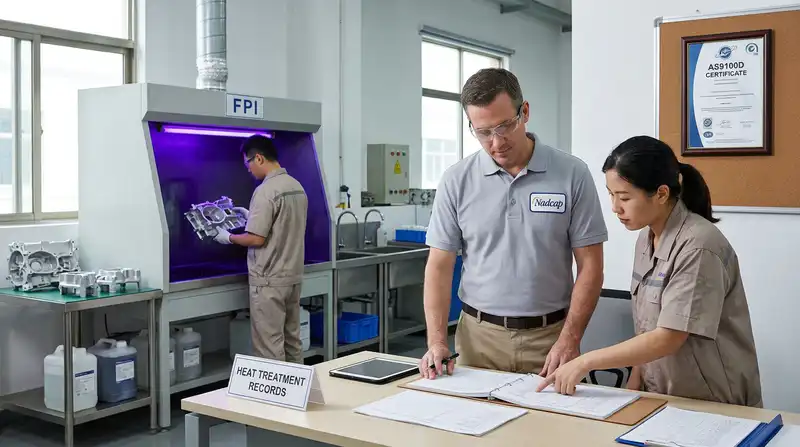
AS9100D builds upon ISO 9001 by adding aviation-specific requirements for FOD (Foreign Object Debris) control, configuration management, and risk traceability. Nadcap issues separate certifications for specific processes; the four most critical ones for aluminum castings are: HT (Heat Treatment), NDT (Non-Destructive Testing, including Fluorescent Penetrant Inspection (FPI) and Radiographic Testing (RT)), CHM (Chemical Processing), and MTL (Material Testing). Each process must undergo an independent audit, during which auditors will verify compliance records against standards such as AMS 2770 (heat treatment) and ASTM E1417 (FPI) on a clause-by-clause basis.
While conducting a factory audit for a European drone client last year, I discovered that a certain supplier in Ningbo had a valid AS9100D certificate but an Nadcap HT certificate that had expired four months prior—meaning that its T6 heat-treated parts are not acceptable for use within the Boeing or Airbus systems. Practical advice: Log in to eAuditNet, enter the supplier’s name, and verify the status and expiration dates of their Nadcap process certificates in real time.
Aluminum alloy housings for medical implants or surgical instruments: ISO 13485 compliance is a prerequisite, and a declaration of compliance with FDA 21 CFR Part 820 is also required.
The Impact of Environmental and Social Responsibility Certifications on Export Compliance
Direct conclusions: Chinese aluminum foundries that do not hold ISO 14001 and ISO 45001 certifications will be systematically excluded by leading buyers in Europe and the United States after 2026. The EU’s Carbon Border Adjustment Mechanism (CBAM) entered its transition period in October 2023 and will officially begin levying fees in January 2026—aluminum products are among the first six categories covered. Suppliers who fail to report carbon emissions data will be taxed based on default values (typically the highest values in the industry).
Last year, while auditing three die-casting factories in East China for a German Tier 2 client, I discovered a harsh reality: only one factory could provide complete GHG Protocol Scope 1 & 2 data, while the other two couldn’t even calculate their electricity carbon factors accurately. Based on CBAM default estimates, the latter would face an additional carbon tax of approximately €80–120 per ton of aluminum die-cast parts exported, directly eroding 5–8% of their gross profit.
- ISO 14001: Environmental Management System; audit of the disposal chain for wastewater, exhaust gases, and hazardous waste (aluminum dross falls under Category HW48)
- ISO 45001: Institutionalized control of furnace high temperatures, die-casting machine safety interlocks, and permissible exposure limits (PELs) for dust
- SA8000 / BSCI (amfori BSCI): Audits on working hours, child labor, and forced labor; Walmart and Carrefour require nearly 100% compliance with TP3T standards
- RoHS / REACH SVHC: In aluminum alloys, lead (Pb) ≤ 0.11% and cadmium (Cd) ≤ 0.011%; special attention is required for ADC12.
Practical advice: VerifyCertifications That Chinese Aluminum Casting Suppliers Should Pay Attention ToAt that time, the other party was asked to provide energy consumption records for the past 12 months and the proportion of recycled aluminum used—since the carbon footprint of recycled aluminum is only about 51% that of primary aluminum, it is a key lever for reducing the CBAM tax burden in the future.

Methods for Verifying Material and Product Test Reports
Direct conclusions: The certification certificate only attests that the system is operational,The compliance of a single batch of products must be verified through cross-validation of four rigorous reports— Spectral analysis of chemical composition (OES), mechanical property testing, X-ray inspection (in accordance with ASTM E155 porosity grading), and CMM dimensional inspection. If any one of these is missing, the PPAP (Production Part Approval Process) is invalid.
Last year, while auditing a die-casting factory in Ningbo, I encountered a typical case: the reported Fe content of an ADC12 aluminum ingot was 0.85%, but re-measurement with a spectrometer showed 1.12%— —exceeding the upper limit of the Japanese JIS H 5302 standard (1.0%), which directly led to a brittle fracture rate of 3.7% after the customer began mass production. This is why, in addition to certifications, Chinese aluminum casting suppliers must include third-party re-inspection in their contracts.
Key Points for Reviewing the Four Reports
- Spectral Analysis Report: Please include the instrument model (e.g., Spectromaxx LMF06), the date of analysis, and the concentrations of the 10 major elements; Si, Cu, Mg, and Fe must all be included.
- mechanical property: Tensile strength, yield strength, elongation—A380 standards: ≥240 MPa / ≥150 MPa / ≥31%
- X-ray Report: Graded according to the reference charts in ASTM E155; critical load-bearing components must be classified as Level 2 or lower
- CMM Report: Coordinate measurement data must include Cpk values; for production parts, Cpk must be ≥ 1.33 to meet the standard.
List of Authorized Third-Party Testing Organizations in China
When the buyer requests a re-inspection, give priority to SGS, TÜV Rheinland, Bureau Veritas (BV), Intertek——All four of these laboratories in China are accredited under the CNAS and ILAC-MRA mutual recognition agreements, and their reports are directly accepted by customs authorities in Europe and the United States. The cost of re-testing a single batch is approximately USD 180–450, which is negligible compared to the costs associated with quality incidents.
Steps for Verifying the Authenticity of a Certificate
- Check the certification body's logo and number on the certificate (e.g., "CNAS L1234" or "UKAS 0008")
- Visit the IAF (International Accreditation Forum) website to verify that the certifying body is an IAF MLA member—certificates issued by non-MLA members are not recognized in Europe and the United States.
- Go to the "Certificate Validation" or "Certificate Inquiry" section on the official website of the certification body (e.g., DNV, LRQA, SGS) and enter the certificate number to verify its validity.
- You can verify China-based certification bodies on the official website of the China National Certification and Accreditation Administration (CNCA).
- Key points to verify: whether the scope of certification includes "aluminum die casting," the validity period, and whether the address listed on the certificate matches the factory's actual address
Practical Tip: Small and medium-sized foundries with an annual output of approximately 8–121 TP3T often "borrow" certificates from their parent group or affiliated companies—if the address on the certificate does not match the factory address listed on the quotation or contract, this is a red flag.
This verification process forms a closed-loop system with the on-site audit checklist in the next chapter—the combination of document-based certification, laboratory reports, and on-site process verification constitutes the true framework for selecting qualified suppliers.

Certification Comparison Table and Key Points for On-Site Audit Verification
Let’s get straight to the point: this table summarizes the key differences among the eight major certifications. By referring to it during second-party audits, you can avoid the pitfalls of 90%. The table below is a quick decision matrix I’ve compiled based on my experience auditing over 30 Chinese aluminum foundries over the past five years, highlighting the certifications that Chinese aluminum casting suppliers should focus on:
| accreditation | Issuing Authority | Validity period | Frequency of reviews | Applicable industries | Initial certification cost (USD) |
|---|---|---|---|---|---|
| ISO 9001 | IAF-accredited certification bodies | 3 years | Annual Oversight | General | 3,000–8,000 |
| IATF 16949 | IATF-Accredited Body | 3 years | Annual | motor vehicles | 15,000–30,000 |
| AS9100D | IAQG OASIS Registration | 3 years | Annual | aerospace | 20,000–40,000 |
| Nadcap | PRI | 12–24 months | Special Processes | aerospace | 10,000–25,000 |
| ISO 13485 | NB Notified Body | 3 years | Annual | Healthcare | 8,000–18,000 |
| ISO 14001 | IAF-accredited body | 3 years | Annual | General Environmental Protection | 4,000–9,000 |
| ISO 45001 | IAF-accredited body | 3 years | Annual | Occupational Health | 4,000–9,000 |
| IECQ QC 080000 | IECQ System | 3 years | Annual | Electronic RoHS | 5,000–12,000 |
7 Key Areas to Check During On-Site Audits
- Original certificate + QR code for traceability: Check the CNAS/UKAS certification mark and scan the QR code to visit the certifying body’s official website (not a third-party verification site).
- Consistency between the scope of certification and actual production capacity: If the "Scope" section of the certificate specifies "aluminum high-pressure die casting," and there is a sand casting line on-site that is not listed, that product is not covered by the certification.
- Internal Audit and Management Review Records: Review at least two internal audit reports from the past 12 months and verify the closure records for nonconformities.
- Procedure for Handling Nonconforming Products: Review three Red Tag cards dating back to the MRB resolution and 8D report—if the process breakpoint rate exceeds 151 TP3T, the system is considered to be idling.
- Monitoring of Key Process Parameters: SPC control charts for injection speed, mold temperature, and holding time must be accessible online.
- Calibration and Measurement Traceability: Are the calibration certificates for the CMM and OES spectrometers still valid and traceable to NIST or CNAS?
- Employee Competency Matrix: Percentage of certified personnel in key positions (smelting operators, X-ray film evaluators)—scores below 80% result in direct point deductions.
Last year, while auditing a die-casting factory in Dongguan that claimed to be IATF 16949 certified, I conducted on-site spot checks and found that its MSA (Measurement System Analysis) GR&R values were as high as 321 TP3T (the industry pass threshold is <101 TP3T). The certificate was genuine, but the system had long since become a mere formality. This is why, when comparing costs between China and India, Chinese quotes may appear higher but are actually good value for money—provided you know how to conduct an audit.
Practical Tips for Identifying Fake Certifications and Certification Fraud
To cut to the chase: Of the 47 Chinese aluminum foundry suppliers I’ve dealt with over the past three years,Approximately 191,000 certificates are found to have issues such as forgery, expiration, or scope misalignment.—This is why Chinese aluminum casting suppliers should not rely solely on scanned copies of certificates when evaluating certifications.
A Five-Step Verification Method:
- IAF Official Website Search: Log in to IAFCertSearch, enter the certificate number, and check whether the certification body is on the IAF MLA mutual recognition list. Most fake organizations, such as "XX International Certification Center," will not appear in the records.
- CNAS Dual Verification: Check the scope of certification by comparing it with the "Certified Organizations" section on the CNAS website—I’ve encountered cases where a certificate stated "aluminum alloy die-cast parts," but the actual scope only covered "aluminum profile processing."
- Google Reverse Image Search: Upload a screenshot of the certificate PDF. If the same certificate appears on multiple suppliers' websites, it is most likely a case of Photoshop forgery.
- Cross-verification of certificate numbers: Must-see for IATF 16949 certificates: Visit the IATF database at oem.iatfglobaloversight.org and enter the IATF certificate number to verify the factory address.
- The Pitfalls of Registering a Branch Plant Under Another Company: Ask the supplier to provide the Scope Annex to confirm that the address of the facility where you placed your order is listed—just because the headquarters is certified doesn’t mean the branch is.
Frequently Asked Questions and Supplier Screening Checklist
Is ISO 9001 sufficient?Aluminum castings for consumer electronics, lighting fixtures, and furniture hardware are acceptable, but they fall far short of the requirements for automotive, aerospace, and medical applications—ISO 9001 is merely the "minimum standard" and does not address industry-specific requirements such as PPAP and APQP.
Does certification guarantee quality?This is not the same thing. Certification proves that "the system is in operation," but it does not guarantee that "every batch of products is compliant." According to publicly available data from the IAF (International Accreditation Forum), approximately 3–51,000 ISO certificates are suspended annually worldwide due to failure to pass surveillance audits.
Can we work with a small manufacturer that doesn't have IATF 16949 certification?We are open to negotiation for Tier 2 and below, provided you agree to our second-party audit and sign a quality agreement.Who bears the cost of the audit?Industry practice: The cost of the initial second-party audit is borne by the buyer (approximately 8,000–15,000 RMB per audit), while the cost of annual re-audits may be included in long-term contracts and shared by the supplier.
Print-and-Use Checklist:
- ✅ Request color scans of the 6 major certifications + certificate numbers, and verify each one on the official website
- ✅ Please provide third-party OES spectral reports and X-ray inspection records for the past 12 months.
- ✅ Verify on-site that the scope of production matches the information in the certificate annex
- ✅ Verification of CBAM carbon emissions accounting capabilities (mandatory for exports to the EU)
- ✅ Sign a quality agreement that includes PPAP and annual audit provisions
For a free drawing evaluation or a customized certification audit plan tailored for Chinese aluminum casting suppliers, please feel free to contact our team of procurement consultants.