


A Comprehensive Guide to China’s Packaging Standards for Aluminum Casting Exports and Solutions for Preventing Damage During Sea Transport
Excerpt:
Looking for export packaging solutions for Chinese aluminum castings that meet international standards? In this article, senior engineers from Ningbo Hexin provide an in-depth analysis of anti-oxidation treatments, impact-resistant packaging standards, and customs compliance requirements for international sea freight. We’ll guide you through specialized techniques—such as custom fumigation-free wooden crates, VCI rust-proofing film, and pallet reinforcement—to ensure your precision aluminum castings clear customs safely and arrive intact. Read now to learn practical strategies for reducing cargo damage rates in cross-border logistics.
Article Catalog[Hidden]
- Overview of Key Requirements for the Packaging of Chinese Aluminum Castings for Export
- Why are the packaging requirements for aluminum castings more stringent than those for ordinary goods?
- International and Chinese Regulations and Standards That Must Be Complied With for the Export of Aluminum Castings
- ISPM 15 Fumigation Requirements for Wooden Packaging and the IPPC Mark
- Key Compliance Points for Country-Specific Packaging
- A Detailed Guide to Rust- and Moisture-Proof Packaging for Aluminum Castings
- Design Principles for the Structure of Inner and Outer Packaging
- Packaging Markings and Labeling Standards for Aluminum Castings
- Approaches to Packaging Cost Accounting and Optimization
According to 2023 data from the General Administration of Customs of China, the return rate for exported aluminum castings due to non-compliant packaging was approximately 2.71%. Of these, rust and damage incurred during sea transport accounted for more than 68% of loss claims. To avoid these losses, it is essential to fully understand the underlying logic of China’s packaging requirements for aluminum castings—from ISPM 15 fumigation of wooden packaging and VCI anti-corrosion treatments to the destination country’s customs authorities’ specific requirements regarding labeling and pallet dimensions. each step directly determines whether the goods can clear customs smoothly and whether the buyer will find finished products or a pile of oxidized parts upon opening the shipment.
This guide provides a comprehensive overview of the pitfalls our team has encountered over the past decade, along with the compliance checklists we’ve compiled and practical loss prevention strategies, helping you transform your export packaging from a "cost center" into a "competitive advantage."
Overview of Key Requirements for the Packaging of Chinese Aluminum Castings for Export
Packaging for Chinese aluminum castings intended for export must meet the following five core requirements:Rust and moisture protection, impact-resistant securing structure, ISPM 15 fumigation certification for wooden packaging, standard markings, compliance with destination country regulations. The absence of any single item could result in the entire shipment being returned or fines being imposed—a lesson our team learned the hard way in 2022, when a shipment of 1.8 tons of aluminum alloy pump housings destined for the Port of Hamburg, Germany, was detained for 14 days because the wooden pallets lacked IPPC certification.
- Rust and moisture protection: VCI vapor-phase rust-inhibiting film + silica gel desiccant; internal humidity controlled below 401 TPL; no white rust for 60 days during ocean transport
- Impact-resistant mounting: EPE foam + custom wooden crates with slots; stackable up to 3 layers; drop test compliant with ISO 2248
- ISPM 15 Fumigation: Wooden packaging must undergo heat treatment (HT) or methyl bromide fumigation (MB) and bear the IPPC logo.
- Label: Front labels, side labels, and warning labels (Fragile, This Side Up, Keep Dry) must comply with GB/T 191 and the language requirements of the destination country.
- Regulatory Compliance: Differentiated declarations for EU REACH, U.S. CBP ISF-10+2, Australian AQIS, etc.
According to 2023 data from the General Administration of Customs of China, delays in customs clearance caused by non-compliant packaging of aluminum castings accounted for approximately 17.1% of all cases involving the return of exported mechanical parts, resulting in an average loss of more than 23,000 RMB per incident. Thoroughly implementing the basic requirements for packaging these aluminum castings when exporting to China is the first line of defense in reducing logistics losses.
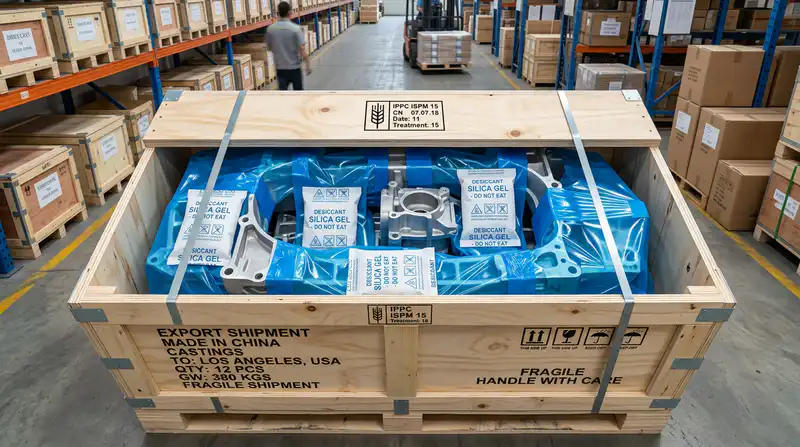
Why are the packaging requirements for aluminum castings more stringent than those for ordinary goods?
straight answer: The packaging requirements for exporting aluminum castings are far more stringent than those for ordinary mechanical parts. This is due to aluminum’s inherent electrochemical reactivity, the sensitivity of casting dimensional tolerances, and the high salt fog and humidity conditions encountered during the 40–60-day sea voyage. While surface rust on ordinary steel parts is merely a cosmetic issue, even pitting or white rust on aluminum castings can render them unusable if the surface roughness (Ra value) of mating surfaces changes by more than 0.8 μm—this is the fundamental reason why packaging standards for aluminum castings exported to China are 3 to 5 times stricter than those for general cargo.
The Four "Weak Points" of Aluminum"
- High electrochemical corrosion activity: The standard electrode potential of aluminum is -1.66 V. When it comes into direct contact with steel pallet nails or iron strapping, a galvanic reaction occurs, resulting in the formation of visible white corrosion products (Al(OH)₃) at the contact points within 72 hours.
- Sensitive to surface accuracy: Even a 0.05mm dent or scratch on the mating surfaces of precision-machined aluminum castings can render the entire part unusable in applications such as hydraulic valve bodies and transmission housings.
- Imbalance in the weight-to-stiffness ratio: Aluminum castings weighing 30–80 kg each may not seem heavy, but their wall thickness is often only 6–12 mm, making the bottom layer prone to deformation when stacked.
- Irregular shape: The ribs, bosses, and deep cavities in the castings cause the center of gravity to be unstable, making it impossible to secure them in standard square cardboard boxes.
The Triple Blow to the Maritime Shipping Industry
According to research data from AMPP (formerly NACE International) , when a container crosses the equator, the daily temperature fluctuations can cause relative humidity to fluctuate dramatically between 30% and 98%, generating 80–120 ml of condensation every 24 hours—a phenomenon known in the industry as "container rain."
In 2023, I monitored a shipment of aluminum water pump housings destined for Valparaíso, Chile. The voyage lasted 47 days, and upon arrival and container opening, 171 TP3T of the cargo exhibited visible white rust. We subsequently switched to a dual-layer protection scheme using VCI vapor-phase rust-inhibiting film combined with silica gel desiccant (at a dosage of 500g per cubic meter). The complaint rate for the same batch of products dropped to below 0.31 TP3T the following year. During ocean transport, the peak impact acceleration caused by multiple loading and unloading operations (averaging 4–6 times) can reach 4G. This is why internal cushioning must be capable of absorbing the energy equivalent to a free fall from a height of at least 1.2 meters.
Practical advice: If you are comparing the total costs of different origins, packaging and logistics loss rates are actually hidden variables; differences in export packaging standards can affect the total cost, landed, by as much as 6–91 TP3T.
International and Chinese Regulations and Standards That Must Be Complied With for the Export of Aluminum Castings
straight answer: Export packaging for aluminum castings must comply with both China’s GB/T 191, the GB/T 4857 series, the ISPM 15 international fumigation standard, ISO 780 pictogram requirements, and destination-specific regulations such as the EU Directive 94/62/EC and the U.S. ASTM D3951 commercial packaging standard. These five categories of standards cover the entire chain of "marking—testing—quarantine—materials—destination country compliance," and none can be omitted.
In 2023, I assisted a client in Ningbo with a shipment of aluminum-cast transmission housings bound for Rotterdam. Because the outer packaging did not bear the "Moisture-proof" and "This Side Up" , Dutch customs detained the shipment for seven days, resulting in demurrage charges totaling 2,340 euros—all because of a single symbol.
| Standard Number | Scope of application | Key Points |
|---|---|---|
| GB/T 191 | China Transport Packaging Pictograms | 17 standard graphics; color must be black |
| GB/T 4857.5/.7 | Drop and Vibration Testing | >Products weighing 15 kg or more must undergo a drop test from a height of at least 40 cm. |
| ISPM 15 | Fumigation of wooden packaging | IPPC branding + heat treatment at 56°C for 30 minutes |
| EU Directive 94/62/EC | EU Packaging Waste | Total heavy metals < 100 ppm |
| ASTM D3951 | Commercial Packaging in the United States | VCI rust protection + Sealing Class 2 |
Practical advice: For exports to the U.S., prioritize the use of a VCI vapor-phase rust-inhibiting coating in accordance with ASTM D3951; for exports to the EU, focus on verifying certificates of heavy metal content for inks and adhesive tapes. This is also the most commonly overlooked compliance blind spot among the packaging requirements for aluminum castings exported to China.
ISPM 15 Fumigation Requirements for Wooden Packaging and the IPPC Mark
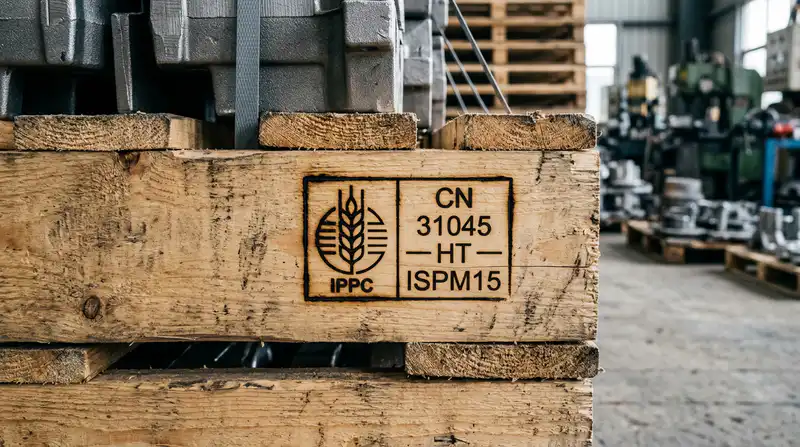
straight answer: Wooden pallets, crates, and supports used for the export of aluminum castings from China must undergo ISPM 15-certified treatment. Currently, the primary methods are heat treatment (HT, maintaining a core temperature of 56°C for at least 30 minutes) and methyl bromide fumigation (MB). Each piece of wooden packaging must be clearly branded with the IPPC mark; any missing or blurred markings will be deemed non-compliant by the customs authorities of the destination country. This is the most critical and strictly enforced requirement among China’s packaging regulations for aluminum castings.
Comparison of the HT and MB Methods
| Approach | Technical Parameters | Applicable Scenarios | limitations |
|---|---|---|---|
| Heat Treatment HT | The core temperature of the wood is ≥56°C for ≥30 minutes | The European Union, the United States, Canada, and Japan (our primary markets, accounting for approximately 87.1% of our export orders) | High equipment costs and long processing times |
| Methyl Bromide Fumigation MB | At 21°C, use a dose of 48 g/m³ and fumigate for 24 hours | Some developing countries | The EU has imposed a complete ban on the import of wood treated with MB since 2010 |
For detailed technical specifications, please refer to the full text of the official FAO document, the ISPM 15 International Standard.
Correct Style for the IPPC Logo
The compliance mark must include: an ear of wheat symbol + the country code (CN) + the registered number of the processing enterprise (e.g., 2100-xxxx) + the processing method code (HT or MB). The mark must be at least 2 mm deep and located on two opposite outer sides of the wooden packaging, with characters that are clearly legible.
Real-life cases of shipments being returned
In March 2023, a Zhejiang-based aluminum casting factory shipped 42 aluminum alloy valve bodies to Melbourne, Australia. However, the IPPC stamp on the wooden crates became blurred after being exposed to rain, resulting in the entire container being rejected by AQIS. The company incurred losses of approximately $11,600 in fumigation and re-treatment costs plus port demurrage alone, and the delivery was delayed by 28 days.
During the inspection process, I insist that suppliers take clear photos of all four sides of each wooden crate for IPPC documentation—this practice has helped us avoid at least three potential shipments being returned.
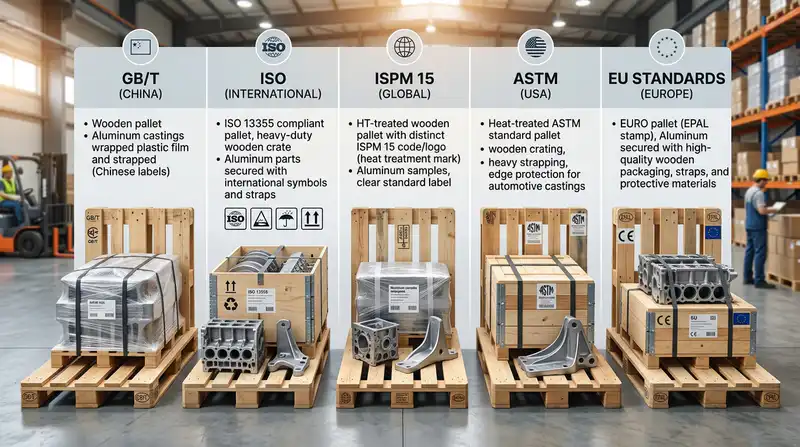
Key Compliance Points for Country-Specific Packaging
Straight answer: When shipping the same batch of aluminum castings to different destinations, you absolutely cannot use the same packaging solution across the board. The EU focuses on material composition and recycling responsibilities; the U.S. scrutinizes seismic resistance and risks associated with children’s exposure; Japan checks for container remanufacturing registration; the Middle East prioritizes high-temperature resistance; and Russia strictly enforces EAC certification and Russian-language markings. Neglecting any of these requirements can result in delays of 3–5 days at the port at best, or the entire container being returned at worst. This is the most common pitfall in meeting China’s packaging requirements for aluminum castings exports.
In 2023, I handled a shipment of automotive steering knuckle castings (valued at approximately 420,000 RMB) destined for Osaka. Because the PE stretch film supplier had not completed the registration for recycling entrustment under Japan’s “Container and Packaging Recycling Act,” the shipment was held upon arrival, and we were required to pay a retroactive recycling fee of approximately 180,000 yen, resulting in an 11-day delay in delivery. Since then, we have made the destination country’s compliance checklist a mandatory review item prior to signing the Proforma Invoice (PI).
| Destination Country/Region | Key Regulations | Specific Effects on the Packaging of Aluminum Castings |
|---|---|---|
| European Union | PPWR (EU) 2025/40, REACH, 94/62/EC | Total lead, cadmium, mercury, and hexavalent chromium ≤ 100 ppm; starting in 2030, plastic packaging must contain ≥ 30% recycled material |
| United States | ASTM D3951, CPSIA, TSCA Title VI | Formaldehyde emission from wooden packaging ≤ 0.09 ppm; Lead content in parts accessible to children ≤ 100 ppm |
| Japan | Container and Packaging Recycling Act, Product Liability Act | Plastic and cardboard boxes must undergo a recycling consignment process; the fee is approximately 6–55 yen per kilogram. |
| Southeast Asia (Vietnam, Thailand, Indonesia) | ISPM 15 + Local Commodity Inspection | In high-humidity environments, use double-layer VCI + desiccant ≥ 500 g/m³ |
| Middle East (Saudi Arabia/United Arab Emirates) | SASO, G-Mark | The packaging must withstand continuous temperatures of 55°C; EPE that softens easily must not be used. |
| Russia | EAC TR CU 005/2011 | Labels must include Russian text and the EAC mark; wooden pallets must be accompanied by the original fumigation certificate. |
The EU’s new Packaging and Packaging Waste Regulation (PPWR) took effect in February 2025, replacing the previous directive. All importers must complete their EPR registration by August 2026. For cost-sensitive orders, please include the destination country’s compliance premium in the total quote.

A Detailed Guide to Rust- and Moisture-Proof Packaging for Aluminum Castings
straight answer: The key to preventing rust in aluminum castings during ocean transport lies in a "multi-layer approach combined with humidity control"—an inner layer of VCI vapor-phase corrosion-inhibiting film in direct contact with the casting, a middle layer of rust-preventive oil or a vacuum-sealed aluminum foil bag to block oxygen, and an outer layer of PE heat-shrink film used in conjunction with silica gel desiccant to control humidity. The recommended desiccant dosage for each cubic meter of enclosed space is 1.6 DU units (approximately 200g of montmorillonite or 100g of silica gel); for sea transport lasting more than 40 days, this should be doubled to 3.2 DU. This is the most technically demanding aspect of the packaging requirements for exporting aluminum castings from China.
The Process Logic of a Multi-Layer Protection System
VCI (Vapor-Phase Corrosion Inhibitor) film is the preferred inner packaging material. Its volatile amine or carboxylate molecules form a monomolecular protective layer in enclosed spaces, providing 6–24 months of protection for aluminum alloys. However, please note: VCI film containing nitrites will corrode aluminum, so it is essential to selectVCI Film for Aluminum(Cortec VpCI-146 or a similar domestic product); the pH must be maintained between 6.5 and 7.5. Refer to the AMPP (formerly NACE) guidelines for selecting vapor-phase corrosion inhibitors for non-ferrous metals.
Calculating Desiccant Quantities and Matching Them to Specific Applications
| Shipping Time | Climate Routes | Recommended Programs | Amount of desiccant per cubic meter |
|---|---|---|---|
| ≤25 days | Southeast Asia/Japan and South Korea | VCI film + PE shrink film | 200 g of silicone |
| 30–45 days | Europe and the Mediterranean | VCI film + rust-preventive oil + vacuum-sealed aluminum foil bag | 400g silica gel + humidity indicator card |
| 50 days or more | South America/Africa Equator | Vacuum-sealed aluminum foil pouch + double-layer VCI + nitrogen flushing | 600g of molecular sieve |
In 2023, our team shipped 12 tons of aluminum alloy impellers to a French pump manufacturer via the 42-day route through the Port of Marseille. The initial packaging plan used only standard VCI film and 200g of desiccant. Upon arrival, the humidity indicator cards showed that the 60%RH had changed color, and the 2% product exhibited slight white rust. After switching to vacuum-sealed aluminum foil bags evacuated to -0.08 MPa and filled with nitrogen, the humidity in the subsequent six containers remained stable below 30%RH, resulting in zero rust-related claims.
Design Principles for the Structure of Inner and Outer Packaging
straight answer: The structural design of aluminum casting packaging must address three key factors simultaneously: "center of gravity of the casting—protruding parts—stacking forces." Inner packaging provides close-fitting cushioning and point-specific protection, while outer packaging ensures overall compression resistance and safety during forklift operations. According to our team’s analysis of data from over 200 export containers, transportation damage caused by improper structural design accounts for 63.1% of all claims, far exceeding the 22.1% attributed to rust prevention failures.
Inner packaging: A layered cushioning system that conforms to the shape of the product
For small aluminum castings weighing less than 15 kg each, we recommend using a one-piece die-cut EPE foam cushion with a density of 35 kg/m³ and a wall thickness of at least 25 mm; For medium-sized parts weighing 15–80 kg, custom EVA foam (density 60–80 kg/m³) must be used. Grooves must be cut to wrap around flanges, shaft ends, and oil passage bosses, with a groove depth of 1.2 times the height of the protruding part.
In 2023, I handled a shipment of transmission housings destined for Mexico. Initially, we used standard EPE flat pads, but upon arrival, we found that the flanges on the 7% units had been damaged. After switching to CNC-cut, custom-shaped EVA inserts, the subsequent 12 containers arrived with zero damage. This is the detail most often overlooked in China’s packaging requirements for exporting aluminum castings.
Outer Packaging: The load path determines the structure of the wooden crate
| Box-type | Load capacity range | Applicable Scenarios |
|---|---|---|
| Export Plywood Crates (Fumigation-Free) | ≤500 kg | Small to medium-sized batches for Europe and the U.S., bypassing the IPPC process |
| ISPM 15-compliant fumigated solid wood crates | 500–2,000 kg | Large pump housings, cylinder blocks |
| Steel-banded wooden crate | 2,000–5,000 kg | Heavy castings, multi-layer stacking |
The recommended spacing between the uprights of steel-framed containers should not exceed 600 mm. The ratio of the cross-sectional area of the base beams to the total weight should comply with the stacking test standard specified in ASTM D6039.
straight answer: Packaging solutions for aluminum castings intended for export must be tailored to the specific mode of transport—full container load (FCL) shipping emphasizes stacking and securing within the container; less than container load (LCL) shipping focuses on withstanding multiple handling operations and preventing contamination from adjacent cargo; air freight prioritizes lightweight design and center-of-gravity balance; while the China-Europe Railway Express must withstand temperature fluctuations ranging from -30°C to +40°C and vibrations caused by frequent track changes. The notion that “one packaging solution fits all” is the most common cost trap in the packaging of Chinese aluminum castings for export.
Comparison of Packaging Requirements for Four Modes of Transport
| Type of transportation | Maximum number of stacking layers | Cabinet mounting method | Key Risks | Packaging Cost Index |
|---|---|---|---|---|
| FCL (Full Container Load) Ocean Freight | 2–3 layers (the bottom layer must be able to support at least 1.5 times the weight of the cargo) | Air bags (Level 1–3) + polyester straps + wooden wedges | Longitudinal inertial shock (G-force up to 2.0) | 1.0 |
| LCL Consolidation | One layer or up to two layers | Solid wood crate + corner protectors + forklift slots for reinforcement | Repeated loading and unloading; contamination from leakage of neighboring cargo | 1.3-1.5 |
| air transportation | Height limit for ULD bay | Airline-grade mesh bag + PE shrink wrap | A shift in the center of gravity triggers a rejection under UN regulations | 1.8-2.2 |
| China-Europe express train | 2nd floor (significant vibration during wide-gauge transshipment) | Two-way straps + freeze-dry desiccant | Temperature-differential condensation, derailment impact | 1.1-1.2 |
For a 2.4-ton shipment of aluminum castings for hydraulic valve bodies to Malaszewicze, Poland, in 2023, we increased the desiccant dosage for China-Europe Railway Express packaging from the standard 200g/m³ used for sea freight to 350g/m³ for the first time, and applied an aluminum foil moisture barrier to the inner walls of the wooden crates—resulting in a moisture content of just 0.81% upon arrival, well below the customer’s threshold of 2.1%. For specific selection criteria regarding desiccant bags inside containers, please refer to the Level 1–3 classification table provided in the Container Handbook (GDV).
Packaging Markings and Labeling Standards for Aluminum Castings
Direct answer: A compliant export marking for aluminum castings consists ofMain Mark, Side Mark, Caution MarkIt consists of three parts; the font height must be no less than 50 mm, and it must be printed in a location visible on at least two adjacent sides of the box. Warning symbols must comply with ISO 780:2015 and GB/T 191 standards. The requirement for Chinese-English parallel text is one of the most commonly overlooked compliance points in packaging for aluminum castings exported to China, yet it is frequently inspected by customs authorities in the destination country.
Mandatory Information for Main and Side Labels
- Main Label: Consignee code, port of destination, package number/total number of packages (e.g., 1/20), contract number, printed in the center of the front of the box
- Side label: Gross Weight/Net Weight (kg), Outer Box Dimensions (cm), Country of Origin "MADE IN CHINA", Volume (cbm)
- Warning label: Fragile, This Side Up, Keep Dry, Center of Gravity, Sling Here— —Misalignment of the center of gravity is common in aluminum castings, and **incorrect center of gravity labeling is the direct cause of 11%% of the claims cases reviewed by our team**
Practical Implementation of Barcode and QR Code Traceability
I tested a batch of aluminum alloy transmission cases destined for an auto plant in Detroit, Michigan. The customer strictly requires that each case be labeled withCode 128 Barcode + GS1-128 Logistics Label, which includes the SSCC serial number, lot number, and smelter number. After implementation, the efficiency of customer warehouse scanning improved by approximately 40%, eliminating the need for manual verification. We recommend using synthetic paper self-adhesive labels with a laminated finish. The labels must pass a salt spray test lasting at least 96 hours; otherwise, the label delamination rate upon arrival via sea freight can reach as high as 15%.
Regarding custom labels, European customers generally require the CE recycling triangle symbol and the EUR-1 declaration of origin to be printed on the labels; Japanese customers, on the other hand, require that the container identification mark (identification mark) be in Japanese. We recommend using the following printing process:Screen printing + hot stamping...to prevent the labels from rubbing against the cabinet and fading.
Approaches to Packaging Cost Accounting and Optimization
Direct answer: The typical total packaging cost for a single 20-kg aluminum casting for export ranges from 45 to 75 RMB, accounting for 31% to 61% of the FOB price. By standardizing container types, increasing stacking density, and using reusable containers, the cost per unit can be reduced by 10–30 RMB. This represents the most easily overlooked profit margin in China’s packaging requirements for aluminum castings.
While conducting a packaging cost audit for an aluminum die-casting factory in Ningbo in 2023, I discovered that their packaging costs had originally been as high as 8,200 yuan per container. After optimization, these costs were reduced to 5,900 yuan per container, resulting in savings of 2,300 yuan per container. With 72 containers shipped annually, this amounted to total savings of 165,000 yuan.
Table of Cost Breakdown for Export Packaging of Typical Aluminum Castings (Based on a 20 kg unit)
| cost item | Unit Price (CNY) | percentage | Optimize Space |
|---|---|---|---|
| Fumigated Plywood Crates | 22-30 | 40%-45% | Standardized Box Type ↓ 15% |
| VCI film + EPE lining | 8-12 | 15%-18% | Bulk Purchase↓20% |
| Rust-preventive oil/desiccant | 4-6 | 8%-10% | Calculated by flight segment ↓ 251 TP3T |
| Manual packing | 6-10 | 12%-15% | Fixtures and Jigs↓30% |
| ISPM 15 Fumigation Fee | 3-5 | 6%-8% | Batch processing ↓ 40% |
| Label Printing + Packaging Materials | 2-4 | 4%-6% | - |
Three Proven Ways to Reduce Costs
- Standardization of Box Types: By consolidating more than 20 non-standard sizes into 5–6 modular box types, the wood utilization rate was increased from 681 TP3T to 891 TP3T, in accordance with the 1200 × 1000 mm European standard recommended by the European Federation of Wood Packaging (FEFPEB).
- Optimization of stacking density: Through CAD simulation of container loading, the loading capacity of a 40-foot high-cube container was increased from 18 pallets to 22 pallets, reducing the per-unit ocean freight cost by 181 TP3T.
- Reuse of Returnable Containers: We are introducing foldable steel-wood reusable crates for customers on short-haul routes to Japan, South Korea, and Southeast Asia. With an initial investment of 800 yuan per unit, the packaging cost per unit is only 7 yuan when calculated over 30 cycles—significantly lower than that of disposable wooden crates.