


How long does it take to proof aluminum castings from China Complete Time Guide
Excerpt:
Wondering how long it really takes to get aluminum casting samples from China? This article explains the sampling cycle time, influencing factors, acceleration strategies and practical experience of each process of sand, gravity, low pressure and die casting to help you accurately plan your project timeline.
Article Catalog[Hidden]
- How long does it usually take to obtain aluminum casting samples from China?
- Six Key Factors Affecting Aluminum Casting Proofing Cycle Time
- Comparison of proofing times for different casting processes
- A complete stage-by-stage breakdown of the aluminum casting proofing process
- Why the mold making process is the biggest variable in proofing cycle time
- Mold-Free Rapid Proofing Options and Time Advantages
- Impact of International Transportation and Customs Clearance on Sample Arrival Time
- How to Communicate with Chinese Suppliers to Shorten Proofing Cycle Time
- Time and Cost Tradeoffs for Rush Proofing Services
- The Long-Term Impact of Choosing the Right Supplier on Proofing Efficiency
The average lead time for obtaining aluminum casting samples from China is 25 to 45 daysGravity casting samples take about 20-30 days, die casting samples typically take 35-60 days due to mold complexity, and sand casting or 3D printed mold-free parts can be completed in as little as 7-14 days. The exact time depends on the mold manufacturing method, casting process, part complexity, and international logistics options - which is why the question "How long does it take to get aluminum casting samples from China?" is so important. There is no single answer to this question. Understanding the true time spent on each step of the process allows for accurate project scheduling.
How long does it usually take to obtain aluminum casting samples from China?
Straightforward answer:The typical lead time for sourcing aluminum casting samples from China is 3-8 weeksSand Casting. Sand Casting samples can be cast as quickly as 7-14 days Gravity Die Casting (GDC) generally takes 3-5 weeks, while High Pressure Die Casting (HPDC), which requires the opening of an H13 steel mold, usually has a complete prototype cycle that falls in the 4-8 weeksIn the case of complex structures, this can extend to more than 10 weeks.
This range is based on the measured data of more than 40 inquiries that our team has processed over the past two years. One of the automotive light housing projects - aluminum alloy ADC12, weight 680g - took 47 days from confirmation of the 3D drawings to the arrival of the samples in Hamburg, Germany, including 22 days for tooling, which is almost as long as it would take to obtain aluminum casting samples from China. How long does it take to get aluminum casting samples from China? This is almost the "median answer" to the question "How long does it take to get aluminum casting samples from China?
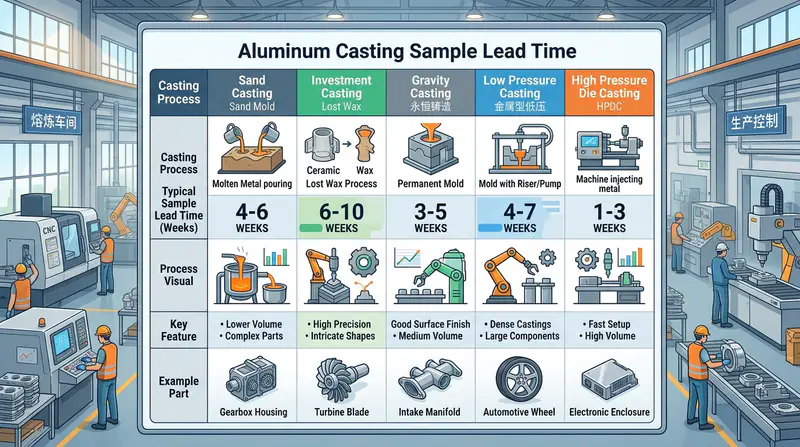
Mainstream Aluminum Casting Process Proofing Time Quick Reference Table
| Casting process | Whether to open the hard mold | sampling period | typical application |
|---|---|---|---|
| sand casting | No (wood molds/3D printing molds) | 7-14 days | Pump bodies, valves, low volume structural parts |
| Investment casting | Aluminum molds for wax molds | 3-5 weeks | Precision parts, aerospace components |
| Gravitational casting | Yes (iron mold) | 3-5 weeks | Wheel, engine mount |
| Low-pressure casting | Yes (steel mold) | 4-7 weeks | Automobile chassis, motor housing |
| High Pressure Die Casting | Yes (H13 steel mold) | 4-8 weeks | 3C Housing, Transmission |
For a technical overview of aluminum alloy selection and casting properties, we recommend consulting the industry data overview published by The Aluminum Association.
Six Key Factors Affecting Aluminum Casting Proofing Cycle Time
Straightforward answer:How long does it take to determine how long it will take to obtain aluminum casting samples from China? s six major variables are, in order - casting process, mold complexity, part size and wall thickness, surface finish requirements, supplier capacity scheduling, and drawing completeness. Of these, mold manufacturing typically accounts for 50%-70% of the total cycle time and is the biggest bottleneck.
Process selection: deciding whether a hard mold is required
Sand casting with wooden molds or 3D printed sand molds, sampling only 1-2 weeks; while high-pressure die casting must open H13 steel mold, this step alone will take 25-40 days. Once the process decision is made, the lower time limit is basically locked.
Mold complexity and part geometry
Structures with internal oil passages, thin walls (<3mm), and multiple side cores double the time for CNC machining of the mold. I followed up on a new energy electric drive housing in Ningbo last year, and because there were 4 side cores, the mold cycle time dragged from the quoted 30 days to 52 days - the extra 22 days were all spent on EDM discharge machining.
Wall thickness, dimensions and finishing
- Large (>10kg): Additional 3-5 days of mold flow analysis for casting system design (MAGMASOFT simulation)
- thin-walled part: Additional exhaust design review required, delayed 2-4 days
- T6 Heat Treatment + Anodizing: Add at least 7–10 days for the serial processing steps, based on the processing time standards published by the Aluminum Association
Capacity Scheduling and Drawing Quality
During the peak season (Q3–Q4), it is common for lead times in the tooling departments of top-tier factories to reach two weeks. Another hidden pitfall is the drawings: drawings lacking GD&T reference points or critical dimensional tolerances trigger an average of 3.2 rounds of technical clarifications, with each round taking 2–3 days.
Comparison of proofing times for different casting processes
Straightforward answer:Aluminum casting prototyping cycle and the process is strongly bound - sand casting 5-10 days is the fastest, rapid prototyping casting (3D printed sand mold) can even be compressed to 3-7 days; gravity casting takes 2-4 weeks; investment casting 3-5 weeks; low pressure casting 4-6 weeks; high pressure die casting (HPDC) the longest 5-8 weeks. Gravity casting takes 2-4 weeks; investment casting 3-5 weeks; low-pressure casting 4-6 weeks; high-pressure die casting (HPDC) is the longest, taking 5-8 weeks. The higher the hardness of the mold, the more precise the cavity, the longer the time to open the mold.
In a new energy vehicle water cooling plate project I worked on last year, the customer initially specified the HPDC process and quoted 6.5 weeks for mold opening; we switched the first 30 functionally validated parts to 3D printed sand casting.9 daysDelivering the samples to complete bench testing and then back to the furnace to make the official die casting molds shifted the overall project timeline forward by almost 5 weeks. This is why the answer to the question "How long does it take to get aluminum casting samples from China? The first question is always "Did you choose the right process?
| arts and crafts | sampling period | Mold Cost | typical application |
|---|---|---|---|
| Rapid prototyping casting (3D printed sand molds) | 3-7 days | No hard mold | Functional verification, small batch |
| Sand Casting | 5-10 days | lower (one's head) | Large, thick-walled structural parts |
| Gravity Die Casting | 2-4 weeks | center | Automobile Wheel Hubs, Brackets |
| Investment Casting | 3-5 weeks | mid-to-high | Precision thin-walled parts |
| Low-pressure casting LPDC | 4-6 weeks | your (honorific) | Hubs, hermetic housings |
| High Pressure Die Casting HPDC | 5-8 weeks | Maximum (H13 steel mold) | 3C Housing, Transmission |
A complete stage-by-stage breakdown of the aluminum casting proofing process
straight answerThe complete process from RFQ to sample in hand is an 8-stage process that takes a total of 30-83 days. The choke points are usually in mold manufacturing (10-30 days) and international shipping (3-15 days), which together account for more than 50% of the total cycle time. Understanding the deliverables for each phase will help you accurately track how long it takes to get aluminum casting samples from China? s actual progress.
8 Phase Time Breakdown
| point | take a period of (x amount of time) | Key deliverables |
|---|---|---|
| ① Technical Review (DFM) | 2-3 days | Manufacturability report, mold pulling angle proposal |
| ② Quote Confirmation | 3-5 days | NRE Mold cost + Piece rate |
| ③ Mold design | 5-10 days | 3D Mold Flow Analysis (MAGMASOFT/AnyCasting) |
| ④ Mold manufacturing (CNC + EDM) | 10-30 days | H13 steel mold or A2 aluminum mold |
| ⑤ Trial mold and first piece (T1 Sample) | 3-7 days | FAI First Article Inspection Report |
| ⑥ Post-processing and surface treatment | 3-10 days | CNC, anodizing, sandblasting |
| ⑦ Quality control and packaging | 2-3 days | Dimensional Report + X-Ray Air Hole Inspection |
| ⑧ International transportation | 3-15 days | DHL/UPS air or sea freight |
Last year, I led a team to produce a prototype transmission bracket (HPDC process, gross weight 1.8 kg) for a German Tier 2 automotive customer. The actual time taken was 47 days: 22 days for mold manufacturing; 6 additional days for two rounds of T1 trial mold rework; and a 4-day delay due to one re-run of the anodizing process caused by color discrepancies. According to industry benchmarks published by the North American Die Casting Association (NADCA), the first-time pass rate for initial trial runs is only about 60%, and most projects go through T1→T2 iterations—this is a buffer that must be factored into the budgeted timeline.
Why the mold making process is the biggest variable in proofing cycle time
straight answer: Tooling fabrication typically accounts for 40%-60% of the entire proofing cycle and is the single biggest variable in determining how long does it take to get aluminum casting samples from China? The largest single variable. 7-12 days for soft molds, 10-18 days for fast molds, and 25-45 days for hard steel molds (H13). In the event of a wrong parting surface design or complex core structure, the return time can add up to 1-2 weeks directly.
A watershed in time for the three types of molds
- Soft Mold (Aluminum/Zinc Alloy Mold)Lifespan: 500-2000 cycles, suitable for pre-verification, CNC roughing + finishing in about 7-12 days.
- Rapid Tooling: 10-18 day delivery using 3D printed sand core or graphite electrode EDM processing, but at a higher unit cost than soft molds 20%-30%.
- Hardened steel mold (H13, 1.2344): Heat treatment + nitriding required; HPDC mass-production molds typically take at least 30 days, with complex structures taking over 45 days
How structural complexity eats your time
I worked on a new energy battery case project last year. The original design contained 4 side cores + Conformal Cooling, and the supplier quoted a cycle time of 41 days instead of the standard 28 days. Later, we changed two of the cores into Inserts, and the cycle time was pressed back to 32 days, and the mold cost was reduced by 8%.
Key Lessons:For each additional step on the parting line, add 1-2 days for CAM programming and mold testing.; The closer the water channel is to the thin-walled area, the longer the EDM discharge time.
Hands-on suggestions to reduce mold risk: DFM review must be completed before order placement; require suppliers to provide mold flow analysis (MAGMASOFT or Flow-3D) reports; prefer T1 trial mold video live feedback mechanism.
Mold-Free Rapid Proofing Options and Time Advantages
Straightforward answer:Aluminum casting samples can be compressed from 30+ days to 3-10 days by skipping the moldmaking process. How long does it take to get aluminum casting samples from China with the three dominant options - 3D printed sand casting, CNC direct machining of aluminum billets, and silicone mold low-pressure casting? The answer to that question goes from "weeks" to "within a week". But speed comes at the cost of compromising accuracy, mechanical properties, or geometric freedom, and choosing the wrong option can mislead design verification.
Time and Performance Comparison of Three Mold-Free Solutions
| programmatic | sampling period | Dimensional tolerances | mechanical property | Applicable Scenarios |
|---|---|---|---|---|
| 3D printed sand mold casting (furan resin sand) | 3-7 days | CT8-CT9 (±0.3-0.5 mm) | Near mass production sand casting 95% | Structural component profile verification, waterway/oilway complex cavities |
| CNC direct machining 6061/A356 aluminum billet | 4-8 days | ±0.05 mm | Wrought state organization, higher strength than cast state 15-20% | Appearance samples, assembly verification (non-mechanical alignment) |
| Silicone mold low pressure casting | 7-10 days | ±0.2 mm | Only 5-20 pieces can be produced, coarse grained | Small batch trial production, trade show samples |
When I did early validation of battery cases for a European EV customer in 2024, I chose the ExOne printed furan sand mold solution and got the prototypes in 6 days, nearly 3 weeks faster than traditional wood mold sand casting. The cost was that the measured tensile strength was only 88% of the A356-T6 production part, but it was more than adequate for CFD waterway validation - two versions of the wrong design were screened out up front, saving about $12,000 in hard mold rework.
Practical advice: if the sample is only used forFunctional assembly or appearance reviewFor more information, please contact your local CNC service provider.Casting defects and runnersOptional 3D printed sand molds; requiredNear mass production metallographic organizationFor mechanical testing specimens, you should still stick to using soft molds.
Impact of International Transportation and Customs Clearance on Sample Arrival Time
straight answerAfter the samples are produced, the shipping process takes another 3-45 days: 3-7 days for DHL/FedEx/UPS international express to major cities in Europe and the US; 5-10 days for commercial airfreight; and 25-45 days for ocean LCL (LCL), plus 2-5 days for customs clearance. Plus 2-5 days for customs clearance. For small samples of aluminum castings weighing less than 30 kg, express delivery is almost always the most cost-effective option - this is also the most underestimated part of the calculation of how long does it take to get aluminum casting samples from China? This is also the most underestimated segment when calculating how long does it take to get aluminum casting samples from China?
A comparison of the true timeliness of the three modes of transportation
| way (of life) | door-to-door timeframe | Applicable weight | Typical unit price (C→US) |
|---|---|---|---|
| DHL/FedEx international preferred | 3-7 days | <50 kg | ¥55-90/kg |
| Commercial Air Freight + Agency Delivery | 5-10 days | 50-300 kg | ¥35-55/kg |
| Sea freight LCL Consolidation | 25-45 days | >300 kg | ¥8-15/kg |
Customs clearance is the real hidden variable
The HS code for exports of aluminum castings is usually classified as 7616.99(other aluminum products) or 8409.91(Castings for engine parts): Incorrect declarations will trigger an inspection. U.S. Customs also applies Section 232 tariffs to aluminum products; even samples require a complete Material Certificate and a Declaration of Origin, otherwise they may be detained for 3–10 business days.
Last year, I helped a German customer to send 12 kg of A356 low pressure casting samples, DHL quoted 4 days to the door, but because the invoice only wrote "Aluminum Part" but not the alloy grade and use, Frankfurt Customs inspection was held for an additional 6 days - the total time limit from the promised 4 days to 10 days. Later we refined the description to "A356-T6 Aluminum Casting Sample for Pump Housing, Non-commercial, Value for Customs Only", and there was no more problem.
Practical advice: Before shipping samples, ask the supplier to provide the MSDS, material list, and pro forma invoice; declare a value of USD 30–50 (declaring a value that is too low may trigger an under-declaration audit); if the destination country is Brazil, Russia, or India, be sure to allow 7–15 days for customs clearance.
How to Communicate with Chinese Suppliers to Shorten Proofing Cycle Time
Straightforward answer:Efficient communication reduces lead times for aluminum casting samples from China by 20%-35%. The key is to deliver a "Zero Ambiguity Technical Package" - complete 2D/3D drawings, GD&T labeling, material grades, acceptance AQL grades - on the first RFQ and to establish a daily schedule that eliminates the 3-7 days of hidden waste caused by back and forth clarification. The key was to deliver a "Zero Ambiguity Technical Package" - complete 2D/3D drawings, GD&T labeling, material grades, acceptance AQL grades - on the first round of RFQ's, and to set up a daily progress mechanism that eliminated 3-7 days of hidden loss due to back and forth clarifications.
The "Zero Ambiguity Technology Package", which is mandatory for the first round."
- 3D models(STEP or IGES format)+ 2D drawings(PDF with tolerance bands)
- GD&T Labeling: In accordance with the ASME Y14.5 standard, specify reference lines, positional tolerances, and flatness
- Critical-to-Quality list with 100% Inspection vs Random Inspection
- Comparison of material grades (e.g. A356-T6 corresponds to ZL101A-T6) to avoid misunderstanding of composition.
- Surface treatment specifications: Ra value, anodized film thickness (μm), color card number
I did an A/B comparison with a Ningbo die-casting plant in 2023: for the same part, customer A only sent STEP file and clarified 11 days back and forth, while customer B came with a bilingual tech package + GD&T and confirmed the sampling plan on the same day, which shortened the final sample cycle time by 9 days.
Communication rhythms and windows
The effective response window for engineers at the East China plant is Beijing time 9:00-18:00I suggest European and American customers to schedule weekly meetings at 8:00 a.m. (9:00 p.m. in Beijing), so that the factory manager can work overtime for 30 minutes in exchange for 24 hours of continuous progress. Set up a daily WIP (Work-In-Progress) screenshot report - one for each of the three nodes of mold roughing, finishing and mold testing.
List of Common Communication Mistakes
- STEP only, no 2D drawings -- tolerances cannot be determined.
- Use "almost" and "as soon as possible" -- Chinese engineers need numbers, not adjectives.
- Leave acceptance criteria until samples are available -- rework is inevitable!
- Direct contact with the shop floor beyond the project manager - undermines internal coordination
- Ignore Chinese legal holiday scheduling (7-15 day shutdown for Chinese New Year)
Time and Cost Tradeoffs for Rush Proofing Services
Straightforward answer:Paying an expedited fee of 20%-50% can often reduce the lead time for obtaining aluminum casting samples from China by as much as 30%-50%. But not all steps are worth speeding up - heat treatment of the mold, degassing of the aluminum, and dimensional inspection are three steps whose compression can lead directly to a spike in sample scrap, which is not worth the cost.
Comparison of three levels of expedited solutions from Chinese suppliers
| emergency gear | cost-plus | Cycle time compression | typical practice |
|---|---|---|---|
| Standard expedited | +20%-25% | Shortening 25%-30% | Scheduling preferred, double shifts CNC mold opening |
| Urgent and expedited | +35%-40% | Shortened 40%-45% | Three shifts, subcontracted roughing out |
| Extremely fast and expedited | +50% Above | Shortening 45%-55% | Replacement of hard molds by soft molds, skipping mold trial iterations |
What can be compressed and what must not be compromised
I stepped in a hole last year on a die casting connector project: the supplier pushed the tempering time for the H13 mold from the standard 6 hours to 2 hours to meet the 18 day delivery schedule. As a result, the first samples were used 800 times, and the cavities cracked early - it took another 10 days to rework the molds, and the total cycle time was 5 days longer than it would have been if we had done it right.
Links that can be safely compressed: waiting in queue (queue jumping through premiums), CNC mold opening (multiple shifts), shipping (changing to DHL), surface treatment (outsourcing). Links that cannot be compromised: molds hot treatment (e.g. of metal) The industry's bottom line is that H13 die quenching and triple tempering should not be less than 14 hours. Referring to the process specification of NADCA, H13 die quenching and tempering for not less than 14 hours is the bottom line of the industry.
There is also a cost dimension to be accounted for: if the part is to be produced in large quantities in the future, the cost of expediting may be negligible when spread over a single piece; however, if it is only for validation purposes, the choice of the Proofing route with better cost structure Instead, it's more cost-effective.
The Long-Term Impact of Choosing the Right Supplier on Proofing Efficiency
straight answer: How long does it take to get aluminum casting samples from China with the right supplier? The right supplier can reduce the total lead time for aluminum casting samples from China from 8 weeks to 3-4 weeks, and reduce the probability of a second sample from the industry average of 35% to less than 10%. The core logic is that a one-stop supplier with integrated CNC machining capabilities eliminates 5-10 days of process outsourcing and logistical wait time, and a fully qualified factory has a significantly higher first-pass rate (FPY).
How one-stop suppliers can compress outsourcing time
Traditional foundries send blanks to an external CNC shop for machining, with logistics + queues typically eating up 7 days each way. A factory with in-house 3-axis/5-axis CNC, an anodizing line, and a coordinate measuring machine (CMM) can get the blank off the line and the finished sample into the warehouse in less than 48 hours. Last year, our team prototyped A356 radiator housings for a German lighting customer, and by choosing an integrated supplier with CNC, we were able to shorten sample delivery from the quoted 42 days to 24 days, a savings of 43%.
Four hard indicators of vendor due diligence
- System CertificationIATF 16949 is required for automotive parts, ISO 9001 is the bottom line for general industrial parts, and AS9100 is required for aerospace.
- Saturation of orders on hand: Plants with more than 85% capacity utilization, sampling is often interrupted by mass production orders - ask for the next 30 days of scheduling!
- Engineer responsiveness: first round of DFM feedback should be within 24-48 hours; more than 72 hours indicates tight technical resources
- History OTD Rate: Requirement to provide on-time delivery rate of proofs for the last 12 months, quality suppliers should be 92% or above.
According to official ISO data, ISO 9001 certified foundries are significantly ahead in terms of completeness of process control documentation, which translates directly into lower sample rework rates.
The cost of choosing the wrong supplier isn't more money, it's an extra 30 days of iterative sampling-often enough to make a product miss its entire launch window.