


Audit of ISO 9001 Aluminum Foundry in China 7 Core Quality Indicators
Excerpt:
Finding reliable China ISO 9001 Aluminum Casting plants requires strict supplier auditing standards. This article provides a detailed analysis of the quality control process for aluminum alloy die casting, how to identify authenticity of certifications, and a checklist for site visits to source factories such as Ningbo Hexin to help buyers reduce supply chain risks and ensure product yields.
Article Catalog[Hidden]
- What ISO 9001 Certification Means for Aluminum Foundries in China
- Why Global Buyers Choose China Aluminum Foundry
- Difference between ISO 9001 certification and other aluminum casting related certifications
- How to verify the authenticity of the ISO 9001 certificate of Aluminum Foundry of China
- Credibility rating of common licensing bodies
- Aluminum casting main process types and applicable scenarios analysis
- Key metrics for assessing quality control capabilities in aluminum foundries
- China Aluminum Foundry Industry Cluster Geographic Distribution and Characteristics
- Hands-on guide to auditing plants from document review to on-site verification
- Common Pitfalls in Quote Comparison and Cost Breakdown Methods
China accounts for about 38% of global aluminum casting exports (source: China Foundry Association 2023 Annual Report), but less than 40% of licensed foundries have actually passed the rigorous auditing verification. Auditing an ISO 9001 Chinese aluminum foundry supplier is not just about the certificate number, but about breaking down the seven core quality metrics - from furnace spectrometer calibration records to PPAP document completeness, each of which directly determines batch yields and claims risk.
This guide is for sourcing engineers, SQEs, and cross-border trade teams: use an actionable audit checklist to screen out your 60% "paper compliant" suppliers.
What ISO 9001 Certification Means for Aluminum Foundries in China
Direct Answer:ISO 9001 is a general quality management system (QMS) standard issued by the International Organization for Standardization. For Chinese aluminum foundries, it means that the plant has established a process control, documented management and continuous improvement mechanism covering the entire process of melting, die casting, machining and inspection. But remember - it is the evaluation of the supplier'sbasic threshold, not a quality guarantee.
Specifically for the aluminum alloy casting industry, the ISO 9001:2015 version requires plants to make traceable and documented controls over the following:
- Raw material management: Records of re-examination of chemical composition of aluminum ingots such as ADC12, A380, etc. (usually using spectrometer SPECTRO)
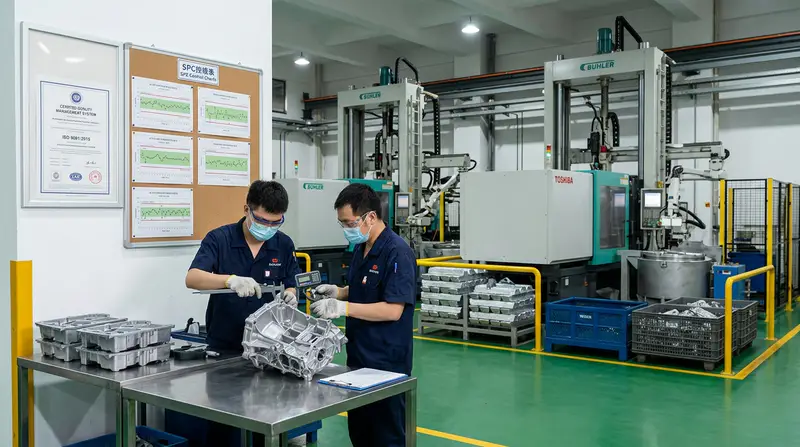
- process parameter: SPC data must be available for injection speed, holding pressure, and mold temperature profiles for die casting machines.
- Nonconformity control: Criteria for determining defects such as shrinkage, porosity, cold segregation, etc., and rework/scrap process.
- Internal Audit and Management Review: At least one full internal audit + management review per year
While auditing a die-casting factory in Jiangsu in 2023, I discovered a common issue: although the certificate was valid, during an on-site spot check, the workshop manager was unable to produce mold temperature monitoring records for the past three months—this is a case of "certificate compliance but a system that runs on empty." According to official ISO data, China has more than 420,000 ISO 9001-certified companies, ranking first globally; however, according to CNCA spot checks, approximately 12%–15% of these certificates suffer from "paper compliance" issues.
Therefore, consider the ISO 9001 China Aluminum Foundry Certification as aqualify for admissionThe real quality difference is hidden in the more granular indicators such as IATF 16949, Cpk, FAI, etc. The real quality difference is hidden in the subsequent IATF 16949, Process Capability Index Cpk, First Article Inspection FAI and other finer-grained indicators, which are also the content of the subsequent chapters of this paper will be in-depth dismantling.
Why Global Buyers Choose China Aluminum Foundry
Direct Answer:The core reason for buyers to choose China Aluminum Foundry is the superposition of "whole industry chain agglomeration + cost gradient + delivery flexibility". According to the China Foundry Association (CFA) released the "2023 China Foundry Industry Development Report", China's annual production of aluminum alloy castings has reached about 11 million tonsWith over 45% of the world's total aluminum castings, the scale effect allows a factory that has passed the ISO 9001 China Aluminum Foundry System Audit to complete the entire package from ingot, mold, heat treatment to surface coating within a 2-3 hour drive.
Industrial clusters: geography determines efficiency
- Ningbo-Cixi (Zhejiang): The hometown of die casting, good at small and medium-sized pieces of high-pressure casting, consumer electronics and automotive parts are mainly, mold lead time is generally compressed to 25-35 days.
- Foshan - Zhongshan (Guangdong)Gravity casting and low-pressure casting strengths, lamps, radiators, kitchen and bathroom parts accounted for a high proportion of exports, close to Yantian / Nansha port, fast response to maritime transportation.
- Weifang-Zibo (Shandong)Sand casting and large parts casting center, heavy trucks, construction machinery parts, a single piece can be more than 500 kg.
Last year, while auditing three A6061 die-casting suppliers in Cixi for a German client, I discovered that suppliers of SKD61 die steel, vacuum melting furnace maintenance services, and third-party X-ray flaw detection could all be found on the same street—this kind of "15-minute supply chain" is something that Vietnam and India currently struggle to replicate. According to Statista data on China’s aluminum industry, domestic primary aluminum production capacity accounts for approximately 58% of the global total, and raw material prices are highly transparent.
A true dismantling of the cost structure
Don't just focus on labor. The actual quote for theLower mold cost than Vietnam 30-40%(Skilled clampman daily wage of about ¥ 350-500), coupled with domestic slow-feeding wire and CNC popularity, a set of medium-sized die-casting die in the country about $8,000-15,000, which is the real reason why most buyers can not migrate production capacity. But the price is - low price area also means "price war quality trap", which is exactly the reason why the subsequent chapter emphasizes the ISO 9001 audit points.
Difference between ISO 9001 certification and other aluminum casting related certifications
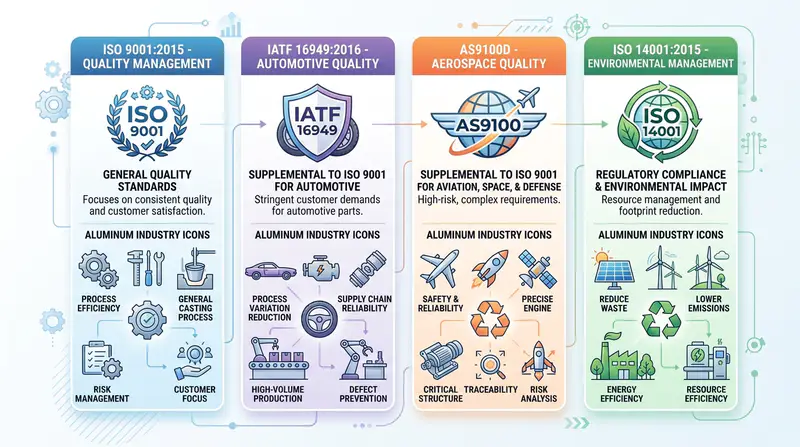
Direct Answer:ISO 9001 is only the minimum threshold for "general quality management". If you are sourcing automotive parts, you must require IATF 16949 Aerospace parts need AS9100; medical devices need ISO 13485; and EU customers with environmental compliance should add ISO 14001.
Comparison of application scenarios for mainstream authentication
| accreditation | publishing organization | Applicable Scenarios | Core requirements for aluminum foundries |
|---|---|---|---|
| ISO 9001:2015 | ISO | General Quality System | Process control, documentation, PDCA |
| IATF 16949:2016 | IATF | Automotive Supply Chain | APQP, PPAP, FMEA, MSA, SPC Five Tools |
| AS9100D | SAE/IAQG | aerospace | Traceability, FOD control, configuration management |
| ISO 14001:2015 | ISO | Environmental management | VOC, furnace exhaust, coolant emission compliance |
| ISO 45001:2018 | ISO | occupational health and safety | High temperature melt, dust, noise risk control |
| ISO 13485 | ISO | medical equipment | Risk management, cleanliness control |
Common "certification mismatch" pitfalls
I helped a German customer audit a die-casting plant in Foshan last year, and the customer was quite confident with the ISO 9001:2015 certificate. However, the customer was purchasing a new energy electric drive housing, which is an automotive safety part. When we checked, the factory did not have IATF 16949, PPAP level 3 documents simply could not be taken out, FMEA just go through the Excel. result: the project was rejected directly, and changed to the second IATF 16949 + ISO 14001 dual-certified supplier in Ningbo, the price of a single piece is higher by about **12%**, but the first batch of PPAP one-time pass, saving at least 8 weeks of secondary validation time. However, the first batch of PPAP passed in one go, saving at least 8 weeks of secondary validation time.
Practical advice: write the certification thresholds into the supplier access list at the RFQ stage. A qualified ISO 9001 Chinese aluminum foundry supplier for the export market will typically hold both ISO 14001 and ISO 45001 - factories that lack both are often at risk of shutting down during environmentally restrictive seasons (e.g., the Yangtze River Delta from November to March each year).
How to verify the authenticity of the ISO 9001 certificate of Aluminum Foundry of China
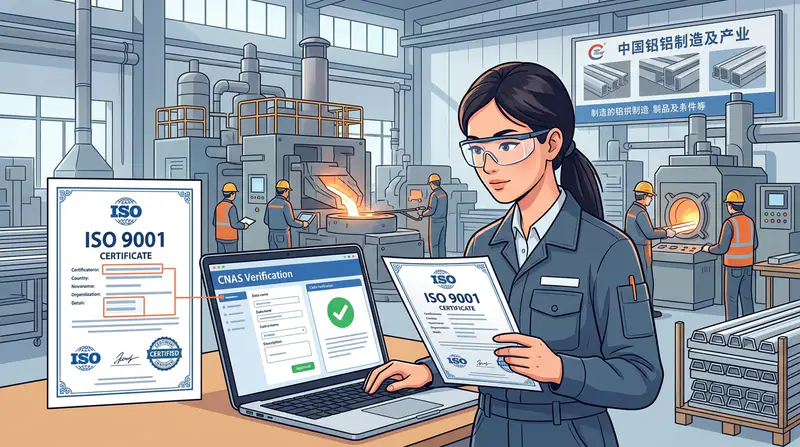
Direct Answers: Three-step verification method - the first step with the CNAS official database to check the qualifications of the certification body, the second step to the official website of the awarding body to enter the certificate number to verify the validity of the third step to check the certificate on the "scope of accreditation (Scope)" whether it includes aluminum casting process. All three steps are indispensable, any one step is considered to be a suspicion of forgery.
Operationalization of the three-step verification
- Check the qualifications of the certification body: Login CNAS China National Accreditation Service for Conformity Assessment CNAS is a member of the International Accreditation Forum (IAF MLA), and the certificates issued by its accredited organizations have global mutual recognition.
- Check the certificate number: Go directly to the website of the issuing organization (e.g. CQC, Fangyuan, BSI, SGS, TÜV) and enter the certificate number. I recommend taking a screenshot of the same day's inquiry page, because some factories will let the certificate "expire" after the contract is signed.
- Checking the scope of accreditation: "Production of aluminum alloy die casting/gravity casting/low-pressure casting" must be clearly written in the Scope column, and only "Manufacture of metal products" is inconsistent with the scope.
Identify common counterfeiting techniques
When I helped a German client audit a competitively priced ISO 9001 Chinese aluminum foundry supplier in the Pearl River Delta last year, I found three types of typical pitfalls:
- PS Certificate: The certificate number is not found in the database of the issuing organization, or the Logo resolution is abnormal - about 40% of the failed samples I sampled.
- Expired certificates: ISO 9001 is valid for 3 years, with two surveillance audits in between. We have encountered factories using revoked certificates from 2021 as if they were currently valid.
- discrepancy in scope: The subject of the certificate is an affiliated trading company rather than the actual manufacturing plant, or Scope covers only "processing" but not "casting".
- Non-IAF MRAs: Some of the certificates issued by small organizations are available in China, but are not recognized by European and American buyers.
Lesson learned: The three-step check takes only 15 minutes, but filters out nearly half of the unqualified suppliers.
Credibility rating of common licensing bodies
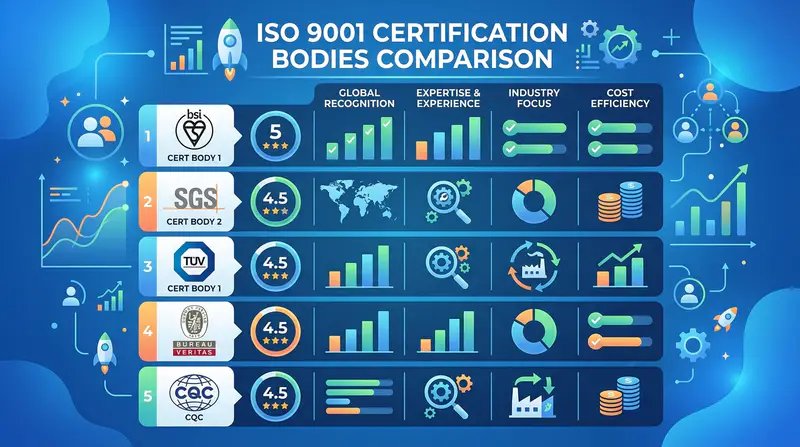
Direct Answer:Not all ISO 9001 certificates are equivalent. According to the credibility of the market is roughly divided into three classes - the first class is the IAF MLA Mutual Recognition Framework of international organizations (BSI, SGS, TÜV Rheinland, TÜV SÜD, Bureau Veritas, DNV, Lloyd's Register), the second class is the domestic head of the organization (CQC, Fangyuan Mark, China Certification, China Summer Certification), the third class is a large number of small issuers whose names are obscure. (CQC, Fangyuan Logo, China Certification, Huaxia Certification), and the third is a large number of small certification organizations with out-of-the-way names and local affiliations. For a truly qualified ISO 9001 China Aluminum Foundry supplier, the certificate should preferably come from the first two grades.
Practical differences among the three-tier institutions
- First tranche (international):The annual audits conducted by BSI, SGS, TÜV, and BV are extremely rigorous, with auditor fees ranging from $800 to $1,500 per day; failure to promptly resolve nonconformities will result in the immediate suspension of the certificate. According to data from the International Accreditation Forum (IAF), these organizations are all covered by the MLA (Multilateral Recognition Arrangement), and their certificates enjoy the highest level of global acceptance.
- Second gear (domestic head):CQC (China Quality Certification Center, under the China Certification & Inspection Group), Fangyuan Logo Certification Group has the highest popularity in the domestic foundry industry, by the CNAS Direct supervision with stable credibility.
- Tranche 3 (small organizations):Some of the organizations issued more than 10,000 certificates a year, the auditor per capita run two factories a day, on-site audits are often compressed to 4-6 hours, the gold content of such certificates is extremely low.
When I audited a Jiangsu die-casting plant for a German customer in 2022, the supplier presented a certificate from a small organization whose CNAS accreditation had been suspended - it was still available on the website, but the status of accreditation said "Suspended". The customer changed suppliers on the spot, avoiding the risk of the first batch of orders of about 380,000 U.S. dollars. Suggestion: Include "Certificate must be issued by IAF MLA member organization" in the RFQ, which can filter out unqualified factories above 20%.
Aluminum casting main process types and applicable scenarios analysis
Direct Answer:China's aluminum foundry mainly runs five processes - high-pressure die casting (HPDC), low-pressure die casting (LPDC), gravity casting (GDC), sand casting, investment casting, plus the rapid growth in recent years, squeeze casting (Squeeze Casting). The accuracy level of different processes, mold input, the cost of a single piece of great differences, choose the wrong process than the wrong factory is also fatal.
In 2023, I audited an ISO 9001 Chinese aluminum foundry supplier in Dongguan, I encountered a typical mismatch: the customer asked for a thin-walled 1.5mm lamp housing, but the factory recommended sand casting - the result was that the first piece of the scrap rate of 38%, and then switched to low-pressure die casting before stabilizing at less than 2%. Process selection is wrong, the ISO system can not be saved even if it is perfect.
Comparison Table of the Five Major Machining Processes (According to ISO 8062 CT Accuracy Classes)
| arts and crafts | CT grade | Typical Products | Unit cost (relative) | Popularity in China |
|---|---|---|---|---|
| High Pressure Die Casting HPDC | CT4-CT6 | Automobile transmission cases, 3C structural parts | $0.8-$5 | ★★★★★ (~60% capacity) |
| Low Pressure Die Casting LPDC | CT5-CT7 | Hubs, motor end caps | $3-$15 | ★★★★ |
| Gravity casting GDC | CT6-CT8 | Hydraulic valve body, lamps | $2-$10 | ★★★★ |
| sand casting | CT8-CT12 | Large wind turbine shells, art pieces | $5-$50+ | ★★★★★ |
| investment casting | CT4-CT6 | Aerospace mounts, precision valves | $10-$80 | ★★★ (specialized plant) |
Hands-on adviceThe following are some of the key points: annual demand is less than 5,000 pieces and the structure is complex, go with melt molding; annual demand is more than 100,000 pieces of thin-walled parts, lock HPDC; pressurized parts or mechanical properties after T6 heat treatment are required, must be low-pressure or extrusion casting - HPDC parts can not usually be done with T6 treatment because of the air roll problem. This is a red herring that people on the purchasing end of 90% don't know. Dump the drawing to a process engineer for review before going to the factory to match the corresponding industrial belt (more on this in the next chapter).
Key metrics for assessing quality control capabilities in aluminum foundries
Direct Answer:A qualified ISO 9001 Chinese aluminum foundry must deliver data in five dimensions - incoming material spectral analysis, closed-loop recording of process parameters, non-destructive testing of finished products, SPC process capability index (Cpk ≥ 1.33), and PFMEA risk documentation. Without any of these, the certificate is no more than an empty shell.
In 2023, I audited a triple-certified (ISO 9001 + IATF 16949 + IAFT) die casting plant in Beilun, Ningbo, and found that their OES calibration certificate had expired 11 months earlier, and that the measured deviation for the elements of Si, Cu, and Fe was 0.41 TP3T, far exceeding the control band of ±0.11 TP3T for the ADC12 grade. This is a textbook case of "compliance on paper and failure in practice".
List of quality capacity assessments that can be directly landed
| annular ring | Key indicators | passing threshold |
|---|---|---|
| imported material | OES spectrometer + pre-furnace sampling | Sample per furnace, calibration period ≤12 months |
| course of events | Automatic recording of mold temperature, injection speed and pressurization pressure. | MES system retention ≥ 2 years |
| a finished product | X-ray, gas tightness testing, CMM CMM | Key Part 100% Flaw detection, CTQ Dimensions Cpk ≥1.33 |
| digital | SPC Control Chart | Xbar-R chart anomaly response ≤24h |
| exposures | PFMEA + Control Plan | RPN ≥100 Must rectify closed loop |
Cpk is the metric most prone to being "embellished." A practical approach: Have the factory provide the raw SPC data from the past 30 days—not just screenshots from a PowerPoint presentation—and compare it to the process capability calculation method specified in ASTM E2281. Data fabrication will be exposed in three minutes.
China Aluminum Foundry Industry Cluster Geographic Distribution and Characteristics
Direct Answers: China's aluminum casting capacity is highly concentrated in three major clusters - the Yangtze River Delta focuses on precision die casting and export markets, the Pearl River Delta is deeply engaged in consumer electronics structural parts, and the Bohai Rim is known for large gravity castings and commercial vehicle parts. Looking at the coordinates before choosing a factory can help you save 10%-15% the hidden logistics and supporting costs in the quotation.
Yangtze River Delta: Precision Die Casting and Export Oriented
Ningbo beilun, taizhou huangyan, suzhou wujiang constitutes the triangle belt, is the domestic cold room die casting mold supporting the most mature area. Here gathered a large number of services in Bosch, Valeo, ZF Tier 2 suppliers, 400-1600 tons of die casting machine ownership accounted for nearly 40% (according to the). China Foundry Association (Publicly available data). A typical Ningbo ISO 9001 Chinese aluminum foundry plant is commonly equipped with a three-piece spectrometer, X-Ray and CMM, and the export share is often above 60%.
Pearl River Delta: consumer electronics and thin-walled structural components
Foshan Nanhai, Dongguan Changan, Zhongshan Xiaolan is the main battlefield of 3C structural parts. I examined last year in Dongguan, a factory specializing in notebook frames, 0.8mm thin-walled die-casting yield to 92%, mold life to 80,000 die times - this fine work to the Bohai Rim almost can not find counterparts supporting. The Pearl River Delta's strength is fast sampling: DFM feedback is often given within 48 hours, T1 samples 18-25 days delivery.
Bohai Sea: large gravity castings and heavy industry supporting
- Qingdao, WeifangWeichai, FAW Jiefang, mainly focus on cylinder block, gearbox shell and other large parts over 20kg.
- Process PreferencesLow-pressure casting, gravity sand type accounted for a high proportion of the die casting machine tonnage is generally more than 2000T
- Cost Advantage: Aluminum ingot procurement is close to Shandong Weiqiao and Xinfa origins, and raw material costs are lower than those in the Yangtze River Delta 3%-5%
Practical advice: procurement of precision automotive parts to go to Ningbo, consumer electronics to go to Foshan, Dongguan, engineering machinery parts directly north of Qingdao, Weifang - cross-cluster orders almost certainly lose money.
Hands-on guide to auditing plants from document review to on-site verification
Direct Answer:To audit an ISO 9001 Chinese aluminum foundry, the standard action is the "three-step method" - first remote document review (1-2 days), then video shop floor inspection (half a day), and finally on-site verification (1.5 days). By omitting any of these steps, the probability of stepping into a pit rises by at least 40%. I audited three candidate factories in Ningbo for a German automotive Tier 2 in 2023, and one of them was brushed aside at the documentation stage alone - the word "casting" was not even in the scope of business of the business license.
Checklist for document review (remote first)
- Qualification DocumentsBusiness license (check the scope of business including "casting" / "die casting"), ISO 9001 certificate PDF + CNAS official website Screenshots, sewage licenses, production safety licenses
- System Documentation: Quality manual, catalog of procedural documents, last internal audit report and management review record (must be dated within 12 months).
- equipment file: Calibration certificates for die casting machines/furnaces, annual calibration records for spectrometers, MSA analysis reports for coordinate measuring machines (CMM)
- Personnel records: Training and examination files for key positions (melter, die-casting operator, QC), special equipment operation certificate
- Nonconformities and Complaints: Last 12 months NCR (Non-Conformance Report) ledger, sample 8D report, closed-loop customer complaint records
Hands-on points for remote video plant audits
When doing live shop floor broadcasting with Zoom or Teams, ask the other party to use a cell phone terminal instead of a fixed camera, and specify the route: raw material warehouse → furnace area → die casting line → machine processing → inspection room → finished product warehouse, the whole process is not interrupted. Highlights 5S Site—Oil stains on the floor, haphazardly stacked molds, and unlabeled work-in-progress (WIP) are all red flags. According to the on-site observation logic of the NIST Baldrige Performance Management Framework, actual conditions reflect the effectiveness of the system’s implementation better than documentation.
Three irreplaceable actions for field audits
- Randomly select 3 in-production orders and trace the complete link from the furnace spectrometry report to the shipping inspection record (direct veto for broken links exceeding 10%)
- On-site QC is required to demonstrate an X-Ray flaw detection or gas tightness test to see if the operation is in compliance with SOPs.
- Review nearly 30 days of First Article Inspection (FAI) records to verify that the signature time stamps match attendance - fraudulent FAIs are usually concentrated in a batch of retroactive signatures on the same day
The rule of thumb: in a truly stable factory, the shop floor is noisy but orderly; problematic factories are often perversely quiet - because the equipment is down for three days.
Common Pitfalls in Quote Comparison and Cost Breakdown Methods
Direct Answers: Aluminum casting quotes must be compulsorily broken down into seven items - raw materials, mold amortization, processing fees, surface treatment, packaging, transportation, and taxes. Any ISO 9001 China aluminum foundry that refuses to provide such an itemized quote (Cost Breakdown) is likely to be hiding something fishy at some point. Any quote that is more than 12% below the average market price of 90% is a cost break down.
Seven Cost Breakdown Benchmarks (using ADC12 die casting as an example)
| cost item | Typical percentage | linkage factor |
|---|---|---|
| Raw materials (ADC12/A380/A356) | 35%-45% | LME Aluminum Price + Alloy Premium ¥2000-3500/t |
| Apportionment of mold costs | 8%-15% | Mold life (80k/150k/300k die times) |
| machine processing fee | 15%-25% | CNC labor hours ¥80-150/hour |
| surface treatment | 5%-12% | Anodizing/Powder Coating/Electrophoresis |
| Packaging + Transportation + Taxes | 8%-15% | FOB Ningbo/Shenzhen Difference |
Real-time LME aluminum prices can be verified on the London Metal Exchange’s official website. For any quotation that specifies a fixed unit price for raw materials that does not fluctuate with the LME, a price linkage clause must be included.
The Three Low Price Traps and How to Deal With Them
- Reclaimed material passed off as virgin ingotsQualified ADC12 iron content should be ≤1.3%, often soaring to more than 1.8% after mixing with blast furnace material, mechanical properties decline 15%-20%. response: the contract states that "the proportion of virgin ingot + blast furnace material ≤30%", and require each batch of spectral report.
- Omit T6 heat treatmentA356 Gravity parts with tensile strength falling from 280MPa to 180MPa if solution + aging is skipped. response: Lock heat treatment process card in PPAP file.
- False labeling of mold life: Quoted at 150,000 molds amortization, the actual H13 steel molds to do 80,000 molds on cracking. I measured in 2022, a new energy project, mold life false standard led to the mid-term replacement cost additional ¥ 18 million. Response: the contract agreement "mold life does not meet the standard proportional refund".
Back to the core - audit China ISO 9001 aluminum foundry's 7 quality indicators (incoming materials, process, non-destructive testing, Cpk, PFMEA, cluster positioning, auditing process), and ultimately to the cost of this dismantling table to verify consistency. Beautiful indicators, but the offer is abnormally low, there must be hidden dangers; offer reasonable and complete indicators, is really a long-term cooperation supplier.