


7 Core Criteria for Evaluating IATF 16949 Certified Aluminum Casting Suppliers in China
Excerpt:
Looking for Chinese aluminum die casting suppliers that meet automotive industry standards? This article provides an in-depth analysis of the practical impact of IATF 16949 certification on the quality of aluminum castings, and offers a practical checklist for factory audits. Learn how quality manufacturers such as Ningbo Huxin ensure the yield and delivery stability of cross-border sourcing projects through strict process control.
Article Catalog[Hidden]
- IATF 16949 certification of the core value of Chinese aluminum die casting manufacturers
- IATF 16949 standard for aluminum die casting industry specific requirements
- Control points for special processes in aluminum die casting
- Typical Capability Portrait of IATF 16949 Certified Aluminum Die Casting Manufacturers in China
- How to verify the authenticity and validity of a supplier's IATF 16949 certificate
- Key Evaluation Dimensions for Selecting Aluminum Die Casting Suppliers in China
- Shop floor details to focus on during on-site audits
- IATF 16949 Certified Aluminum Die Casting Cost Structure and Quotation Logic
About 62% of the world's IATF 16949-certified companies are located in China (source: IATF Official 2023 Bulletin), but fewer than 8% of them specialize in aluminum die casting, which means that screening for qualified IATF 16949-certified aluminum casting suppliers in China is far more complicated than just looking at a copy of a certificate! --What you need is a factory that can pass PPAP Level 3, control special processes, and deliver consistently to Tier 1 customers. Based on 40+ field audits, this article breaks down the 7 core assessment dimensions that truly determine whether a supplier can fulfill automotive orders.
IATF 16949 certification of the core value of Chinese aluminum die casting manufacturers
IATF 16949 is the "ticket to entry" for the global automotive supply chain.It is an automotive industry-specific quality management system standard developed by IATF Global Oversight based on ISO 9001, replacing the old ISO/TS 16949. For IATF 16949-certified aluminum castings suppliers in China, this means that they must meet the mandatory requirements of Tier 1 automotive OEMs on the five core tools of APQP (Advanced Product Quality Planning), PPAP (Production Part Approval Procedure), MSA (Measurement System Analysis) and FMEA (Failure Mode Analysis). For IATF 16949 certified aluminum castings suppliers in China, it means that they must meet the mandatory requirements of Tier 1 automotive OEMs in the five core tools of APQP (Advanced Product Quality Planning), PPAP (Production Part Approval Process), MSA (Measurement System Analysis), SPC (Statistical Process Control) and FMEA (Failure Mode Analysis).
When I audited six aluminum die casting plants in East China for a European Tier 1 gearbox customer in 2023, I found that plants with valid IATF 16949 certificates had an average PPM (Parts Per Million Defective) of less than 350, while ISO 9001-only plants generally had a PPM of 1200 to 2500 - a difference of almost a factor of 2 to 3. -The difference is nearly 7 times.
The practical implications for purchasers are threefold:
- traceabilityEvery aluminum die casting can be traced back to the furnace number, die number, operator and SPC data for a minimum of 15 years.
- Process Stability: The key characteristic CPK ≥ 1.67 is a mandatory threshold, not a "recommended value"."
- Claims risk transfer: Sourcing through IATF 16949 certified aluminum castings Chinese manufacturers can significantly reduce the probability of 8D report disputes and OEM chargebacks.
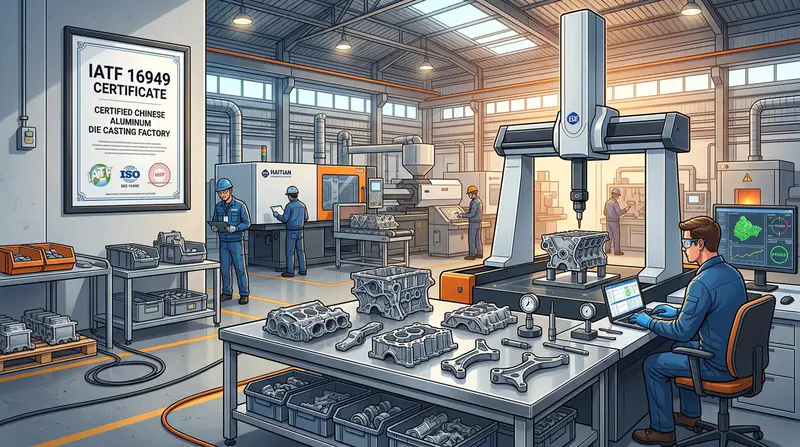
IATF 16949 standard for aluminum die casting industry specific requirements
Straightforward answer:IATF 16949 in ISO 9001 based on the addition of 100+ automotive industry-specific requirements, the core of the mandatory landing of the "five tools" - APQP, PPAP, FMEA, SPC, MSA. aluminum die casting, which means that from the mold DFM review to the mass production of SPC monitoring, every link should have data traces. For a truly qualified IATF 16949 certified aluminum casting plant in China, the PPAP documentation package is typically 200-400 pages thick, covering 18 standard submission elements.
I audited an aluminum die casting plant in Ningbo in 2023, which had a full ISO 9001 certificate, but the PPAP only submitted a Level 2 sample report and lacked data from the initial process capability study with a Cpk ≥ 1.67 - the watershed between IATF 16949 and ISO 9001.
Five tools in the aluminum die casting site landing points
- APQP (Advance Product Quality Planning)Aluminum die casting projects typically take 18-24 weeks from T0 mold development to PPAP approval, and APQP requires a 5-stage Gate Review, including DFM mold flow analysis, cooling waterway simulation, and shrinkage risk prediction.
- PPAP (Production Part Approval Process)Automotive OEMs mostly require Level 3 submissions, including Dimensional Full Measurement Report (DFMR), Material Spectral Analysis (ADC12 Chemical Composition Deviation ≤±0.3%), and X-Ray Internal Porosity Rating (within ASTM E505 Level 2).
- FMEA (Failure Mode Analysis): Perform the 7-step method according to the AIAG-VDA FMEA Handbook, First Edition (2019) Typical failure modes in aluminum die casting include cold segregation, shrinkage and loosening, and flying edges stuck in the mold, and improvement measures must be developed for RPN values over 100.
- SPC (Statistical Process Control)Critical characteristics such as injection speed, mold temperature, and holding time need to be collected in real time, with Cpk ≥ 1.33 as the bottom line, and Cpk ≥ 1.67 for safety parts.
- MSA (Measurement Systems Analysis): CMM GR&R must be ≤10%, calipers, plug gauges, and other gauges calibrated every 6 months, and retained traceable to the CNAS Accredited Laboratory of the calibration certificate.
A practical reminder: many Chinese aluminum die casting factories treat the FMEA as a "homework" document, and make up for it temporarily during the audit. A real factory will update the DFMEA/PFMEA within 48 hours after each process change or customer complaint - this is a key detail to recognize the authenticity of the certification.
Control points for special processes in aluminum die casting
straight answerAluminum die casting is clearly classified as a "Special Process" in IATF 16949, meaning that the quality of its output cannot be fully verified by subsequent inspection, and must be monitored and documented in 100% real-time on process parameters. The five key control points are melt temperature, injection speed, mold temperature, release agent spray, and vacuum - any drift in any of these can lead to porosity, cold segregation, or dimensional irregularities.
When I audited a Chinese supplier of IATF 16949 certified aluminum castings in South China in 2023, I witnessed their ADC12 gearbox housing batch porosity spike to 4.7% (industry acceptable upper limit is usually 1.5%) due to a drift of the press-shot diametral speed from 3.2 m/s to 3.8 m/s without triggering an alarm. After rectifying the situation they improved the CPK from 1.12 to 1.67 and the scrap rate dropped back to 0.81 TP3T.
- melting temperature: ADC12/A380 Aluminum Liquid Controlled at 660-690°C, Spectral Composition Analysis Every 2 Hours
- mold temperature: Temperature difference between moving/setting mold ≤30°C, closed-loop control by mold temperature controller instead of relying on experience.
- vacuum: ≤ 50 mbar for high vacuum die casting, ≤ 30 mbar recommended for structural applications.
- release agent: Dilution ratio strictly 1:80-1:150, spraying robot path incorporated in PFMEA
Parameters are subject to trend monitoring by means of control charts as specified in the AIAG SPC manual, rather than simple upper and lower limit determination.

Typical Capability Portrait of IATF 16949 Certified Aluminum Die Casting Manufacturers in China
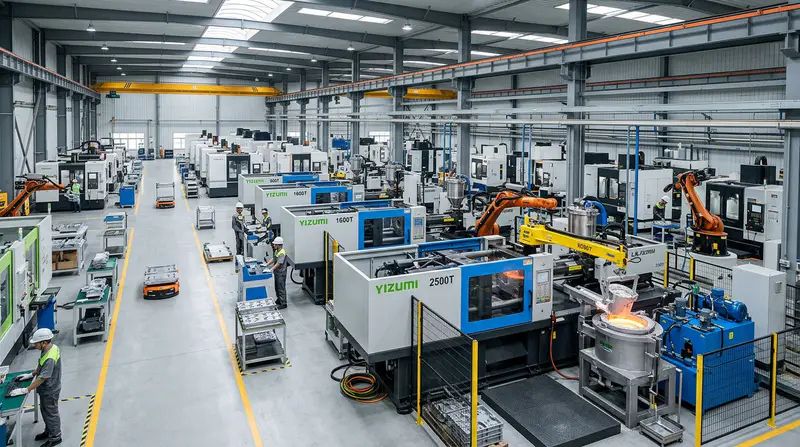
straight answerTypical IATF 16949 certified aluminum casting Chinese manufacturers are usually equipped with 10-30 sets of 160T-3000T cold chamber die casting machines, with an annual production capacity of 3,000-15,000 tons, mainly focusing on the two major brands ADC12 and A380, with supporting CNC three-axis/four-axis machining centers of more than 20 sets of Tier 2 accounted for 60-70% in the structure of the customer, Tier 1 accounted for 20-30%, direct supply OEMs about 5-10%. The customer structure is 60-70% for Tier 2, 20-30% for Tier 1, and 5-10% for direct OEM.
Equipment and Tonnage Configuration
Mainstream manufacturers of die-casting island to force strength (L.K.), UBE (UBE), Bühler (Bühler) is the main. 160T-400T covers the sensor shells, connectors; 500T-1250T is the main section, do gearbox bracket, motor end cover; 1650T-3000T corresponds to the new energy three electric shells, battery tray. An empirical signal: if there are 800T and 2500T equipment in the workshop, it means that the manufacturer has the ability of "small high-precision + large structural parts" double line.
Materials and secondary processing
- Conventional grades: ADC12 (Day Marker, corresponds to aluminum (Al-Si-Cu system), A380 (American Standard) accounted for more than 80% of shipments.
- High-end grades: AlSi10Mg, Silafont-36, Castasil-37 for heat-treatment-free integrated die castings
- surface treatmentAnodizing, shot peening, Dacromet, powder coating, most manufacturers have their own 3-5 production lines, Impregnation is usually outsourced.
Customer structure judgment
I audited last year in Ningbo, a certified 9 years manufacturers found a law: the real mature IATF 16949 aluminum die casting plant, PPAP file cabinet at least 20-30 in production project Level 3 documents, customers covered at least Bosch, Valeo, Magna one of them. If the other side can only show Tier 3 level customer list, the gold content of the certification to be discounted - the certificate in, the system may not really run. Reference to the IATF Global Oversight public certification database can be cross-verified.
How to verify the authenticity and validity of a supplier's IATF 16949 certificate
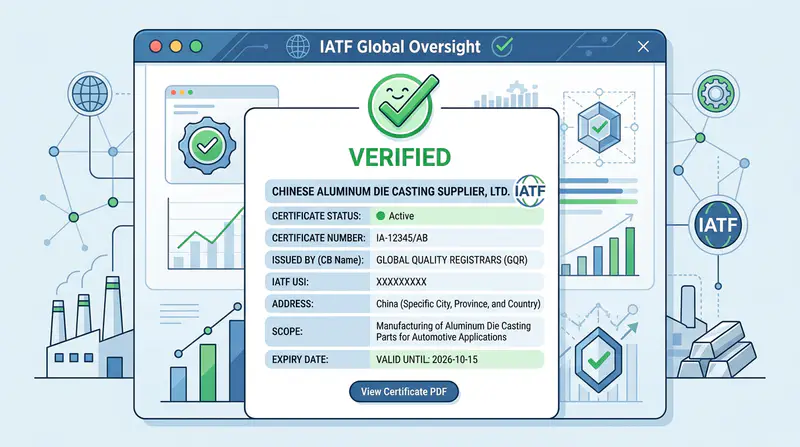
straight answerThe first step to get a scanned copy of the certificate is to check the status on the official IATF Global Oversight database. Enter the certificate number, within 3 seconds to confirm the authenticity, validity, scope of certification and qualification of the certification body - any one of them does not match, basically can be judged as a fake or has lapsed.
In practice I recommend following four steps:
- Verification of IATF certificate numberThe real certificate must have a 7-8 digit IATF number that is independent of ISO 9001 and can be found in the official database. Last year, when we screened a die-casting plant in Jiangsu Province, the "IATF certificate" provided by the other party can only be found in the ISO 9001 records - in fact, it is a dependent certification.
- Verification of Certification Body (CB) qualifications: It must be an IATF-recognized CB, such as TÜV SÜD, BSI, DNV, SGS, DEKRA. some of the small CBs in China are not in the IATF white list, and the certificates issued are not recognized by the OEMs.
- Review of the Scope clauseScope of Certification: The scope of certification must explicitly include "aluminum casting" or "high-pressure die casting of aluminum alloy components". Those who only write "manufacturing of metal parts" are just a side issue, and will be rejected by the customer's OEM when auditing the factory.
- Check suspension/revocation records: A Status field in the database that shows Suspended or Withdrawn means that the CB found a major nonconformity during the most recent Surveillance Audit.
There are three common counterfeiting techniques: PS modification of the certificate number to confuse the initial screening, using the certificate of the associated company to pretend to be the main body of the production, the certificate has expired, but still use high-definition scanned copies. A real IATF 16949 certified aluminum casting China supplier will not mind you to open the official website in person to verify - hesitation eighty percent have problems.
Key Evaluation Dimensions for Selecting Aluminum Die Casting Suppliers in China
straight answer: The certificate is just the threshold, what really opens the gap is the system operation maturity. It is recommended to score from seven dimensions: PPAP submission experience, customer complaints PPM, two-party audit pass rate, mold development capabilities, raw material traceability, IMDS reporting capabilities, SPC data integrity. Each item is weighted by 1-5 points, and the total score below 25 points is directly eliminated.
I screened 11 Chinese suppliers of IATF 16949 certified aluminum castings for a European Tier 1 in 2023, and only 2 were shortlisted - the main reason for the elimination was not the certification, but ratherPPAP Practical Skills. I asked for a sample Level 3 PPAP and 3 vendors couldn't even produce a process capability report for Cpk 1.67, and 2 confused the CMM inspection report with the first article report.
Focus on these hard indicators:
- Customer Complaint Response: Requirement for 8D report within 24 hours for a Containment Action and 72 hours for a Root Cause Analysis.
- Traceability of raw materials: ADC12 ingots are subject to a four-stage traceability chain of furnace number → melting ladle number → shot number → part serial number
- IMDS declaration: Able to independently complete the submission of substance data on the official IMDS platform, in compliance with the EU ELV Directive 2000/53/EC.
- Record of second-party audits: VDA 6.3 audit score of ≥85 in the last 2 years by BMW, Volkswagen or Bosch
Mold development capability is often overlooked. Mature manufacturers of mold T0 to T1 mold repair times on average ≤ 3 times, low-quality manufacturers often reach 7-8 times, directly affecting the SOP node 3-4 weeks.
Shop floor details to focus on during on-site audits
straight answerCertificates and documents can be packaged, but workshop details do not lie. On-site audit, focus on six "can not be hidden" traces of implementation - furnace records, the first piece of inspection area, the isolation of non-conforming products, mold numbering system, calibration labels of measuring instruments, operating instructions on duty status. I have audited the factory, any one of these items failed suppliers, mass production PPM exceeded the probability of up to 70% or more.
I'd like to share a case study with you. In early 2024, I audited a Chinese supplier of aluminum castings in Suzhou that claimed to be IATF 16949 certified. The certificate was available in the IATF Global Oversight database, but I rejected it straight away when I walked into the workshop - there was only one piece of A4 paper stuck to the wall in the non-conforming area, and the red material frames were mixed with pending inspection and scrap. The red material frame is mixed with parts to be inspected and waste parts.
- Furnace Records: Each furnace melting temperature, degassing time, the amount of refining agent injection must be handwritten or automatically collected, sampling the last 30 days record completeness rate should be ≥ 98%
- First Article Inspection (FAI) area: Individual stations, with coordinates or special inspection tools, the first release order must be affixed to the machine.
- Segregation of nonconforming productsRed material frame + physical separation barriers + "non-conforming products disposal list" three-piece set is indispensable!
- Mold Numbering System: Each set of molds hang tags to show the number, the cumulative number of times, the next maintenance type (usually 8000-10000 molds a maintenance)
- Calibration labels for measuring instruments: 5 randomly selected calipers, calibration date must be within the validity period and traceable to the CNAS laboratory
- Operating instructions (SOPs): posted above the workstation, with color charts, consistent with current production models - not a one-size-fits-all edition
One last tip: take a turn in the workshop during your lunch break. The real system is solid IATF 16949 certified aluminum die casting plant, shift handover records, 5S status in the unsupervised still neat - this is not pretend.
IATF 16949 Certified Aluminum Die Casting Cost Structure and Quotation Logic
Direct Answer: The unit price of IATF 16949 certified aluminum castings Chinese suppliers is usually 8%-15% higher than non-certified vendors, which is not a profit but a rigid cost of system operation. Understand this account in order to determine whether the offer is reasonable.
The cost of certification compliance is spread over five main calibers:
- Amortization of testing equipment: A Zeiss coordinate is about $800,000-1,200,000, a direct-reading spectrometer is $400,000-600,000, and an X-ray flaw detector is $700,000-1,500,000, which is amortized to about $0.3-0.8 per kilogram of casting based on five years of depreciation.
- System operation manpower: SQE, clerical control, internal auditor team of 5-8 people, annual labor cost of 800-1.2 million, accounting for revenue of about 0.8%-1.2%.
- Certification maintenance fee: Annual surveillance audits + 3-year recertification at a cost of $60,000 - $150,000 plus a CQI-9 heat treatment assessment of about $30,000/year.
- PPAP Sample: Level 3 Complete Submission Single Project Cost $15,000 - $30,000 with dimensional full size report, material certification, MSA analysis.
- Continuous improvement inputs: The annual improvement program budget is typically 1%-2% of revenue per IATF Clause 10.3.
When I helped a Tier 2 customer do a cost break down last year, I found that a South China certified manufacturer quoted $18.50/piece for ADC12 die casting, and the non-certified manufacturer quoted $15.80, a difference of 14.6% - break it down, of which 9% is the above compliance cost, and 5.6% is the real brand premium. This ratio is in line with industry benchmarks published by IATF Global Oversight. Certified factories with a premium below 8% should be wary of the system being empty, while those with a premium above 20% have significant bargaining space.