


The Complete Guide to Sourcing CNC Machined Aluminum Castings in China
Excerpt:
To gain an in-depth understanding of China's CNC machining aluminum castings process, quality standards, supplier selection and cost components, to help global buyers efficiently connect with Made-in-China and avoid common risks.
Article Catalog[Hidden]
- What is CNC machining aluminum casting and why choose China supplier
- Main process types of CNC machining aluminum castings in China
- Comparison of commonly used aluminum alloy grades and properties
- Complete production process from drawing to finished product
- Quality control standards and testing methods
- How to screen reliable China aluminum casting suppliers
- Frequently Asked Questions
According to Statista, China accounts for more than 58% of the world's aluminum castings, of which approximately 35% are exported to the North American and European markets. CNC machined aluminum castings from China have become the industry's default option for buyers looking for high-precision, low-cost machined parts - at an average cost per part of 40-60% less than in the U.S., with lead times generally in the 25-40 day range. This guide dismantles the entire process from process selection, alloy grades, quote structure, and supplier audits to help you avoid the hidden pitfalls that cost overseas buyers millions of dollars every year.
What is CNC machining aluminum casting and why choose China supplier
CNC machining aluminum castingsIt is a composite process part in which aluminum alloy blanks are formed by die-casting, gravity casting or low-pressure casting, and then precision machined by CNC to achieve a tolerance of ±0.02mm. China, with a global market share of approximately 20%, is the largest aluminum alloy producer in the world.Aluminum processing capacity of 57%(Statista aluminum industry data), complete Die casting The supply chain and a combined cost that is 30-50% lower than Europe and the United States make it the first choice for sourcing CNC machined aluminum castings from China.
I last year for a German customer audit three suppliers in the Pearl River Delta found: the same ADC12 motor housing, the domestic offer $8.2 / piece, the German local offer € 14.5 - delivery time is also compressed from 12 weeks to 5 weeks. This gap is not accidental, but the foundry and CNC workshop often in the same park or even the same plant results.
- capacity density: Ningbo, Dongguan, Ninghai three clusters gathered more than 2000 aluminum casting enterprises
- process closure: One-stop delivery of casting→heat treatment→CNC→surface treatment, reducing logistics loss
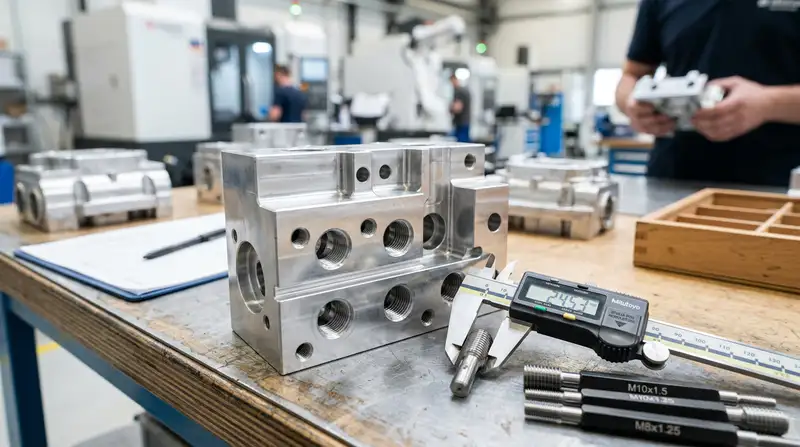
Main process types of CNC machining aluminum castings in China
Direct Answer:CNC-machined aluminum castings from China on the Chinese market are based on four casting processes - high-pressure die casting (HPDC), gravity casting, low-pressure casting (LPDC), and sand casting - each with significant differences in gross accuracy, porosity, and CNC The difference in blank accuracy, porosity and CNC machining allowances for each process is significant and directly determines the tolerance capability and cost per part of the finished part. Choosing the wrong process can expose problems such as porosity, leakage, and abnormal tool wear in later CNC machining.
I evaluated the process choices of two suppliers in Ningbo and Guangdong for a new energy vehicle electronic control housing project in 2023: the die-casting version had a lower unit cost of 42%, but the porosity resulted in an 8.7% product leaking in the helium checking process after CNC boring; after switching to low-pressure casting, the yield rebounded to 98.4%, and the overall cost was lower instead. These types of decisions are the ones that must be locked down before purchasing.
Comparison of four mainstream casting processes
| arts and crafts | Typical tolerances (rough) | Surface roughness Ra | Applicable products | CNC machining allowance |
|---|---|---|---|---|
| High Pressure Die Casting HPDC | ±0.1-0.3 mm | 1.6-3.2 μm | Housings, heat sinks, consumer electronics structural components | 0.3-0.8 mm |
| Gravitational casting | ±0.3-0.5 mm | 6.3-12.5 μm | Medium and small quantities of pump bodies, valve bodies, mechanical parts | 1.5-3 mm |
| Low Pressure Casting LPDC | ±0.2-0.4 mm | 3.2-6.3 μm | Automobile wheel hubs, electronic control housings, aerospace structural parts | 1-2 mm |
| sand casting | ±0.5-1.5 mm | 12.5-25 μm | Large structural parts, prototype parts, non-standard chassis | 3-6 mm |
Hands-on advice on process selection
- Die Casting + CNC: The top choice for annual production volumes exceeding 5,000 pieces. According to the process standards of the North American Die Casting Association (NADCA), ADC12 and A380 are the most well-established alloys used in Chinese factories. Note that die-cast parts with internal porosity are not suitable for deep-hole tapping or air-sealed surfaces; vacuum high-pressure die casting (Vacuum HPDC) must be specified.
- Low pressure casting + CNC: Optimal solution for scenarios with high air tightness requirements (e.g. new energy vehicle battery shells, hydraulic valve bodies). Porosity can usually be controlled below 0.5%.
- Gravity casting + CNC: Medium volume sweet spot of 100-5000 pieces. Mold opening cost is 60-80% lower than die casting, suitable for product iteration period.
- Sand casting + CNC: For single piece or prototype stage use, the cost of wooden molds can be as low as ¥3000-8000, with a delivery time of 7-14 days.
Lesson learned: Always ask the supplier to specify "casting process + CNC process number + key dimensions GD&T" in the quotation to avoid the later process mismatch to produce tug-of-war.
Comparison of commonly used aluminum alloy grades and properties
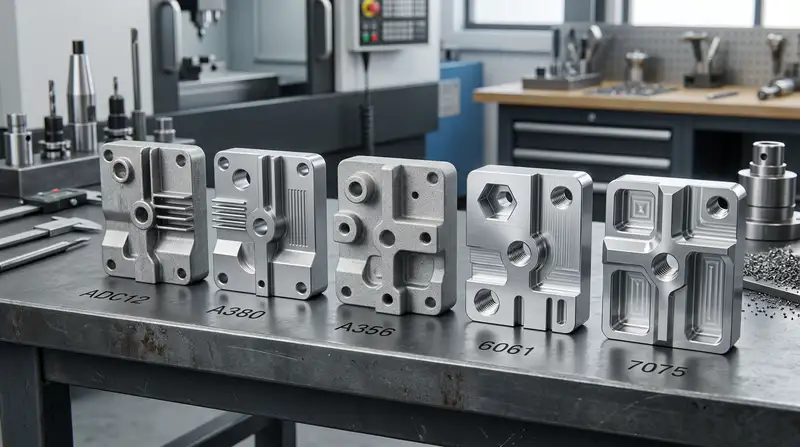
Choose the wrong material and it's all for naught later. When sourcing CNC machined aluminum castings from China, ADC12 is suitable for thin-walled die-cast housings, A356-T6 is suitable for load-bearing structural parts, and 6061-T6 is the preferred choice for CNC cut parts. The following table summarizes the key parameters of the five commonly used grades for engineering selection reference.
| grades | base | Tensile strength (MPa) | Elongation (%) | workability | typical application |
|---|---|---|---|---|---|
| ADC12 | Al-Si9.5-Cu2 | 228 | 1.5 | favorable | Motor casing, 3C housing |
| A380 | Al-Si8.5-Cu3.5 | 324 | 3.5 | favorable | Gearbox, bracket |
| A356-T6 | Al-Si7-Mg0.3 | 262 | 5 | talented | Wheel, aviation parts |
| 6061-T6 | Al-Mg1-Si0.6 | 310 | 12 | talented | Structural components, radiators |
| 7075-T6 | Al-Zn5.6-Mg | 572 | 11 | mediocre | Military, high-strength parts |
In 2023, I helped a German client resolve an issue with air leaks in LED lamp housings—the original design used ADC12 die-casting, but a porosity of 0.8% resulted in an IP67 test failure rate as high as 22%. After switching to A356 low-pressure die casting, the failure rate dropped below 1.5%, but the unit price increased by 18%. This is a classic cost-versus-performance trade-off. According to The Aluminum Association’s alloy classification standards, only alloys with a magnesium content exceeding 0.3% are suitable for T6 heat treatment strengthening. Price premiums for different alloy grades can vary by as much as 25%.
Complete production process from drawing to finished product
Direct Answer:From 3D drawings to CNC machined aluminum castings from China for export, the standard process is divided into seven steps - DFM review (3-5 days), mold design and development (25-40 days), test mold T1 sample (7 days), batch casting, CNC finishing, surface treatment, FAI quality inspection and packaging for shipment. Surface treatment, FAI quality inspection and packaging for shipment, the overall first piece cycle is usually 45-60 days.
I have led the team to dock a new energy vehicle motor end cover project: DFM stage engineers found that the original drawings R angle 0.3mm will lead to mold pull, changed to R1.5mm after the mold life from 80,000 to 150,000 die times. This kind of DFM optimization can often save 20-30% of the overall cost.
Quality control standards and testing methods
Direct Answer:Qualified suppliers of CNC machined aluminum castings from China must also hold ISO 9001 quality system certification, and suppliers of automotive parts are additionally required to be IATF 16949 certified; key tests include CMM CMM dimensional inspection (tolerance ±0.02mm), X-ray flaw detection (porosity ≤2%), airtightness testing (leakage rate <5×10 -³ mbar-L/s) and salt spray test (neutral salt spray ≥ 96 hours without red rust). The PPAP Level 3 documentation package must be requested by the purchaser before placing an order.
Core Quality System Certification Comparison
| Certifications/Standards | Applicable industries | Core requirements |
|---|---|---|
| ISO 9001:2015 | General Manufacturing | Quality Management System Foundation Threshold |
| IATF 16949:2016 | Auto Parts | PPAP, APQP, FMEA Enforcement |
| AS9100D | aerospace | Product traceability to raw material furnace number |
| ISO 13485 | medical equipment | Cleanroom + Biocompatibility |
| ISO 14001 | Environmental management | Waste aluminum dross, cutting fluid compliance treatment |
Interpretation of key testing tools
- CMM Coordinate Measurement: Hexagon or Zeiss equipment to digitally verify positionality, flatness, coaxiality, first FAI report as standard.
- X-ray flaw detection (RT): Internal porosity and shrinkage grades are determined in accordance with the ASTM E155 standard; pressure-bearing components are typically required to be within Level 2.
- Air tightness test: Transformer shells, hydraulic valve bodies must be inspected, using helium mass spectrometry to detect leaks with a sensitivity of up to 10-⁹ mbar-L/s.
- Salt spray testASTM B117 neutral salt spray, anodized parts standard requirement 240 hours, sprayed parts 480 hours without blistering off.
- Spectral analysis (OES): Must be done for each aluminum furnace to confirm that the ADC12/A356 chemistry is in the grade range.
List of quality control documents that must be requested by the purchaser
- Material Certificate (Mill Certificate with furnace number traceability)
- FAI First Article Full Size Report (AS9102 format)
- CMM test report (critical dimension CPK≥1.33)
- X-ray or penetrant flaw detection report (as required by the drawings)
- Surface treatment COC (film thickness, adhesion data)
- Shipment inspection report (AQL 1.0 sampling, GB/T 2828.1)
Last year, our team audited an aluminum die-casting plant in Guangdong for a German client, and found that its ISO 9001 certificate was valid, but the X-ray machine calibration certificate had expired 11 months ago - a typical trap of "complete certificate, invalid implementation". I asked the site to draw 10 pieces to do CT scanning re-inspection, the results of three pieces of internal porosity more than 4%, much higher than the drawings of the provisions of the 2%. Later, we switched to another Nadcap special process certification of the Jiangsu factory, the PPM from 8700 down to 220, the defective rate fell by 97%.
Practical advice: Do not just look at the scanned copies of the certification, be sure to log on to the CNAS or IAF official website to enter the number to verify the authenticity, and ask the supplier to show the last three months of equipment calibration records.
Direct Answer:The FOB quotation for a CNC machined aluminum casting from China usually consists of mold amortization (first order accounts for 15-25%), raw material of aluminum ingot (20-30%), casting man-hours (10-15%), CNC machining (20-28%), surface treatment (5-10%), packaging logistics (3-8%) and miscellaneous tariffs. -The MOQ can be increased from 500 pieces to 5000 pieces, and the unit price can be reduced by 18-27%. .
| cost item | percentage | Key points for cost reduction |
|---|---|---|
| Amortization of molds | 15-25% | Multi-order apportionment, T1 pass rate |
| Aluminum ingot (ADC12/A356) | 20–30% | Lock LME price, reference LME aluminum price |
| casting hours | 10–15% | Wall thickness optimization, beat compression |
| CNC machining | 20–28% | Reduced secondary clamping |
| Surface + Logistics + Tariffs | 15-25% | Consolidated cabinets, HS code optimization |
I helped a German customer do a benchmarking last year: the same A380 die-cast motor end cap, China FOB $6.82, Vietnam $7.40, India $7.10, Mexico $9.15. China is expensive in tariffs (Section 301 25%), but the total CIF is still lower than the Mexican about 11%.
How to screen reliable China aluminum casting suppliers
Direct Answer:To screen reliable CNC machining aluminum castings suppliers from China, the core look for five things - full qualification (ISO 9001/IATF 16949), factory on-site or video audits, full-size reports of prototype parts, mass-production cases in the same industry, and intellectual property protection agreements (NNN rather than NDA). Anything less may turn over at the mass production stage.
Qualification and Hardware Review Checklist
- Business license and export qualification: Recommended registered capital of ≥5 million RMB; in business for ≥8 years; export records can be cross-verified through the U.S. Department of Commerce’s Bureau of International Trade.
- System Certification: ISO 9001 is the bottom line, automotive parts must be IATF 16949, and aerospace parts look at AS9100.
- List of equipment: Die-casting machine tonnage (280T-1650T coverage), number of CNCs (3-axis + 4-axis + 5-axis collocation), CMM brand (Zeiss/Hexagon is better than domestic).
Key points of factory audit and sample evaluation
I audited 6 Guangdong die casting factories for a German customer last year, and 3 of them were directly exposed in the item of "mold maintenance records" - thick dust in the mold library, no use of the ledger, indicating that the capacity data is not real. Suggest that the audit focus on: workshop 6S, scrap rate Kanban (qualified factory usually ≤ 3%), incoming inspection IQC report. Be sure to ask for the sample stageFull-size FAI report + material spectral analysis + X-ray flaw mapping, three copies are complete to be considered a passing sample.
Common pitfall scenarios and avoidance methods
| stomping ground scenario | circumvention |
|---|---|
| Trading companies posing as factories | Require live video feeds into workshops, check VAT invoice headers |
| Batch quality reduction after the first order of good products | Contractual agreement AQL 1.0 sampling + third party SGS inspection |
| Mold Ownership Disputes | Signing the Chinese version of the NNN agreement (non-disclosure/non-use/non-circumvention) |
Frequently Asked Questions
Direct Answers: Purchasing CNC machining aluminum castings from China the most common six questions, the answers are as follows - sampling cycle 25-45 days, mold attribution should be clearly agreed in the PO to the buyer, MOQ usually 500-2000 pieces / time, payment methods Mainstream for 30% deposit + 70% see copy of bill of lading, surface treatment to anodizing, powder coating, electrophoresis three choose one of the most common, quality disputes are prioritized to go to the third party inspection + CIETAC arbitration.
Q1: Why does the proofing cycle take 25-45 days?
Soft mold sampling about 20 days, hard mold trial mold needs more than 35 days. Last year, for a German customer to catch up with the work, we used a fast graphite mold to compress the T1 sample to 18 days, but the unit price rose 22%.
Q2: What is the agreement on mold attribution?
It must be stated in the purchase contract that "the ownership of the molds shall be vested in the buyer after full payment has been made." The photo of the mold and the steel grade (e.g., 8407) must be attached to the purchase contract. Otherwise, the molds may be seized as collateral if the supplier goes out of business or changes factories.
Q3: Is there room for negotiation on MOQ and payment method?
Customers placing orders of 5,000 units or more per year may negotiate payment terms such as TT 30/70 or even OA 60 days. For small-batch sample orders, we recommend using Alibaba, where orders of $50,000 or less per transaction are covered by the platform’s guarantee.
Q4: How do I choose between the three finishes?
- anodic oxidation: film thickness 10-25μm, salt spray resistance ≥ 336h, suitable for 6061/6063; ADC12 due to high silicon content (9-11%) oxidized black, do not recommend
- powder coating: Lowest cost (approx. $0.3/piece), free color, scratch-resistant but chipped edges
- electrophoresis: Uniform film thickness of 15–25 μm; the preferred choice for automotive parts; complies with the ASTM B117 salt spray test for 1,000 hours
Q5: How are quality disputes handled?
The first step of the third party inspection (SGS/BV cost about $300/person day) issued a report; the second step of withholding the final payment of 30% as a bargaining chip; the third step of the arbitration according to the contract. In practice, about 85% of disputes can be resolved by negotiation at the stage of goods inspection report.