

Is it Safe to Source Aluminum Castings from China A Complete Guide to the Risks and Pitfalls to Avoid?
Excerpt:
Is it safe to source aluminum castings from China? This article provides an in-depth analysis of potential risks, supplier selection criteria, quality control processes, compliance certification and logistics solutions to help you safely and efficiently complete your cross-border aluminum castings sourcing decisions.
Article Catalog[Hidden]
- Is it safe to purchase aluminum castings from China or not?
- The Real Status and Advantages of China's Aluminum Casting Supply Chain
- Six Common Risks of Sourcing Aluminum Castings from China
- Material counterfeiting does not match the chemical composition
- Casting defects and substandard mechanical properties
- How to screen reliable China aluminum casting suppliers
- Technical specifications and industry standards that must be recognized
- Complete process of quality control and third party inspection of goods
China accounts for about 55%(according to CRU Group 2023), but the same RFQ quote can vary by as much as 40% - a source of anxiety for purchasers. Regarding the question, is it safe to buy aluminum castings from China? The answer is yes, but only if you use the three lines of defense of supplier screening, specification lock-in, and third-party inspection. This guide is based on our 7 years of experience with 60+ foundries in the Yangtze River Delta and Pearl River Delta, dismantling the real risks and avoiding the pitfalls on the ground.
Is it safe to purchase aluminum castings from China or not?
Direct answer: Overall safe, but risks are concentrated in supplier screening.By targeting ISO 9001 and IATF 16949 certified factories, insisting on Material Chemical Composition (MTC) reports, arranging for third party inspections, and writing payout clauses in contracts, the failure rate of sourcing aluminum castings from China can be kept below 5%. The buyers who really stepped on the pit, 90% have skipped these steps.
There are really only four core variables that determine safety:
- Supplier Qualification: whether or not held ISO 9001The company has been certified to IATF 16949 (automotive parts), AS9100 (aviation parts) and other systems, as well as corresponding export records.
- documentation: Whether each lot is provided with a spectral analysis report that complies with ASTM B85 or ISO 3522, rather than just a homemade COA.
- third party inspection: Whether AQL 2.5 spot checks by SGS, BV, TÜV or Intertek are done before shipment.
- terms of contract: Clarity of PPAP documentation, tolerance ranges, defect rate thresholds (typically ≤1.5%), and return/exchange mechanisms.
In 2023, I audited 12 Chinese aluminum foundries on behalf of a German hydraulic components client. Four of them had deviations in material chemical composition (primarily in Si and Fe content), but these were all concentrated in small workshops without spectrometers. After selecting two Tier-1 foundries, the PPM defect rate remained consistently below 800 over 18 consecutive months of supply—which is essentially on par with the standards of foundries in Europe and the United States. Therefore, the issue has never been whether "Made in China" is safe, but rather whether "the specific supplier you choose" is safe. Data from the U.S. Department of Commerce’s Bureau of International Trade also shows that in 2023, China remained the world’s largest exporter of aluminum castings, accounting for approximately 34%. This volume alone demonstrates that compliant supply chains do exist.
The Real Status and Advantages of China's Aluminum Casting Supply Chain
straight answer: China currently contributes approximately 58% of the world's aluminum casting production, making it an irreplaceable supply pool for any single country outside of the United States, Germany, and Japan. To determine whether it is safe to buy aluminum castings from China? It's important to look at the true volume and process integrity of the supply chain-its scale advantage is itself part of the risk hedge.
According to global aluminum production data from Statista and figures released by the China Foundry Association (CFA), China’s production of aluminum alloy castings in 2023 was approximately 10.85 million metric tons, and the value of exported aluminum castings exceeded $9.2 billion, with the majority going to automotive and home appliance OEMs in North America, Europe, and Southeast Asia.
Industrial clusters have a clear division of labor, each with its own technological bias:
- Ningbo (Beilun, Cixi)Die casting (HPDC) strong point, service Tesla, BYD integration die casting project, 6000T + large die casting machine retention of the domestic first.
- Foshan South China Sea: Concentration of gravity casting and low-pressure casting, with wheel hubs and lamp housings predominating.
- Botou, Hebei: Sand casting traditional base, specializing in large parts, single piece of small quantities, mechanical equipment structure parts.
- Suzhou, KunshanPrecision die casting + CNC post-processing integration, consumer electronics and medical device customers.
Last year, I took a German customer to inspect 3 factories in Ningbo and Foshan, the same set of ADC12 radiator drawings, China FOB offer $3.8/kg, against the Italian mainland €9.2/kg - the difference is more than 58%, and the delivery time is compressed from 14 weeks to 5 weeks. There is no alternative in the short term for China's supply chain in terms of price and production capacity.
Six Common Risks of Sourcing Aluminum Castings from China
straight answer: The most common mines that buyers step on are centered on six points - substandard materials, exceeding dimensional tolerances, shrinkage of air holes, shrinkage of surface treatments, delivery delays, and leaked drawings. This is also Is it safe to buy aluminum castings from China? The real pain point behind this question needs to be dismantled.
| Type of risk | real life scenario | root cause |
|---|---|---|
| falsification of material | Quoted ADC12 actually doped with 30% recycled aluminum, tensile strength dropped from 240MPa to 180MPa. | Difference between primary aluminum and recycled aluminum is about RMB 2000-3000/ton. |
| excessive tolerance | ±0.1mm Required by drawing, measured ±0.3mm, assembly interference | Mold wear and tear is not repaired in time, CMM is not fully inspected. |
| stomatal loosening | X-ray shows internal porosity >3%, die casting pressure test leakage | Inadequate design of exhaust channel, deviation of mold temperature control |
| Substandard anodizing | Film thickness only 8μm (standard 15μm), white rust after 48h salt spray. | Factory outsourcing small workshops, unstable tank fluid concentration |
| delivery delay | 45 days promised, 75 days actual, in time for the pre-holiday locker shortage. | Insufficient time reserved for mold development, production stoppage in Chinese New Year |
| Leakage of drawings | The same product appeared on Ali's international website six months later | Unsigned NDA, factory taking competing orders at the same time |
Last year, I helped a German client inspect a batch of transmission housings. The supplier’s MTC report looked perfect, but we insisted on conducting a spectroscopic retest—the Si content was overstated by 1.8%. The entire batch of 1,200 units was returned, resulting in a loss of 180,000 RMB. The lesson here is: reports can be fabricated, but spectrometers don’t lie. Porosity issues are even more difficult to detect, so I recommend clearly defining acceptance criteria in accordance with the ASTM E155 radiographic reference standard for aluminum castings, rather than relying on verbal agreements such as "no visible defects."
These six categories of risk are expanded in the next section in order of severity - material counterfeiting comes first, as it is the most difficult to recognize with the naked eye, yet directly determines product life.
Material counterfeiting does not match the chemical composition
Straightforward answer:Material counterfeiting is the most hidden and fatal pit in sourcing Chinese aluminum castings. Common techniques include using recycled material as virgin ingots, ADC10 as ADC12, and domestic A380 as ASTM B85-compliant die-cast aluminum - all of which are invisible without spectroscopic testing. Evaluating the safety of aluminum castings from China? The first red line is the material.
The Three Mainstream Sign Numbers Dropped in Real Techniques
- ADC12 (Japanese Standard JIS H5302)Standard requirements: Si 9.6-12.0%, Cu 1.5-3.5%, Fe ≤ 1.3%. workshop factories often push Fe to more than 1.8% (recycled materials with high iron content), and dilute the Cu content in order to reduce costs. As a result, the tensile strength of castings dropped from nominal 228 MPa to below 180 MPa.
- A380 (ASTM B85): Similar in composition to ADC12 but with a more stringent Zn limit (≤3.0%). Some suppliers directly ship ADC12 as A380, which will cause galvanic corrosion on hydraulic parts with high precision requirements.
- A356 (gravity casting/low pressure)Mg 0.25-0.45% is required to ensure strength after T6 heat treatment. a low Mg of 0.1% will result in a yield strength loss of 15-20%.
When our team did incoming material inspection for a European customer in 2023, we sampled 12 batches of ADC12 die castings, 3 batches exceeded the Fe standard, and 1 batch had a Cu content of only 1.1% - a failure rate of 33%, all of which came from "high quality suppliers" offering prices lower than the average market price of 8%.
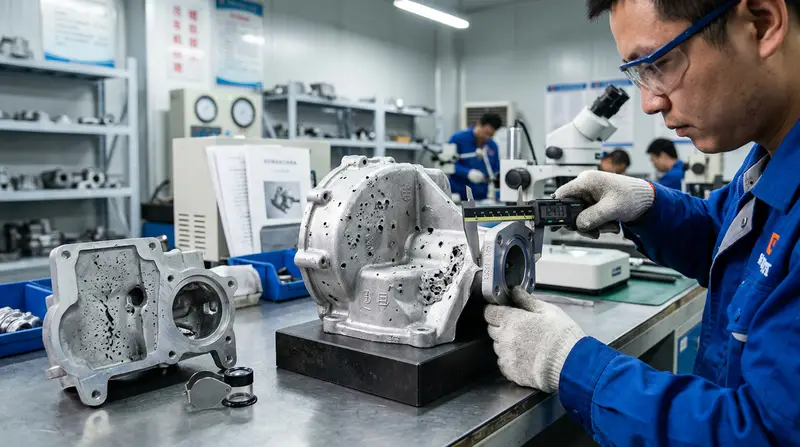
Spectrometer testing is not optional
Handheld XRF spectrometers (e.g., Thermo Scientific Niton or Hitachi X-MET) cost about $5-15 per test and produce results in 30 seconds. Suppliers are required to provide a Material Chemical Composition (MTC) report for each batch and randomly sample 3-5 pieces for review upon arrival. The grade standard can be directly referred to the ASTM B85/B85M specification for die-cast aluminum alloys, so as to avoid being fooled by the supplier's "customized grades".
Practical reminder: the contract must be written in the "chemical composition of any element exceeds the poor that the whole batch of returns, freight borne by the seller" - this article can block 80% adulteration motives.
Casting defects and substandard mechanical properties
straight answerEven if the chemical composition is qualified, the casting may be scrapped due to the process out of control. Porosity over 2%, densification below 97%, and tensile strength less than 240 MPa (ADC12 standard value) are the three most common types of hardness in Chinese die casting factories. To determine whether it is safe to buy aluminum castings from China? The second gate to determine whether it is safe to buy aluminum castings from China is to see whether the supplier can stabilize these indicators within the pass line.
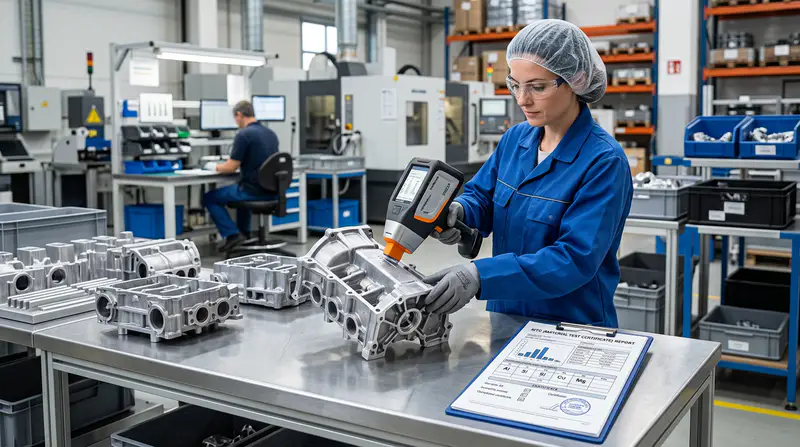
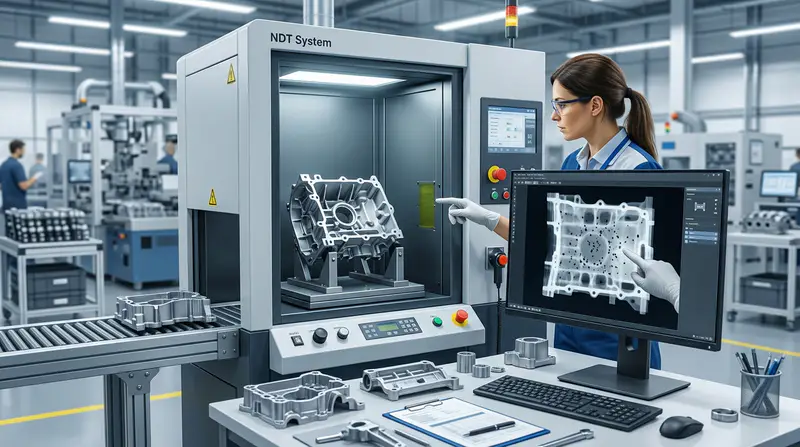
There are two types of porosity: entrapped air porosity, caused by air being entrapped due to excessive injection speed, and shrinkage porosity, caused by insufficient holding pressure or uneven cooling. During our team’s factory audit in Dongguan last year, we randomly sampled a batch of engine mounts and used X-ray inspection to discover that the internal porosity rate was as high as 4.8%, far exceeding the 1.5% upper limit required for automotive parts—the root cause was that the mold’s vent channels were designed to be only 0.15 mm wide, while the North American Die Casting Association (NADCA) recommends a range of 0.25–0.40 mm.
The means of detection should be configured in a hierarchical manner:
- non-destructive testingX-Ray for internal porosity and industrial CT to quantify densities to 99.5% accuracy.
- destructive testing: Universal testing machine tensile strength, yield strength, elongation (ADC12 elongation should be ≥ 1%)
- Metallographic analysis: look at the grain size and DAS (secondary dendrite spacing), the smaller the DAS, the more stable the mechanical properties
Practical advice: AQL 1.0 sampling standards and the ratio of X-Ray per batch (5% is recommended) must be written in the contract, otherwise the factory defaults to only do the appearance of the inspection.
How to screen reliable China aluminum casting suppliers
straight answerThe answer to the question: Is it safe to buy aluminum castings from China by breaking down supplier screening into a four-layer funnel of "qualification-certification-competence-endorsement"? The answer to this question has changed from "luck" to "controllable". My experience is that after going through these four layers of screening, the retention rate of qualified suppliers is usually only 8%-12%, but the batch that stays, the batch rework rate can be pressed to below 1%.
Four-tier funnel screening framework
- Qualification verification (first tier): Log in to China National Enterprise Credit Information Publication System Check the business license, registered capital, years of establishment. Foundry registered capital of less than 5 million yuan, was established less than 5 years, directly eliminated. Then ask the other side to show the "foreign trade operators for the record registration form" and customs AEO certification - no export qualification of the factory, the goods arrived in Hong Kong only to find that they can not declare the case I have seen three times.
- System certification (Tier 2)ISO 9001 is the bottom line, automotive parts must be IATF 16949, environmentally sensitive orders plus ISO 14001, aerospace plus AS9100. certificates must go to IAF CertSearch to verify the validity of the certificate, PS fake certificates are not uncommon in China.
- Capacity assessment (tier 3)Video or field audit checklist must include - die casting machine tonnage and brand (Lijin, Bühler preferred), spectrometer within calibration period, X-Ray flaw detection equipment, coordinate measuring machine (CMM), mold shop owned. Do not have their own CNC and mold repair capabilities of the "factory", eighty percent of trading companies listed.
- Endorsement verification (fourth level): Ask for 2-3 export cases of similar products, and look at the consignee and port of destination on the copy of bill of lading (Bill of Lading). Dare to give is basically a real factory.
Three details of factory vs trading company identification
- Quotation response time: real factory quotes usually 2-3 days (to account for molds and man-hours), trading companies within 4 hours of the second back - because in the group send inquiry.
- Depth of technical questions: Ask "How many mbar of vacuum do you control in ADC12 die casting", the factory will give a specific range of 50-100 mbar, the trading company will be vague.
- VAT invoice header: ask the other party to send a sample of the historical invoice, the header unit and business license does not match, it is a middleman.
Last year, I helped a German customer screening die-casting suppliers in Dongguan, the initial screening of 47, video review of 12, site visits to 4, and finally signed a contract - the process took 6 weeks, but the first 12,000 pieces of orders zero returns.
Technical specifications and industry standards that must be recognized
Straightforward answer:A Request for Quotation (RFQ) must also state four things - international cross-reference of alloy grade, tolerance grade (CT grade), surface roughness Ra, heat treatment status (T5/T6/F), plus NDT requirements. Without one item in the specification, evaluating whether it is safe to buy aluminum castings from China? becomes a gamble.
Alloy Grade Cross Reference
| China GB | ASTM, USA | EU EN | Japan JIS | typical use |
|---|---|---|---|---|
| YL113 / ADC12 | A383 | EN AC-46000 | ADC12 | 3C Housings, Car Mounts |
| YL102 | A413 | EN AC-44300 | ADC1 | Thin Wall Seals |
| ZL101A (A356) | A356.2-T6 | EN AC-42100 | AC4CH | Automobile wheels, aviation parts |
Many buyers think that ADC12 and A383 are completely equivalent, in fact, the Cu limit of ADC12 is 3.5%, and A383 only allows 2.0-3.0% - according to ASTM B85 inspection will be directly judged as unqualified.
Tolerance, roughness, heat treatment
- tolerance levelISO 8062-3 stipulates that die casting is usually CT6-CT8, sand casting is CT10-CT12, and high-pressure precision die casting can be CT5. In a new energy battery shell project, I received the tolerance from CT8 to CT6, and the unit price went up by 18%, but the defective rate of the assembly was reduced from 4.2% to 0.3%.
- surface roughnessThe default Ra is 3.2 μm for die casting, Ra 1.6 μm or less before anodizing, and Ra 0.4 μm for mirror polishing.
- hot treatment (e.g. of metal)A356 aluminum alloy is commonly T6 (solution + artificial aging), and the tensile strength increases from 170 MPa in the F state to over 275 MPa.
Non-destructive testing written into contracts
Critical structural components must be specified with X-ray inspection level (ASTM E155 Level 1-4) or industrial CT scan. Automotive safety parts are generally required to be within Level 2, the diameter of a single point of porosity ≤ 1.5 mm. "100% X-ray + AQL 1.0 sampling" clearly written in the specification is the last technical lock to determine whether it is safe to buy aluminum castings from China. is the last technical lock to determine whether it is safe to buy aluminum castings from China.
Complete process of quality control and third party inspection of goods
straight answer: By breaking down the quality control into four nodes - "first piece - mold - process - shipment", with corresponding verification tools for each node, is it safe to buy aluminum castings from China? This question is really a closed-loop answer. Relying on pre-shipment sampling alone, the leakage rate may be as high as 15%; while the complete four-stage control can suppress the terminal defective rate to within 0.3%.
Four-stage validation process
- First article sample validation (PPAP Level 3 or ISIR): Suppliers are required to submit full-dimension reports, material test certificates (MTCs), X-ray images of internal defects, and salt spray test data. Automotive parts must comply with the AIAG PPAP standard; a complete submission package typically takes 3–4 weeks to prepare.
- Mold Validation (T1/T2/T3 Trial)T1: T1 to see if it can be molded, T2 to adjust the process parameters, T3 to do 300 pieces of small batch run Cpk ≥ 1.33 process capability verification. Skipping T3 and going straight to mass production is the most common starting point for a turnaround I've ever seen.
- IPQC Process Inspection: Critical dimensions are sampled every 2 hours, X-Ray sampling is done every shift, and the porosity level is determined according to ASTM E155.
- Pre-Shipment AQL Sampling: According to ISO 2859-1 (equivalent to GB/T 2828.1, ANSI/ASQ Z1.4) General Inspection Level II, the AQL for major defects is taken as 0.65, and that for minor defects as 2.5.
Third-party organization selection and costs
| organization | Areas of strength | Quote per person-day (USD) |
|---|---|---|
| SGS | Material testing, mechanical properties | 300-380 |
| Bureau Veritas | Automotive parts, industrial equipment | 280-360 |
| TÜV Rheinland | EU CE, RoHS Compliance | 350-450 |
| Intertek | North American market, consumer goods | 300-400 |
When I sourced 8,000 water-cooled plate die castings for a new energy customer in 2023, I insisted on having BV in the plant for 2 days at T3 (~$720) and found on the spot that a defective design in the mold's cooling water circuit resulted in a shrinkage rate of 6.8%. The supplier reworked the mold and avoided a $120,000 back-end recall, despite a 10-day delay - an ROI of about 16x. -The ROI on this inspection fee was about 165 times. Buy third-party inspection as an insurance policy, not as a cost cut, this is the old procurement way of thinking.