


ZL111 (ZAlSi9Cu2Mg) Cast Aluminum Alloy: The Perfect Balance of High Strength and Excellent Castability, Explaining Its Comprehensive Performance Advantages
Article Catalog[Hidden]
- ZL111 Aluminum Alloy Composition Table (based on GB/T 1173 typical requirements)
- ZL111 Physical and Mechanical Properties Parameter Table (metal mold casting, typical values)
- Corresponding international grades
- Application of ZL111 in foundry industry
- 📊 Extended column: Comparative analysis of ZL111 and related alloys
As a Chinese national standard (GB/T 1173) in theAluminum-silicon-copper-magnesium high-strength casting alloyThe quintessential representative of theZL111 (ZAlSi9Cu2Mg) by means ofExcellent comprehensive mechanical properties, good casting performance and multiple composite strengthening effectis known for. The alloy passesSilicon (Si) guarantees casting fluidity, copper (Cu) and magnesium (Mg) synergistically strengthenedAfter T6 heat treatment, it can obtain the high strength level close to that of aluminum-copper alloys, while retaining better casting processability and lower cost than aluminum-copper alloys, and it is the best choice for manufacturing ofImportant castings that are subject to high loads, have complex shapes and require good air tightness.It is the ideal material for a wide range of applications in the fields of aviation, aerospace, automotive and power machinery.
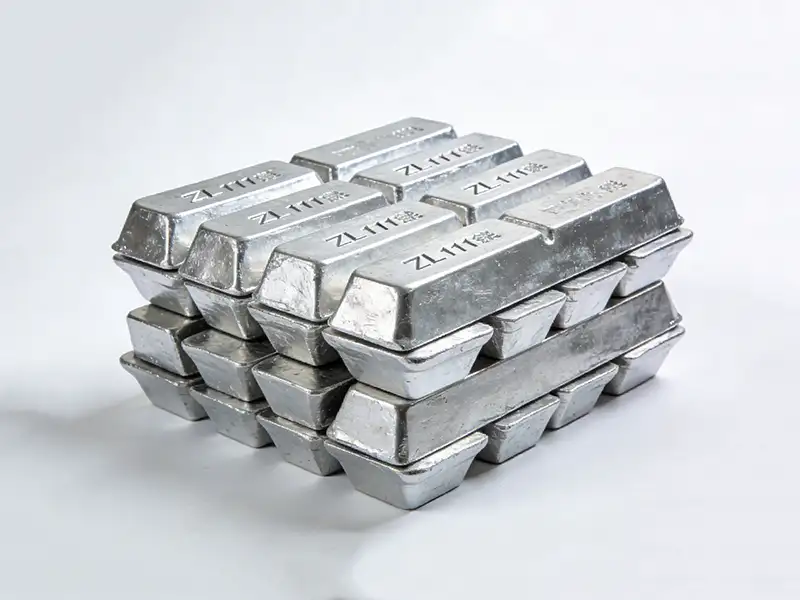
The national grade for ZL111 is ZAlSi9Cu2Mg.
- National Standard Grade: According to GB/T 1173, its grade isZAlSi9Cu2Mg. The name directly reflects its core alloy system: silicon (Si), copper (Cu), and magnesium (Mg).
- Industry/Enterprise Code:ZL111 It is a widely used code for this material in foundry industry drawings, manuals and enterprise standards.
- Core features:Higher silicon content (8.0-10.01 TP3T) Ensures good casting fluidity and air tightness;Medium copper (1.3-1.81 TP3T) vs. magnesium (0.4-0.61 TP3T) Provide compound strengthening effect; after T6 heat treatment, it can getBalance of high strength and good plasticityIt is one of the more outstanding grades in the Al-Si-Cu-Mg alloy system in terms of comprehensive performance.
ZL111 Aluminum Alloy Composition Table (based on GB/T 1173 typical requirements)
| elemental | Content range (wt%) | functional role |
|---|---|---|
| Silicon (Si) | 8.0-10.0 | Main alloying elements. Provides good casting fluidity, resistance to thermal cracking and airtightness. |
| Copper (Cu) | 1.3-1.8 | Core Strengthening Elements. Formation of Al₂Cu reinforced phase significantly improves room and high temperature strength. |
| Magnesium (Mg) | 0.4-0.6 | Key Enhancement Elements.. Formation of Mg₂Si with silicon synergizes with Al₂Cu to produce a composite strengthening effect. |
| Manganese (Mn) | 0.1-0.3 | Neutralizes the harmful effects of iron and improves heat resistance. |
| Titanium (Ti) | 0.1-0.2 (can be added) | Grain refiner. |
| Iron (Fe) | ≤ 0.4 | Impurity elements. Needs to be strictly controlled to ensure mechanical properties and corrosion resistance. |
| Zinc (Zn) | ≤ 0.3 | Impurities. |
| Aluminum (Al) | tolerance (i.e. allowed error) | Substrate material. |
ZL111 Physical and Mechanical Properties Parameter Table (metal mold casting, typical values)
| Performance indicators | Cast (F) | T5 aging state | T6 solid solution + aging state | Performance Positioning and Interpretation |
|---|---|---|---|---|
| intensity | 2.68-2.71 g/cm³ | -- | -- | Similar to ZL104. |
| Tensile strength (Rm) | 200-240 MPa | 260-300 MPa | 300-350 MPa | Excellent strength in T6 stateIt reaches the level of high-strength cast aluminum. |
| Yield strength (Rp0.2) | 120-150 MPa | 200-230 MPa | 240-280 MPa | The yield strength is greatly increased after heat treatment, and the load carrying capacity is high. |
| Elongation (A) | 2.0-4.0% | 2.0-3.0% | 2.0-4.0% | Highlighting Advantages: Maintains good plasticity at high strength levels. |
| Brinell hardness (HB) | 70-80 | 90-105 | 100-120 | High hardness and good wear resistance after T6. |
| High Temperature Strength (200°C) | general | favorable | talented | Copper-magnesium composite allows it to maintain good high-temperature performance. |
| Casting mobility | talented | -- | -- | The high silicon content guarantees excellent mold filling capacity. |
| airtight | talented | talented | talented | Suitable for pressure castings. |
| corrosion resistance | moderate | moderate | moderate | The copper content makes them less resistant to corrosion than copper-free alloys. |
Performance Enhancement Paths and Technology Benefits
The ZL111“s performance comes from its "High silicon guarantees castability + copper-magnesium composite reinforcement”Optimized Design:
- Optimized selection of silicon content: The silicon content of 8-10% is in the sub-eutectic-eutectic interval, which ensures that both theExcellent casting fluidity(better than ZL105, ZL107), and avoid the problem of primary silicon coarsening of per-eutectic alloys.
- Copper-magnesium composite reinforcement: The ratio of copper (1.3-1.8%) to magnesium (0.4-0.6%) is optimized to obtain after T6 heat treatmentAl₂Cu and Mg₂Si double reinforced phasesThe synergistic effect resulted in a significant increase in strength and a uniform distribution of reinforcing phases.
- Good balance of toughness: Compared with ZL105, ZL111 has a higher silicon content and better castability; compared with ZL107, it has a moderate copper content and higher elongation; and compared with ZL104, it has significantly higher strength.Good balance between strength, plasticity, castability.
- Strict impurity control: The requirement of iron content ≤ 0.4% ensures the stability and consistency of mechanical properties.
Corresponding international grades
ZL111 has several close international equivalents:
- Chinese national standard:ZAlSi9Cu2Mg (GB/T 1173)
- American Standard:: In conjunction with the 354.0 (Al-Si9Cu2Mg) is the international counterpart of ZL111, which is highly compatible with its composition.
- EU standard:EN AC-42200 (Al-Si7Mg) Copper free;EN AC-45400 (Al-Si8Cu3) has a slightly higher copper content; the closest approximation is the Al-Si9Cu2Mg custom alloy of some specific brands.
- Japanese Standard:AC4B The higher-end versions are close to it.
- international standard:AlSi9Cu2Mg (ISO 3522) has a counterpart.
Application of ZL111 in foundry industry
based on itsHigh strength, good castability, excellent airtightness and toughness balancefeatures, ZL111 is mainly used in the following fields:
- Aviation and aerospace (high-end applications)
- Aircraft structural parts: Stress braces, joints, frames, hatch rails.
- Engine Accessories: Accessory magazine, pump body, valve body.
- Missile components: Rudder mounts, instrument bay structural members.
- Automotive and Power Machinery (Mainstream Applications)
- Engine components: Cylinder head, intake tube, oil pan, timing gear housing, engine mounts.
- transmission system: Transmission housing, clutch housing, distributor housing.
- Supercharger components: Compressor shells, intermediate shells.
- Hydraulic and pneumatic systems
- High pressure valve body: Hydraulic valves, proportional valves, servo valve housings.
- pump body: Gear pumps, piston pump housings.
- Cylinder end caps: Cylinder components requiring airtightness and strength.
- General and construction machinery
- Reducer housings, industrial gearboxes, hydraulic cylinder end caps.
ZL111 Aluminum Alloy Frequently Asked Questions
Q1: What is the main difference between ZL111 and ZL105, ZL107, ZL104? How to select the model?
- This is the most common comparison in high strength cast aluminum:
- ZL111 (Al-Si9Cu2Mg):High silicon (9%), medium copper (1.3-1.8%), magnesium-containing.Excellent castability, high strength, good elongation, is the most balanced player in terms of overall performance.
- ZL105 (Al-Si5Cu1Mg):Low silicon (5%), medium-low copper (1.0-1.5%), magnesium-containing.High strength and high temperature performance, but slightly less castable.
- ZL107 (Al-Si7Cu4):Medium Silicon (7%), High Copper (3.5-4.5%).High strength and hardness, but with low elongation and medium castability.
- ZL104 (Al-Si9Mg):High Silicon (9%), Copper Free, Magnesium Containing.Excellent castability and good corrosion resistance, but medium intensity.
- selection: RequiredBest overall performance (strength + castability + toughness) 选ZL111(a) The need forHighest strength and slightly less acceptable castability选ZL107(a) The need forHigh temperature performance with low castability requirements选ZL105(a) The need forGood castability and corrosion resistance, medium strength requirements选ZL104.
Q2: What are the general parameters of the heat treatment process for ZL111?
- Typical T6 process (for reference only, needs to be adjusted according to the casting):
- solid solution treatment: 515-525°C × 6-12 hours.Warm water (60-80°C) quenching.
- artificial time limit: 160-180°C × 6-10 hours, air-cooled.
- take note of: The solid solution temperature needs to be precisely controlled to prevent overcooking; the quenching transfer rate should be fast to ensure the solid solution effect.
Q3: What is the casting performance of ZL111? How does it compare with ZL104?
- Excellent, close to ZL104The silicon content of ZL111 (8-10%) is similar to that of ZL104 (8.5-10.5%), so the fluidity, resistance to thermal cracking, and airtightness are all at a higher level. In actual production, the casting process parameters of ZL111 can be basically common with ZL104, and isOne of the best casting performance grades of high strength cast aluminum.
Q4: Why is the elongation of ZL111 maintained at a high level?
- There are three reasons for this:
- Moderate copper content: 1.3-1.81 TP3T of copper provides sufficient strengthening while avoiding the brittleness common to high copper alloys such as ZL107.
- Silicon morphology optimization: Eutectic/subeutectic silicon organization can be refined by densification treatment to reduce the cuts to the substrate.
- Tight control of impurities: Iron content ≤ 0.4% is required to reduce the formation of needle-like brittle phases.
This makes itA good example of the balance of strength and toughness in high-strength cast aluminum.
Q5: What is the welding repair performance of ZL111?
- Upper middle class. Moderate copper content, welding hot cracking tendency is lower than ZL107 and other high copper alloy. When carrying out argon arc welding filler welding, it is recommended toPreheating (100-150°C)The wire used is homogeneous or slightly higher than the performance of the base material, and after welding, it is used forstress reliefThe welding is done in the same way as the welding of the other parts of the machine. For important load-bearing parts, X-ray inspection is required to confirm the quality after welding.
Q6: What is the relationship between ZL111 and A354.0? Are they interchangeable?
- ZL111 is highly similar in composition and properties to A354.0 (a high-purity version of US 354.0)The composition range of A354.0 (Si 8.5-9.5%, Cu 1.5-2.0%, Mg 0.5-0.7%) is basically overlapped with that of ZL111, which can be regarded as the corresponding grade in the standards of China and the U.S. The two materials are often regarded as interchangeable in engineering practice. In engineering practice, the two are often regarded as interchangeable materials. However, it should be noted that A354.0 may have more stringent requirements for impurities and better performance consistency.
📊 Extended column: Comparative analysis of ZL111 and related alloys
| comparison dimension | ZL111 (AlSi9Cu2Mg) | ZL104 (AlSi9Mg) | ZL105 (AlSi5Cu1Mg) | ZL107 (AlSi7Cu4) | A354.0 (AFSL) |
|---|---|---|---|---|---|
| Silicon (Si)% | 8.0-10.0 | 8.5-10.5 | 4.5-5.5 | 6.5-7.5 | 8.5-9.5 |
| Copper (Cu)% | 1.3-1.8 | ≤0.1 | 1.0-1.5 | 3.5-4.5 | 1.5-2.0 |
| Magnesium (Mg)% | 0.4-0.6 | 0.17-0.35 | 0.4-0.6 | ≤0.3 | 0.5-0.7 |
| Tensile strength (T6) | 300-350 MPa | 240-270 MPa | 280-320 MPa | 290-330 MPa | 320-360 MPa |
| Yield strength (T6) | 240-280 MPa | 180-210 MPa | 210-250 MPa | 220-260 MPa | 260-300 MPa |
| Elongation (T6) | 2.0-4.0% | 1.5-3.0% | 1.5-3.0% | 1.5-2.5% | 3.0-5.0% |
| Casting mobility | talented | talented | favorable | favorable | talented |
| Overall performance rating | ★★★★★ | ★★★★★ | ★★★★ | ★★★★ | ★★★★★ |
| Typical Costs | moderate | lower (one's head) | moderate | moderate | Moderately high |
Selection Quick Guide:
- Choose ZL111.: When the need arisesHigh strength combined with good castability and toughnessWhen it is.“all-rounder”Players.
- Select ZL104: Castability and corrosion resistance are preferred, when strength is required moderately.
- Select ZL105: High-temperature performance and strength are preferred, acceptable when castability is slightly poor.
- Select ZL107.: Highest strength is preferred when lower toughness and castability are acceptable.
- Option A354.0: International projects or when there is a higher demand for performance consistency.