


ZL114A (ZAlSi7Mg1A) Cast Aluminum Alloy: The Performance Benchmark of China's Aerospace-Grade High Strength Alloy, In-depth Analysis of Its Composition and Top Applications
Article Catalog[Hidden]
- ZL114A Aluminum Alloy Composition Table (based on GB/T 1173 typical requirements)
- ZL114A Physical and Mechanical Properties Parameter Table (Typical Values, T6 State)
- Application of ZL114A in foundry industry
- ZL114A Aluminum Alloy Frequently Asked Questions
- 📊 Extended column: comparison and analysis of ZL114A with ZL101A and A357.0
As a Chinese national standard (GB/T 1173) in theHigh strength aluminum, silicon and magnesium casting alloysThe top representatives of theZL114A (ZAlSi7Mg1A) by means ofExcellent overall mechanical properties, excellent casting processability and very high reliabilityand is well known. This alloy is the ZL101AHigh-performance upgraded versionBy means of thePrecise control of magnesium content to high levels (0.45-0.75%), strict limitation of impurities (especially iron) and optimization of the heat treatment process.The T6 heat treatment gives a good result in cast aluminum alloys.Top strength and toughness combinationIt's manufacturing.Aviation, aerospace, defense and high-end equipment in the field of bearing high loads, the requirements of high reliability of the key complex castingsIt is the material of choice for cast aluminum alloys and is known as the “performance benchmark for cast aluminum alloys”.
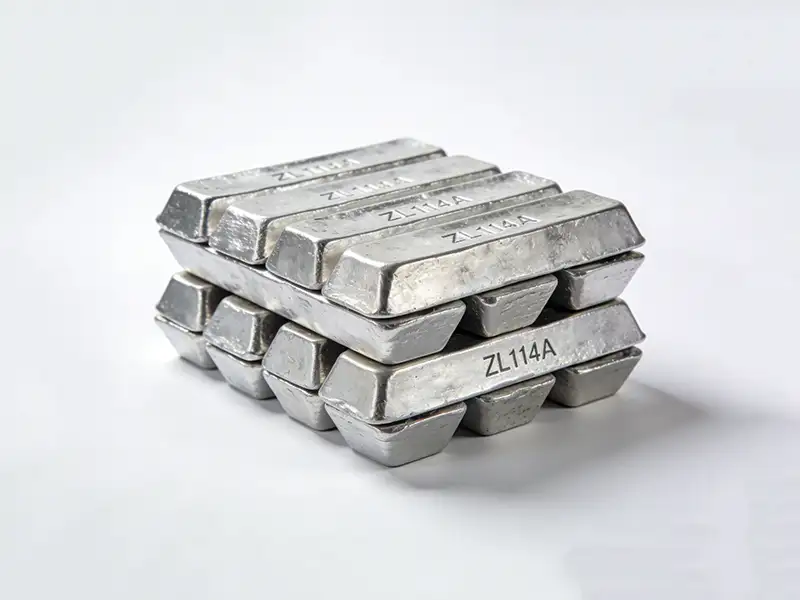
The national grade for ZL114A is ZAlSi7Mg1A.
- National Standard Grade: According to GB/T 1173, its grade isZAlSi7Mg1AThe “1” in the name stands for higher magnesium content and the “A” stands for the high purity version. The "1" in the name stands for the higher magnesium content and the "A" stands for the higher purity version.
- Industry/Enterprise Code:ZL114A is the code name for the material's widespread use in aviation, aerospace and high-end casting.
- Core features:Medium silicon content (6.5-7.51 TP3T) Ensures good casting fluidity;Higher magnesium content (0.45-0.75%) Provide an adequate foundation for sedimentary reinforcement;Extremely strict impurity control (iron ≤ 0.15%) Ensures high toughness and reliability;Optimized heat treatment processes It gives a uniform and fine microstructure. It isOne of the cast aluminum alloys with the best balance of strength and toughness.
ZL114A Aluminum Alloy Composition Table (based on GB/T 1173 typical requirements)
| elemental | Content range (wt%) | functional role |
|---|---|---|
| Silicon (Si) | 6.5-7.5 | Main alloying elements. Provides good casting fluidity, resistance to hot cracking, and forms the basis for the Mg₂Si strengthening phase. |
| Magnesium (Mg) | 0.45-0.75 | Core Strengthening Elements. Forms Mg₂Si phase with Si, which achieves significant precipitation strengthening by T6 heat treatment. Its content is higher than that of ZL101A (0.25-0.45%), which is the key to performance enhancement. |
| Iron (Fe) | ≤ 0.15 | The most critical impurity limits. The iron content is strictly controlled to avoid the formation of needle-like brittle phases and to ensure high elongation and fatigue properties. |
| Titanium (Ti) | 0.10-0.20 (normally added) | Grain refiner to improve the consistency of organization and mechanical properties. |
| Copper (Cu) | ≤ 0.10 | Impurities. Strictly controlled to maintain good corrosion resistance and toughness. |
| Zinc (Zn) | ≤ 0.10 | Impurities. |
| Manganese (Mn) | ≤ 0.10 | Impurities. |
| Other single | ≤ 0.05 | Strict control. |
| Aluminum (Al) | tolerance (i.e. allowed error) | Substrate material. |
ZL114A Physical and Mechanical Properties Parameter Table (Typical Values, T6 State)
| Performance indicators | Numerical range | Performance Positioning and Benefits Explained |
|---|---|---|
| intensity | 2.67-2.69 g/cm³ | -- |
| Tensile strength (Rm) | 320-370 MPa | Top intensity level, significantly higher than ZL101A (290-330 MPa). |
| Yield strength (Rp0.2) | 260-300 MPa | High yield strengthExcellent load carrying capacity. |
| Elongation (A) | 5.0-10.0% | Core Advantages. With such a high level of strength, it still maintains excellent plasticity and is a good example of a balance of strength and toughness. |
| Brinell hardness (HB) | 90-110 | Moderate hardness and good workability. |
| fatigue strength | excellent | Excellent fatigue resistance due to high purity and tissue homogeneity from optimized heat treatment. |
| Fracture toughness | talented | High resistance to crack expansion and high reliability. |
| corrosion resistance | talented | Copper-free, excellent resistance to atmospheric and seawater corrosion. |
| Casting mobility | favorable | The medium silicon content ensures that the mold filling capacity is sufficient for complex thin-walled parts. |
| Heat treatment responsiveness | excellent | Highly sensitive to T6 heat treatment, the combination of properties can be optimized through process adjustments. |
Performance Enhancement Paths and Technology Keys
The ZL114A's superior performance stems from its “High magnesium + high purity + precision heat treatment”The Technical Route:
- Designed for high magnesium content: Compared with ZL101A, the magnesium content is elevated from 0.25-0.45% to 0.45-0.75%, resulting in the precipitation of T6 after heat treatment.Higher number and denser distribution of Mg₂Si reinforced phasesThis results in higher strength.
- Extremely tight impurity control: The requirement of iron content ≤ 0.15% is more stringent than that of ZL101A (≤ 0.20%), which fundamentally reduces the formation of brittle intermetallic compounds for obtaining theHigh elongation and excellent fracture toughnessLaying the groundwork.
- spoilage treatment: It is common to addStrontium (Sr) 或Sodium (Na) Densification of eutectic silicon to change its morphology from coarse flakes to fine fibers, theSignificantly improved elongation and machinability.
- Precision T6 heat treatment:
- solid solution treatment: Hold at 540±5°C for 8-14 hours to fully dissolve Mg₂Si.
- harden by quenching: Usually usedWarm water (60-80°C) quenching, balancing mechanical properties with quenching stresses. For very high performance requirements, thePolymer Quench FluidFurther reduce deformation.
- artificial time limit: Holding at 155-165°C for 4-10 hours to obtain uniformly dispersed Mg₂Si reinforced phase.
- By adjusting the aging parameters, theStrength and ToughnessFine-tune between to meet different application requirements.
Corresponding international grades
As a globally recognized high-performance cast aluminum alloy, it has a clear international correspondence:
- Chinese national standard:ZAlSi7Mg1A (GB/T 1173)
- American Standard:: In conjunction with the A357.0 (Al-Si7Mg0.6) has a high degree of compositional and property correspondence and is the international counterpart of ZL114A. A357.0 usually also contains traces of beryllium (Be) to improve high temperature oxidation resistance.
- EU standard:EN AC-42200 (AlSi7Mg0.6) (EN 1706)
- French standards:A-S7G06
- international standard:AlSi7Mg0.6 (ISO 3522)
Application of ZL114A in foundry industry
based on itsTop toughness combination, excellent castability and high reliabilityWith its features, the ZL114A is primarily used in areas where performance and reliability are most demanding:
- Aerospace and Defense (Core Applications)
- Aircraft structural parts: Wing/fuselage attachment fittings, landing gear mounts, hatch frames, seat slides, maneuvering system rockers, helicopter rotor hub attachments.
- Engine components: Fan magazines, compressor magazines, accessory gearbox housings, intake manifolds.
- Missiles and spacecraft: Rudder structural elements, instrument bay mounts, satellite structural elements.
- High Performance Cars and Racing Cars
- Chassis & Suspension: High-performance control arms, steering knuckles, subframe connectors.
- powertrain: High performance engine blocks, cylinder heads, oil sumps.
- Racing Parts: Hubs, gearbox housings, suspension struts.
- Railway transportation and high-end equipment
- High-speed rail bogie parts, light rail car body joints, robot joints, precision instrument bases.
- defense equipment
- Military vehicle housings, artillery components, optoelectronic instrument mounts.
ZL114A Aluminum Alloy Frequently Asked Questions
Q1: What is the main difference between ZL114A and ZL101A? How to select the model?
- This is the most common comparison in high-end applications:
- ZL114A:Higher magnesium content (0.45-0.75% vs. 0.25-0.45%) and tighter control of impurities (iron ≤0.15% vs. ≤0.20%). After treatment with T6Significantly higher strength (30-50 MPa higher) and better fracture toughness, but it also costs more.
- ZL101A: Strength has been met for most applications at a relatively low cost and is “High Performance Basic”。
- ZL114A: The QuestExtreme performance, maximum reliability and fracture safetyWhen selected, it is “Top Tough”。
- selection: Conventional aerospace structural components, general high performance component selectionZL101AThe selection of components that are safety critical, subject to extreme loads, and require the highest level of reliability.ZL114A.
Q2: What is the relationship between ZL114A and A357.0? Are they interchangeable?
- ZL114A and A357.0 have a high degree of correspondence in composition and performance, and can be regarded as “sister grades” in the standards of China and the United States.”. The main difference is that A357.0 usually containsTrace beryllium (Be, 0.04-0.07%)ZL114A is used to prevent oxidation during high temperature melting and to improve the casting performance of thin-walled parts.ZL114A usually does not contain beryllium, but a similar effect can be achieved by other means of the process in actual production. In engineering practice, the two are often regarded asInterchangeablematerials, but need to be verified against specific performance specifications.
Q3: What are the special requirements for the heat treatment process of ZL114A?
- Requires greater precision:
- Solid solution temperature needs to be precisely controlled: Usually usedGraded solid solution或a slow warming, preventing coarsening of eutectic silicon.
- Hardening transfer should be fast: ≤ 10 seconds is usually required to ensure the formation of a supersaturated solid solution.
- Adjustable aging process: The combination of properties can be “customized” within certain limits by adjusting the aging temperature and time. For example.low-temperature agingHigher elongation can be obtained (at the expense of some strength);high-temperature agingPeak strength can be obtained (elongation decreases).
- “Two-stage aging” is often used.”: Low temperature followed by high temperature to further optimize the toughness balance.
Q4: What is the casting performance of ZL114A? What do I need to pay attention to when designing?
- Good, but comparable to ZL101A. The silicon content is the same (6.5-7.5%) and the fluidity is sufficient for complex thin-walled parts. However, due to its high performance requirements, the casting process design needs to be more refined:
- Pouring system designIt is necessary to ensure smooth filling to reduce air rolls and oxidized inclusions.
- Riser designIt is necessary to ensure that adequate shrinkage is made up to avoid shrinkage and loosening of shrinkage holes.
- Mold DesignConsideration needs to be given to uniform cooling to reduce internal stresses and deformation.
- Typically usedLow pressure casting, differential pressure casting, precision sand castingand other high-quality casting processes.
Q5: What is the welding repair performance of ZL114A?
- favorable. Due to its high purity and absence of copper, it has a low tendency to weld hot cracks. It can be repaired by argon arc welding (TIG), using homogeneous or slightly higher than the parent material properties of the wire. However, attention is required:
- Required before weldingthoroughnessAvoid contamination.
- Required after weldingPartial or total stress relief heat treatment, restoring performance.
- Important load-bearing parts need to be welded after replenishmentX-ray or fluorescent penetrant detectionTo ensure the quality of the repair.
Q6:How is the anodizing effect of ZL114A?
- excellent. Copper free, availableColorless and transparent, uniform and dense, high hardnessThe oxidized film is suitable for high decorative and high weather resistance requirements. After mechanical polishing, mirror effect can be obtained, commonly used inOptical instruments, precision equipmentParts with high surface requirements such as.
📊 Extended column: comparison and analysis of ZL114A with ZL101A and A357.0
| comparison dimension | ZL101A (ZAlSi7MgA) | ZL114A (ZAlSi7Mg1A) | A357.0 (AFSL) |
|---|---|---|---|
| Silicon (Si)% | 6.5-7.5 | 6.5-7.5 | 6.5-7.5 |
| Magnesium (Mg)% | 0.25-0.45 | 0.45-0.75 | 0.45-0.70 |
| Iron (Fe)% | ≤0.20 | ≤0.15 | ≤0.20 |
| Beryllium(Be)% | not have | not have | 0.04-0.07(Optional) |
| Tensile strength (T6) | 290-330 MPa | 320-370 MPa | 320-360 MPa |
| Yield strength (T6) | 220-260 MPa | 260-300 MPa | 250-290 MPa |
| Elongation (T6) | 3.0-6.0% | 5.0-10.0% | 3.0-8.0% |
| Fracture toughness | favorable | talented | talented |
| Casting Performance | favorable | favorable | Good (thin-walled with beryllium improvement) |
| Typical Costs | mid-to-high-end | high-end | High-end (imported) |
| typical application | General aviation parts, automotive parts | Critical safety components, extreme load components | Aero-engine parts, thin-walled complex parts |
Selection Quick Guide:
- Select ZL101AConventional aerospace structural parts and high-performance automotive parts require good overall performance and relatively controllable costs.
- Select ZL114A: Safety-critical components, components subjected to extreme loads, requiring the highest reliability and fracture toughness.
- Option A357.0: International projects, where beryllium content is required to improve the performance of thin-wall casting, or where direct correspondence to the American Standard is required.