


Comprehensive guide to ZL110 casting aluminum alloy: composition system, heat treatment process, international grades and typical applications.
Article Catalog[Hidden]
- ZL110 Aluminum Alloy Composition Table (based on GB/T 1173 typical requirements)
- ZL110 Physical and Mechanical Properties Parameter Table (metal mold casting, typical values)
- ZL110 Performance Enhancement Path and Technical Features
- Corresponding international grades
- ZL110 in the foundry industry
- ZL110 Aluminum Alloy Frequently Asked Questions
- 📊 Extended Column: Comparative Analysis of ZL110 with ZL108 and ZL109
As a Chinese national standard (GB/T 1173) in theHigh copper-aluminum-silicon heat-resistant and wear-resistant casting alloysThe quintessential representative of theZL110 (ZAlSi5Cu6Mg) by means ofHigher copper content, excellent high-temperature strength, good wear resistance and lower costsis known for. The alloy passesMedium silicon content (4.0-6.0%) guarantees basic casting performance, high copper (5.0-8.0%) is used as the core strengthening element.After T1 or T5 heat treatment, it can obtain excellent high-temperature mechanical properties and wear resistance, and it is the manufacture ofCastings with high working temperatures, medium loads and wear resistance requirementsIt is an economical material that is widely used in automobiles, motorcycles, general-purpose power machinery and other fields.
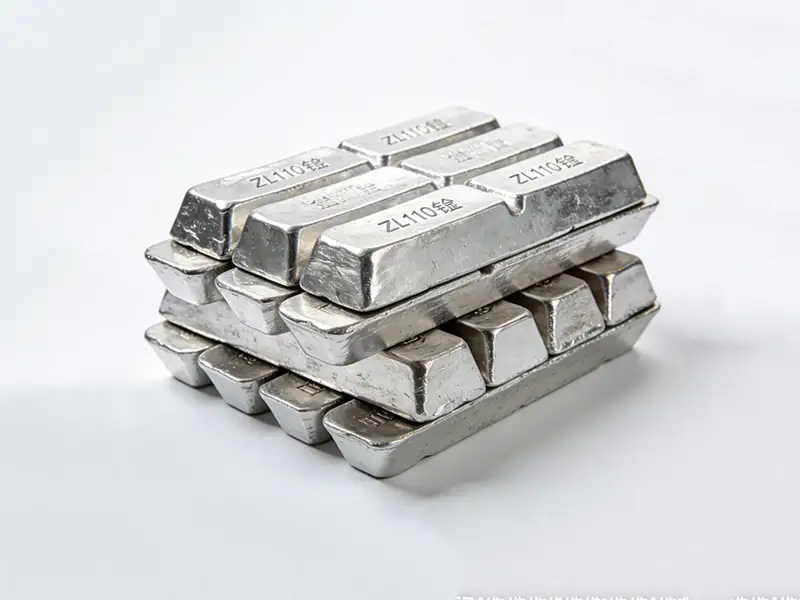
The national grade for ZL110 is ZAlSi5Cu6Mg.
- National Standard Grade: According to GB/T 1173, its grade isZAlSi5Cu6Mg. The name directly reflects its core alloy system: silicon (Si), copper (Cu), and magnesium (Mg).
- Industry/Enterprise Code:ZL110 It is a widely used code for this material in foundry industry drawings, manuals and enterprise standards.
- Core features:Medium silicon content (4.0-6.01 TP3T) Basic casting fluidity is guaranteed;Very high copper content (5.0-8.0%) Gives excellent high temperature strength and wear resistance;Magnesium additionProvide auxiliary strengthening effect. Compared with ZL108, ZL109, its cost is lower, but the high temperature performance is slightly inferior, suitable for heat-resistant wear-resistant parts that are not particularly demanding.
ZL110 Aluminum Alloy Composition Table (based on GB/T 1173 typical requirements)
| elemental | Content range (wt%) | functional role |
|---|---|---|
| Silicon (Si) | 4.0-6.0 | Main alloying elements. Provides basic casting fluidity, partially solid solution strengthened. |
| Copper (Cu) | 5.0-8.0 | Core Strengthening Elements. Formation of a large number of Al₂Cu reinforced phases, significantly enhancing room and high temperature strength and hardness. |
| Magnesium (Mg) | 0.2-0.5 | Ancillary Strengthening Elements. Forms Mg₂Si with silicon, which synergizes with Al₂Cu to further enhance strength. |
| Iron (Fe) | ≤ 0.8 | Impurity elements. Needs to be controlled, but tolerance is high. |
| Manganese (Mn) | ≤ 0.5 | May be added to neutralize the harmful effects of iron. |
| Zinc (Zn) | ≤ 0.3 | Impurities. |
| Titanium (Ti) | ≤ 0.2 | Grain refiner. |
| Aluminum (Al) | tolerance (i.e. allowed error) | Substrate material. |
ZL110 Physical and Mechanical Properties Parameter Table (metal mold casting, typical values)
| Performance indicators | Cast (F) | T1 natural limitation | T5 manual aging | Performance Positioning and Interpretation |
|---|---|---|---|---|
| intensity | 2.75-2.80 g/cm³ | -- | -- | Higher density, due to high copper content. |
| Room temperature tensile strength (Rm) | 160-200 MPa | 200-240 MPa | 240-280 MPa | Good strength after T5, to a medium-high intensity level. |
| High temperature tensile strength (250°C) | general | favorable | Excellent (≥120 MPa) | Core AdvantagesHigh copper content ensures good high temperature performance. |
| Yield strength (Rp0.2) | 90-120 MPa | 140-170 MPa | 180-220 MPa | The yield strength is significantly increased after heat treatment. |
| Elongation (A) | 1.5-2.5% | 1.0-2.0% | ≤1.0% | Lower plasticity, an inherent characteristic of high copper alloys. |
| Brinell hardness (HB) | 70-80 | 85-95 | 100-115 | high stiffnessExcellent abrasion resistance. |
| heat conductivity | Approx. 120-130 W/(m-K) | -- | -- | Medium. |
| Coefficient of linear expansion | Approx. 21.0-22.0×10-⁶/°C | -- | -- | Higher, due to lower silicon content. |
| Casting mobility | moderate | -- | -- | Lower silicon content and less fluidity than high silicon alloys. |
| corrosion resistance | mediocre | mediocre | mediocre | High copper content makes it less resistant to corrosion and requires surface protection. |
ZL110 Performance Enhancement Path and Technical Features
The ZL110“s performance comes from its "High copper dominant and economical”The Technical Route:
- High copper is the core: The high copper content of up to 5-8% is one of the reasons why it is so important to get theHigh hardness and good high temperature strengthThe fundamental reason for the The presence of a large number of Al₂Cu phases provides excellent wear resistance at both room and elevated temperatures.
- Heat treatment optional:
- T1 (natural limitation): cast state for a long period of time, can partially release internal stresses and a small increase in strength, suitable for cost-sensitive, less demanding applications.
- T5 (artificial aging): Holding at 150-180°C for several hours to obtain peak strength and hardness is the common process.
- Generally no T6 processing: Due to the high copper content tends to lead to solid solution overcooking risk, and quenching deformation is difficult to control.
- Cost Advantage: Compared to specialized piston alloys such as ZL108 and ZL109, ZL110 does not contain expensive nickel (Ni) and has a higher tolerance for impurities such as iron.Significantly lower material costsThis is the best choice for “economical heat-resistant and wear-resistant parts”.
Corresponding international grades
ZL110 can be found internationally in alloys with similar properties, but mostly in older grades or in alloys for specific applications:
- Chinese national standard:ZAlSi5Cu6Mg (GB/T 1173)
- American Standard:: In conjunction with the 324.0 (Al-Si5Cu5) or B295.0 (Al-Si4Cu6) have similarities in composition and properties.
- EU standard: There is no direct correspondence, and older numbers such as G-AlSi6Cu6 present in some national standards.
- Russian Standard:AЛ5 或 AЛ6 There are similar ingredients.
ZL110 in the foundry industry
based on itsGood high-temperature strength, excellent wear resistance and low costZL110 is mainly used in cost-sensitive applications with high operating temperatures and low requirements for corrosion resistance:
- Motorcycles and general-purpose power machinery (core applications)
- motorcycle engine: Cylinder block, pistons (low end/small displacement), heads.
- General purpose gasoline engine: Cylinder blocks for lawnmowers, small generators, water pump engines.
- air compressor: Small compressor cylinder block and head.
- Auto Parts
- braking system: Drum brake drums (some low-end models).
- Engine Accessories: Exhaust brackets, engine mount brackets.
- Transmission components: Shift forks, synchronizer tooth hubs (wear resistance required).
- Industrial Wear Parts
- Sliders, bushings, guideways, bearing cages.
- Home Appliances & Hardware
- Iron soleplate, toaster heater holder (to utilize its heat resistance).
ZL110 Aluminum Alloy Frequently Asked Questions
Q1: What is the main difference between ZL110 and ZL108, ZL109? How to select the model?
- comparative analysis:
- ZL110:High copper (5-8%), low to medium silicon (4-6%), nickel-free.Good high-temperature strength, excellent abrasion resistance, low costLibyan Arab JamahiriyaHigh coefficient of thermal expansion, poor corrosion resistance, general castability. Suitable for low to medium heat load, cost-sensitive power machinery.
- ZL108:Per-eutectic high silicon (11-13%), medium copper (1-2%), magnesium-containing, nickel-containing.Lowest coefficient of thermal expansion, highest high-temperature strength, best abrasion resistanceThe pistons are suitable for high heat load diesel engine pistons.
- ZL109:Eutectic high silicon (11-13%), medium-low copper (0.5-1.5%), magnesium-containing, nickel-containing.Balanced overall performance, good castabilityIt is suitable for medium and light diesel engine and gasoline engine pistons.
- selection:Pursuit of extreme performance, high thermal loadChoose ZL108;Pursuing a comprehensive performance balanceChoose ZL109;Cost-effective, low to medium heat loadsGo with ZL110.
Q2: Is ZL110 suitable for making pistons?
- Suitable for low to mid-range applicationsZL110 has been widely used inSmall-displacement motorcycles, general-purpose gasoline engines, agricultural machineryof pistons and cylinder blocks. Their high copper content ensures basic wear resistance and high-temperature strength at low cost. However, forHigh RPM, high power density, high thermal loadsof modern engines, the ZL110 is no longer good enough and needs to be upgraded to ZL109, ZL108 or even higher alloys.
Q3: What is the casting performance of ZL110? What do I need to pay attention to when designing?
- Lower middle. The silicon content is only 4-6%, and the fluidity is not as good as high silicon alloys such as ZL104 and ZL109. At the same time, the high copper content makes its solidification interval wide, theHigher tendency of hot cracking and shrinkage. The design of casting systems and risers needs to be strengthened to compensate for shrinkage and avoid defects in hot joints.
Q4: How is the corrosion resistance of ZL110? Does it need surface treatment?
- mediocre. High copper content gives low corrosion resistance to normal atmospheric and humid environments. For use outdoors or where exposure to moisture is likely.Effective surface protection is necessaryThe anodizing effect is not good, such as painting, plating, etc. Anodizing effect is not good, the film layer is gray and uneven.
Q5: What is the welding repair performance of ZL110?
- mediocre. The copper content is extremely high, and the tendency to weld thermal cracking is very obvious. Argon arc welding repair welding, need to beHigh temperature preheating (200-300°C)The welding wire should be used for this purpose, and the welding should be done immediately after welding.stress relief(b) The following shall be used. For important load-bearing parts, theNo refinishing is allowed.
Q6: Is ZL110 obsolete in modern industry?
- Not completely phased out, but application space is shrinking. With the upgrading of emission regulations and the increase of engine reinforcement, the requirements for material performance are becoming more and more stringent, and the application of ZL110 in the core components of power machinery is gradually being replaced by more advanced alloys such as ZL109 and ZL108. However, inAgricultural machinery, low-end general-purpose power, non-critical wear partsand other extremely cost-sensitive areas, the ZL110 is still recognized for itsUnrivaled cost advantagesAnd take your place.
📊 Extended Column: Comparative Analysis of ZL110 with ZL108 and ZL109
| comparison dimension | ZL110 (ZAlSi5Cu6Mg) | ZL109 (ZAlSi12CuMgNi) | ZL108 (ZAlSi12Cu2Mg1) |
|---|---|---|---|
| Alloy Type | Low Silicon High Copper | Eutectic high silicon with nickel | Per-eutectic high silicon type |
| Silicon (Si) content | 4.0-6.0% | 11.0-13.0% | 11.0-13.0% |
| Copper (Cu) content | 5.0-8.0% | 0.5-1.5% | 1.0-2.0% |
| Nickel(Ni) content | not have | 0.8-1.3% | 0.3-0.9% |
| coefficient of thermal expansion | Higher (21-22) | Lower (19-20.5) | Minimum (18.5-20) |
| High Temperature Strength | favorable | talented | optimal |
| Room temperature strength (T5) | 240-280 MPa | 240-280 MPa | 240-270 MPa |
| abrasion resistance | Good (high copper contribution) | Excellent (high silicon contribution) | Optimal (primary silicon contribution) |
| Casting mobility | moderate | talented | favorable |
| cost positioning | Low (economy) | moderate | Moderately high |
| typical application | Small-displacement engines, agricultural machinery | Pistons for light and medium engines | Heavy Duty Engine Pistons |
Selection Quick Guide:
- Select ZL110: Cost-sensitive, low to medium heat load, no requirement for corrosion resistance (e.g., agricultural machinery, low-end general-purpose power).
- Choose ZL109.: Requires balanced overall performance and moderate thermal loads (e.g., gasoline engines for passenger cars, light-duty diesel engines).
- Select ZL108: Requirements for extreme heat resistance, lowest coefficient of expansion, highest wear resistance (e.g. supercharged diesel engines, heavy-duty engines).