


ADC7 die-cast aluminum alloy: a high-strength, heat-treatable alloy of the aluminum-zinc family, resolving its excellent strength, good machinability and dimensional stability.
Article Catalog[Hidden]
- Standards and grades for ADC7
- ADC7 Aluminum Alloy Composition Table (based on JIS H 5302 typical requirements)
- ADC7 Physical and Mechanical Properties Parameter Table (Die-Cast State, Typical Values)
- ADC7 Performance Enhancement Path and Technical Features
- ADC7 international grade
- Application of ADC7 in die casting industry
- ADC7 Aluminum Alloy Frequently Asked Questions
- 📊 Extended column: ADC7 vs. ADC12, ADC2 comparative analysis
As part of the Japanese Industrial Standards (JIS)Aluminum-zinc high strength die-casting aluminum alloyThe representative grade of theADC7 by means ofHigh mechanical strength, excellent machinability, good dimensional stability and medium castabilityis known for. The alloy passesZinc (Zn) as the main alloying element, with magnesium (Mg) added to provide precipitation strengtheningAfter T5 or T6 heat treatment, it can obtain the top strength level among die-casting aluminum alloys, and at the same time, it has good cutting and machining performance and dimensional stability, and it is the best choice for manufacturing ofPrecision die castings that require high strength, extensive machining, and low corrosion resistance.It is an ideal material for automobile, motorcycle, general machinery, electronic equipment and other fields with wide application value.
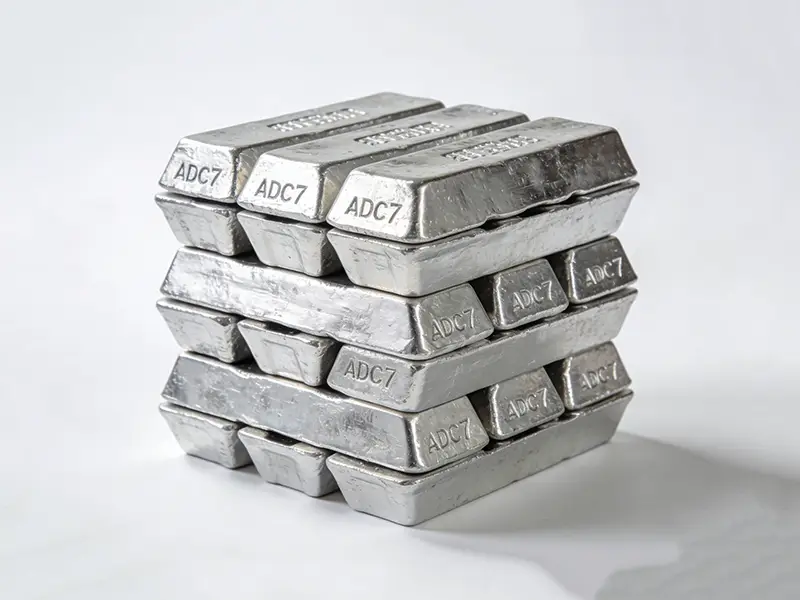
Standards and grades for ADC7
- JIS Standard Grades: According to the Japanese Industrial Standard JIS H 5302, the grade is ADC7The “ADC” stands for “Aluminum Die Casting”. “ADC” stands for "Aluminum Die Casting" and "7" is the number of the alloy in the series with specific composition and properties.
- Core features:Zinc as a major fortifying element (6.0-8.01 TP3T) Provides significant solid solution strengthening and aging strengthening effects;Magnesium (0.3-0.6%) additionFormation of precipitated reinforced phases such as MgZn₂ further enhances the strength;Strict limitation of impurities such as copper (≤0.2%), silicon (≤0.3%), etc.The product is designed to ensure good cutting and machining properties;Heat treatableThe strength can reach the top level of die-cast aluminum alloys after T5 or T6 treatment.
ADC7 Aluminum Alloy Composition Table (based on JIS H 5302 typical requirements)
| elemental | Content range (wt%) | functional role |
|---|---|---|
| Zinc (Zn) | 6.0-8.0 | Core Strengthening Elements. Provides significant solid solution strengthening and aging strengthening and is the primary source of high strength for the alloy. |
| Magnesium (Mg) | 0.3-0.6 | Key Enhancement Elements. Forms precipitated phases such as MgZn₂ with zinc and achieves peak strength by heat treatment. |
| Silicon (Si) | ≤ 0.3 | Tightly controlled impurities. Low silicon content ensures excellent machinability. |
| Copper (Cu) | ≤ 0.2 | Tightly controlled impurities. Low copper content ensures good cutting and corrosion resistance. |
| Iron (Fe) | ≤ 1.0 | Prevents mold sticking during die casting, but needs to be controlled to ensure mechanical properties. |
| Manganese (Mn) | ≤ 0.3 | Neutralizes some of the harmful effects of iron. |
| Titanium (Ti) | 0.1-0.2 (can be added) | Grain refiner. |
| Aluminum (Al) | tolerance (i.e. allowed error) | Substrate material. |
ADC7 Physical and Mechanical Properties Parameter Table (Die-Cast State, Typical Values)
| Performance indicators | Die-cast (F) | T5/T6 heat treatment state | Comparative analysis (vs ADC12) | Core Advantages |
|---|---|---|---|---|
| intensity | 2.80-2.85 g/cm³ | - | Higher than ADC12 | - |
| Tensile strength (Rm) | 220-280 MPa | 320-380 MPa | significantly higher than ADC12 after heat treatment | Core Advantages: Strength is at the top level of die-cast aluminum alloys. |
| Yield strength (Rp0.2) | 150-200 MPa | 260-320 MPa | Much higher than ADC12 | Excellent load-carrying capacity. |
| Elongation (A) | 3.0-6.0% | 2.0-4.0% | Comparable to ADC12 | Maintains good plasticity after heat treatment. |
| Brinell hardness (HB) | 70-85 | 100-130 | High hardness, good wear resistance | - |
| machinability | talented | talented | Significantly better than ADC12 | Core Advantages: Low silicon design for low tool wear. |
| dimensional stability | favorable | talented | Better than ADC12 | Dimensional stability after heat treatment. |
| corrosion resistance | general | general | Below ADC12 | Higher zinc content and medium corrosion resistance. |
| Casting mobility | moderate | - | Below ADC12 | Very low silica content and average fluidity. |
ADC7 Performance Enhancement Path and Technical Features
The ADC7 was designed with the concept of “Zinc and magnesium reinforcement as the core, featuring cuttability”:
- Zinc-magnesium composite reinforced: Zinc (6-8%) has a high solid solubility in aluminum and provides significant solid solution strengthening. Combined with magnesium (0.3-0.6%), it forms, after heat treatment, aMgZn₂, Al₂Mg₃Zn₃, and other precipitated reinforced phasesThe strength of ADC7 is a very strong aluminum alloy, which is at the top level of die-cast aluminum alloys (tensile strength up to 320-380 MPa in the T6 state). This strengthening mechanism makes ADC7 in strengthOutperforms common die-cast alloys such as ADC12 and A380, approaching the level of some wrought aluminum alloys.
- Excellent machinability: Extremely low silicon content (≤0.3%) is the key to ADC7's excellent machinability. Silicon forms hard particles in aluminum alloys and accelerates tool wear.The low silicon design of ADC7 makes itLow cutting resistance, long tool life and high surface finishIt is especially suitable for precision parts that require extensive drilling, tapping and milling.
- Good dimensional stability: Zinc-magnesium alloys after heat treatment have aExcellent dimensional stabilityT5 treatment (artificial aging) allows for significant strengthening with small deformations.
- High flexibility in heat treatment: ADC7 is available in a variety of heat treatment regimes to obtain different combinations of properties:
- T5 manual aging: 120-150°C × 4-8 hours, with obvious strength improvement and small deformation.
- T6 solid solution + aging: Solid solution at 450-480°C, water quenching, and re-aging. Peak strength can be obtained.
- T7 time-barred: Better dimensional stability and resistance to stress corrosion can be obtained.
- Higher density: Due to the high zinc content (6-8%), the density of ADC7 (approx. 2.82 g/cm³) is higher than that of ordinary aluminum-silicon alloys (approx. 2.68 g/cm³), which needs to be weighed in situations where lightweighting is critical.
ADC7 international grade
ADC7 has a clear international correspondence as an aluminum-zinc die casting alloy:
| (an official) standard | grades | note |
|---|---|---|
| Japan JIS | ADC7 | - |
| ASTM, USA | A712.0 (Al-Zn6Mg) | Consistent compositional system, similar range of zinc content |
| China GB | YL207 or customized grades | Fewer domestic applications, mostly customized |
| EU EN | EN AC-71000 (Al-Zn10Si8Mg) | Differences in composition, higher zinc content |
| International ISO | AlZn6Mg | having a correspondence |
Application of ADC7 in die casting industry
based on itsHigh strength, excellent machinability, good dimensional stabilityThe unique combination of the ADC7 is mainly used in the following areas:
- Auto Parts
- Precision structural parts: Sensor housing, fuel injection system components, ABS module housing.
- transmission system: Transmission valve bodies, shift forks, clutch components.
- interior components: Seat adjuster components, door locking mechanisms, seat belt retractor components.
- new energy vehicle: Electronic control unit housing, motor end caps, connector parts.
- Motorcycles and General Dynamics
- Engine components: Cylinder head covers, crankcase covers, carburetor housings.
- transmission part: Transmission housing, clutch cover.
- General machinery and industrial equipment
- Hydraulics and Pneumatics: Hydraulic valve bodies, cylinder end caps, pump bodies.
- precision instruments: Measuring equipment housings, optical instrument holders, industrial robot joints.
- power tool: Electric drill gearboxes, angle grinder housings, impact wrench housings.
- electronic equipment
- Precision housings: High-end audio shells, structural parts for photographic equipment, projector shells.
- connectors: Industrial connector shells, fiber optic connectors.
ADC7 Aluminum Alloy Frequently Asked Questions
Q1: What is the main difference between ADC7 and ADC12? How to select the type?
- Here's the core comparison:
- ADC7:Aluminum-zinc-magnesium system, Zinc 6-8%, Magnesium 0.3-0.6%, Silicon ≤ 0.3%.Heat treatablethat the strength after heat treatment (320-380 MPa) was significantly higher than that of ADC12.Excellent machinability and dimensional stabilityLibyan Arab JamahiriyaAverage corrosion resistance, poor castability, high density.
- ADC12:Aluminum-silicon-copper system, silicon 9.6-12%, copper 1.5-3.5%.Not heat treatableThe strength in cast form is 280-310 MPa.Excellent castability, poor corrosion resistanceThe cut and machinability is average.
- selection: RequirementsHigh strength, precision machining, dimensional stability选ADC7Pursuits.Optimal castability, cost-sensitive, moderate strength requirements选ADC12.
Q2: Why is ADC7's cutting and machinability so good?
- The root cause isVery low silicon content (≤0.3%). Silicon forms hard silicon particles in aluminum alloys and is a major source of tool wear.ADC7 keeps silicon at a very low level, while the moderate hardness of the zinc-magnesium alloys and the short fragmentation of swarf result in aLow cutting resistance, long tool life and high surface finish. Tool life can be extended by 30-50% compared to ADC12.
Q3: What are the heat treatment process parameters for ADC7?
- Typical T5 process: 120-150°C × 4-8 hours, air-cooled. Strength enhancement is obvious and deformation is small.
- Typical T6 process: 450-480°C × 4-8 hours solid solution, quenched in warm water, then 120-150°C × 4-8 hours aging. Peak strength can be obtained.
- caveat: The solid solution temperature needs to be precisely controlled to prevent overheating; the quenching transfer speed should be fast; T5 treatment is recommended for important precision parts to avoid quenching deformation.
Q4: What is the casting performance of ADC7? What do I need to pay attention to when designing?
- medium level. Silicon content is only ≤ 0.3%, the mobility is far inferior to high silicon alloy (such as ADC12). Care needs to be taken when designing the casting system:
- Appropriately increase the gate size, increase the pouring temperature and mold temperature (recommended mold temperature 200-250°C).
- Avoid excessively thin-walled structures (recommended minimum wall thickness ≥ 2.5 mm).
- Enhance the exhaust design to prevent porosity defects.
- Suitable for medium wall thickness castings with relatively simple shapes.
Q5: How is the corrosion resistance of ADC7? Does it need surface treatment?
- general. Higher zinc content (6-8%) and less corrosion resistance than aluminum-silicon-magnesium alloys (e.g. ADC2) and aluminum-magnesium alloys (e.g. ADC5, ADC6). Used in wet or outdoor environments.Surface protection is recommendedFor example, painting, electrophoresis, anodizing (the film layer may be grayish), and so on. For indoor dry environment, no additional treatment can be done.
Q6: What is the welding repair performance of ADC7?
- moderate. Higher zinc content results in a slightly higher tendency to weld hot cracks than lower zinc alloys. When performing TIG welding filler welds, it is recommended toPreheating (100-150°C)The same quality of wire is used, and the welding is performed after welding.stress reliefThe following are some examples of the types of welding that should be done. For critical load-bearing parts, make-up welding should be minimized.
Q7: Can ADC7 be used to manufacture high-strength structural parts?
- canADC7-T6 has a tensile strength of 320-380 MPa, one of the strongest grades of die-cast aluminum alloys, and is suitable for the manufacture of structural components with high strength requirements. However, it should be noted that its density is high (about 2.82 g/cm³), in the lightweight requirements of demanding occasions need to be weighed. At the same time, its corrosion resistance is general, in the corrosive environment need to be surface protection.
📊 Extended column: ADC7 vs. ADC12, ADC2 comparative analysis
| comparison dimension | ADC7 (Al-Zn-Mg system) | ADC12 (Al-Si-Cu system) | ADC2 (Al-Si-Mg system) |
|---|---|---|---|
| Silicon (Si)% | ≤0.3 | 9.6-12.0 | 9.0-10.0 |
| Zinc (Zn)% | 6.0-8.0 | ≤1.0 | ≤0.5 |
| Magnesium (Mg)% | 0.3-0.6 | ≤0.3 | 0.4-0.6 |
| Copper (Cu)% | ≤0.2 | 1.5-3.5 | ≤0.2 |
| hot treatment (e.g. of metal) | Can be T5/T6 enhanced | Not heat treatable | Enhanceable T5 |
| Tensile strength (cast) | 220-280 MPa | 280-310 MPa | 220-260 MPa |
| Tensile strength (T5/T6) | 320-380 MPa | - | 280-320 MPa |
| elongation | 2.0-4.0% | 1.5-3.0% | 2.5-4.0% |
| machinability | talented | general | favorable |
| Casting mobility | moderate | talented | favorable |
| corrosion resistance | general | mediocre | favorable |
| intensity | 2.80-2.85 g/cm³ | 2.68-2.71 g/cm³ | 2.65-2.68 g/cm³ |
| Typical Costs | high | moderate | moderate |
Selection Quick Guide:
- Select ADC7.: When the part requiresMaximum strength, precision machining, dimensional stabilityFor example, precision structural parts, high-load parts, and products requiring extensive machining.
- Select ADC12: The QuestOptimum castability, cost-effectivenessWhen strength requirements are moderate.
- Select ADC2: RequiredHigher strength combined with good corrosion resistanceand when heat treatment is acceptable.