


China Aluminum Casting Suppliers with In-house CNC Machining Capabilities - Guide (2026)
Article Catalog[Hidden]
- Why China's aluminum casting suppliers need in-house CNC machining capabilities
- Process Advantages and Application Scenarios of Low Pressure Aluminum Casting China Factory
- Core evaluation criteria for suppliers of integrated aluminum casting and CNC machining
- ISO9001 certification for aluminum alloy foundry of practical significance and verification methods
- Explanation of the whole process quality control system from casting to finish machining
- A look at the cost structure of China's integrated aluminum casting and processing suppliers
- How to efficiently screen and review China aluminum casting CNC machining suppliers
- Common Risks and Avoidance Strategies in Working with Chinese Aluminum Casting Suppliers
- Frequently Asked Questions about China Aluminum Casting CNC Machining suppliers
- Decision Summary and Recommended Actions for Selecting a China Integrated Aluminum Casting Supplier
According to Grand View Research, Global Aluminum Castings Market size by 2025 has surpassed$105 billionIn fact, more than 65% of these export orders go to factories with integrated casting and finishing capabilities - and China occupies the absolute center of this supply chain. If you're looking for a Chinese aluminum casting supplier with in-house CNC machining capabilities, it's not a matter of "who to find" but rather "what criteria to use". This guide will systematically break down the complete decision-making framework for selecting an integrated Chinese aluminum casting CNC machining supplier in 2026, from process capability, quality certification, cost structure to risk aversion.
Why China's aluminum casting suppliers need in-house CNC machining capabilities
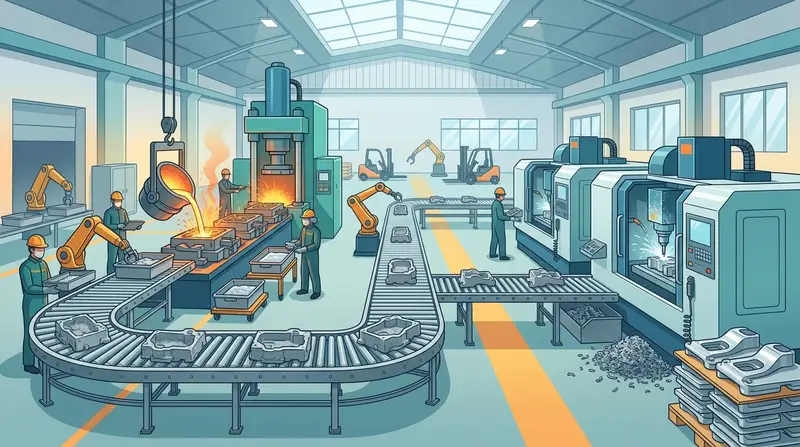
When sourcing aluminum castings, many buyers look for a foundry and a machine shop separately and then coordinate the two ends themselves. This model may seem flexible, but it's actually eating into your profits and time. A Chinese aluminum casting supplier with in-house CNC machining capabilities can fundamentally change supply chain efficiency.
Lead time can be shortened 30%-40%
The castings are transferred from factory A to factory B for finishing, which involves logistics, incoming material inspection, scheduling and waiting, etc., usually adding an extra 7-12 working days. An all-in-one supplier eliminates these intermediate steps - the castings are directly put on the CNC machining center after demolding and cooling, and the overall delivery cycle can be compressed to less than 15 days.
Significant improvement in dimensional accuracy consistency
Aluminum castings have shrinkage differences, and there are small fluctuations in the size of the blanks from batch to batch. When the outsourcing machine shop gets the castings, it often needs to re-establish the datum and adjust the fixture parameters. While the internal CNC workshop and casting workshop share the same set of process database, the machining datum and casting datum are completely aligned, and the key dimensional tolerances can be stably controlled at ±0.05mm.
According to the McKinsey Global Manufacturing Supply Chain Report, quality defects resulting from multi-supplier coordination account for 18%-25% of the total defect rate. single-source consolidation is the most direct means of reducing this risk.
Total cost of ownership advantage goes beyond processing fees
- Zeroing out logistics costs:Elimination of packaging and transportation costs for castings between plants
- Lower communication costs:One project manager for the entire process, rather than managing technical interfaces with two separate vendors
- Scrap rates are down:Casting defects are intercepted before machining, avoiding wasted machining hours on substandard blanks
Choosing an integrated Chinese aluminum casting supplier with in-house precision machining capabilities is essentially trading a cleaner supply chain structure for greater quality certainty and lower hidden costs. This is not icing on the cake, but a fundamental threshold in the global sourcing competition of 2026.
Process Advantages and Application Scenarios of Low Pressure Aluminum Casting China Factory
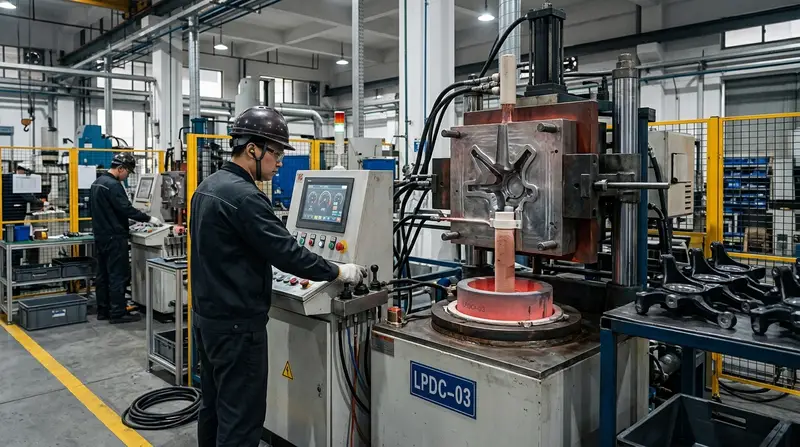
Low Pressure Die Casting (LPDC, Low Pressure Die Casting) core principle is not complicated: sealed crucible into the 0.02-0.06MPa dry compressed air, the molten aluminum from the bottom of the ascending liquid tube slowly pressed into the mold cavity, solidified after the release of the pressure, the excess liquid aluminum flow back. This "bottom-up" filling method determines that it is far superior to gravity casting in terms of density and mechanical properties.
Key differences from gravity casting and high pressure die casting
| norm | Low Pressure Casting (LPDC) | Gravitational casting | High Pressure Die Casting (HPDC) |
|---|---|---|---|
| Filling Pressure | 0.02-0.06MPa | Dependent on their own gravity | 30-100MPa |
| Internal porosity | ≤1% | 2-5% | 3-8% |
| heat treatability | T6 heat treatment feasible | practicable | not normally |
| Wall thickness range | 3-25mm | 5-50mm | 1-6mm |
| Aluminum Liquid Utilization | ≥90% | Approx. 60-70% | Approx. 40-50% |
High-pressure die-casting speed, but the volume of gas is serious, castings can not do T6 strengthening treatment. Gravity casting cost is low, but the organization is loose, poor dimensional consistency. Low-pressure casting just fill the performance gap between the two.
Typical applications of LPDC plants in China
- Automotive structural components:Aluminum alloy steering knuckle, subframe, battery pack shell - the domestic head factory adopts A356.2 aluminum alloy low-pressure casting, the tensile strength after T6 treatment can reach more than 290MPa, and the yield rate is stable at 92-95%.
- Motor housing:The new energy drive motor casing requires very high concentricity (usually ±0.05mm), low pressure casting blanks with internal CNC finishing is the most economical way to achieve this.
- LED radiator:High power industrial lighting cooling module, fin wall thickness can be controlled within 3mm, thermal conductivity better than die casting 15-20%
Choosing a Chinese aluminum casting supplier that masters both the LPDC process and precision machining—and has in-house CNC machining capabilities—means that casting tolerances can be precisely corrected during post-processing, rather than being the subject of repeated back-and-forth between two factories. According to the 2024 industry report by the China Foundry Association, domestic low-pressure casting production capacity already accounts for 38% of the global market share, and the cost advantages derived from economies of scale are unlikely to be replaced in the short term.
Core evaluation criteria for suppliers of integrated aluminum casting and CNC machining
When evaluating a Chinese aluminum casting supplier with in-house CNC machining capabilities, you can’t just look at the factory gates and brochures. What truly determines the success or failure of a partnership are several quantifiable key metrics.
Equipment Configuration: Three Axis Enough or Five Axis Necessary?
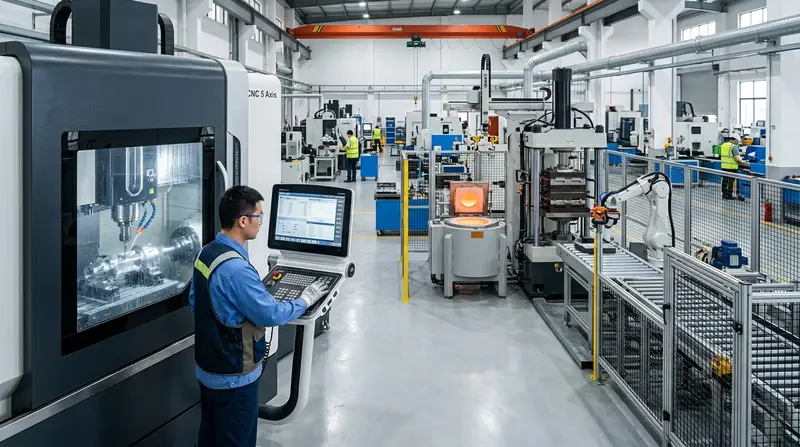
If your castings only require flat surface milling and basic hole machining, three-axis vertical machining centers such as the Fanuc Robodrill series are perfectly suited for the job. But parts involving complex curved surfaces, deep cavity structures or multi-angle features - such as automotive turbine housings or aerospace mounts - can only be machined in a single setup by 5-axis machining centers (such as DMG MORI and Haitian Precision), with tolerances controlled to within ±0.02mm Tolerances are controlled to within ±0.02mm. When asking suppliers for a list of equipment, focus on spindle speed, stroke range and age. Equipment that is more than 8 years old has a high risk of accuracy degradation.
Casting process matching and capacity scale
- Process Type:Does the supplier have both gravity casting, low pressure casting and high pressure die casting capabilities? Single process plants are not flexible enough for different wall thicknesses and volume requirements
- Annual capacity:Small factories with a monthly production capacity of less than 50,000 pieces are subject to significant lead time fluctuations after receiving large orders; factories with a monthly production capacity of more than 200,000 pieces are usually equipped with automated pouring and pickup systems.
- Alloy grade coverage:The ability to handle common grades such as A356, ADC12, AlSi9Cu3, etc., directly affects the freedom of material selection for your product
Technical depth of the engineering team
A key judgment method: after sending 3D drawings, whether the other party can provide feedback on the DFM (design for manufacturability) report within 48 hours, pointing out problems such as insufficient draft angle and uneven wall thickness. Aluminum casting CNC machining integration suppliers in China with this capability usually have an engineering team of no fewer than five full-time engineers with foundry or mechanical engineering degrees, and are skilled in using casting simulation software such as MAGMASOFT or ProCAST.
ISO9001 certification for aluminum alloy foundry of practical significance and verification methods
Almost every Chinese foundry can produce an ISO9001 certificate, but the certificate itself says nothing. The key lies in whether the quality management system really works.
The three core landing metrics behind certification
A qualified Chinese aluminum casting supplier with in-house CNC machining capabilities has an ISO 9001 system that is traceable at least at the following levels:
- Incoming Material Inspection Record (IQC)--Whether the spectral analysis reports of aluminum ingots are kept on file batch by batch, and whether the Si content of A356.2 alloy is controlled within the range of 6.5%-7.5%.
- Process control documentation-Whether there is a work instruction (WI) for each process, and whether there are real-time records of parameters such as pouring temperature and mold preheating temperature.
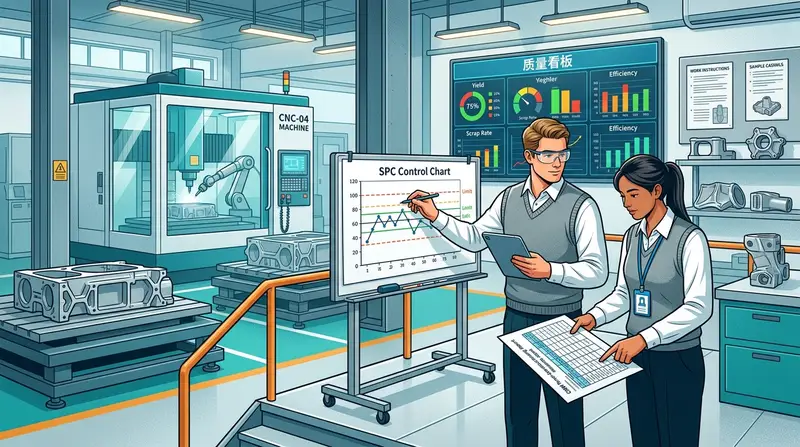
- SPC Statistical Process Control--Whether the Cpk value of critical dimensions is ≥1.33, and whether the control charts are continuously updated instead of being filled in unannounced prior to audit
How to verify the authenticity of certification when auditing a factory
Don't just look at the certificates hanging on the wall. Ask for the last three months' internal audit reports and nonconforming product handling records (NCR) to see if the corrective measures close the loop. An effective method: Randomly select the production work order of a certain batch of castings, and track from the raw material receipt to the CMM inspection report after CNC processing to see if the whole chain of data can be corresponded. The system of a factory with a broken data chain is basically a sham.
The authenticity of the certificate number can be verified through the official website of IAF (International Accreditation Forum) or the official website of the certification body, and SGS, TÜV, BSI and other organizations provide online inquiry.
Explanation of the whole process quality control system from casting to finish machining
Quality is not something that the final inspection "gatekeeper" can cover, it must be embedded in every process. A truly mature Chinese aluminum casting supplier with in-house CNC machining capabilities has at least five key nodes covered by its quality control.
Mold design and melting stage
Mold design stage using mold flow analysis software (such as MAGMA or ProCAST) to simulate the filling and solidification process, in advance to identify the risk of shrinkage, cold segregation. In the melting process, the composition of the aluminum liquid is monitored in real time by a spectrometer, and the deviation of elements such as Si, Mg, and Fe needs to be controlled within ±0.05%, otherwise the subsequent heat treatment and machining performance will be affected.
Post-cast inspection: seeing defects invisible to the naked eye
- X-ray flaw detection (RT):According to ASTM E505 standard, detect the internal porosity and shrinkage of castings, and determine whether the defect level meets the customer's requirements.
- Air tightness test:Leakage rates of less than 1cc/min at 0.3-0.5MPa pressure on housing parts are a hard threshold for the automotive and new energy industries.
- T6 Hardness test after heat treatment:After solid solution aging of A356 aluminum alloy, the Brinell hardness should reach HB 75-95.
CNC finishing and final inspection closed loop
In the finishing stage, Coordinate Measuring Machine (CMM) is the core weapon. The Cpk value of critical dimensions should be ≥1.33, and the first article inspection report (FAI) needs to be output in AS9102 format. The advantage of the integrated factory is that after CNC machining finds internal defects in the casting, the information can be fed back to the foundry to adjust the process parameters within 24 hours, forming a real closed loop of quality.
In a separated supply chain, it is the norm for foundries and machine shops to shift responsibility for defects to each other. Full-process quality control can only really take hold under one roof.
A look at the cost structure of China's integrated aluminum casting and processing suppliers
The question that is always at the forefront of the minds of purchasing decision makers is: where exactly does the integrated model save? To answer this question, one must first disassemble the cost components of a typical aluminum casting order.
Typical Order Cost Component Ratio
| cost item | Percentage (reference range) | instructions |
|---|---|---|
| Mold Costs | 15%-25% | High amortization for the first order, decreasing order by order after mass production |
| Aluminum Alloy Materials | 30%-40% | Most affected by LME aluminum price volatility |
| Foundry processing fee | 15%-20% | Including melting, pouring and cleaning processes |
| CNC Finishing Fee | 10%-18% | Depends on tolerance class and number of processes |
| surface treatment | 5%-8% | Anodizing, powder coating, electrophoresis, etc. |
| Packaging & Logistics | 5%-10% | Sea freight lead time is usually 20-35 days |
TCO advantages of the all-in-one model
Under the subcontracting model, castings are transferred from the foundry to an external machine shop, adding 8%-12% hidden costs for transit logistics and secondary clamping calibration alone. A Chinese aluminum casting supplier with in-house CNC finishing capabilities, with in-house CNC machining capabilities, can compress this cost to near zero.
According to industry empirical data, the total cost of ownership (TCO) of an integrated supplier is on average 15%-22% lower than the subcontracting model, and the lead time is shortened by 30%-40%.
The subcontracting model also has a black hole in cost that is easily overlooked - quality rework. When casting and machining are split between two factories, the responsibility for dimensional overruns is often tied up for weeks, and the cost of rework is ultimately borne by the buyer. With closed-loop processing within an all-in-one supplier, scrap rates are usually kept within 1.5%, a figure that can soar to 4%-6% under the subcontracting model.
So, don't just focus on the single-piece offer when comparing prices. Logistics transit, secondary inspection, rework losses, communication time costs are all discounted, is the real cost of procurement.
How to efficiently screen and review China aluminum casting CNC machining suppliers
Online primary screening: quickly narrowing down the field of candidates
When searching on Alibaba International, Global Sources or Made-in-China platforms, focus on screening three hard conditions: factory establishment ≥ 8 years, having passed ISO9001 on-site audits (not held by a trading company on behalf of a trading company), and product cases clearly demonstrating that casting and CNC machining are completed in the same factory. Control the candidate list at 5-8, and send standardized RFQ one by one.
Four Required Elements of RFQ Technical Documentation
- 3D model (STEP format) and 2D drawing (PDF) with tolerance markings
- Designation of aluminum alloy grades (e.g. A356-T6) and mechanical property requirements
- Estimated annual usage and batch delivery cadence
- CPK target values for surface finish specifications and critical dimensions (recommended ≥ 1.33)
The more precise the technical documentation, the less deviation from the quote. Fuzzy RFQs only invite "lowball" offers.
Focus of Remote Video Factory Inspection
Suppliers were asked to live stream the workshop on their cell phones instead of playing an edited promotional video. Focused observation: CNC machine tool spindle running status, whether the tool management rack is categorized and orderly, whether the coordinate measuring room is independent and constant temperature. A real aluminum casting supplier (China) with in-house CNC machining capability will not avoid showing the machining site in real time.
FAI Assessment and Long-Term Performance Management
The first article inspection report (FAI) should be executed according to AS9102 or PPAP standards, covering all critical dimensions. After the samples are qualified, a supplier scorecard is established to track four KPIs on a monthly basis: on-time delivery rate (target ≥95%), lot qualification rate (target ≥98%), response time to customer complaints (≤24 hours), and the number of continuous improvement proposals. Performance data is reviewed quarterly, and alternative supplier development is initiated if the target is not met for two consecutive quarters.
Common Risks and Avoidance Strategies in Working with Chinese Aluminum Casting Suppliers
The selection of a Chinese aluminum casting supplier with in-house machine tool machining capabilities does not mean that the risk is zero. The following four types of problems recur in actual cooperation and must be locked down in advance with contracts and processes.
intellectual property leakage
Include explicit NDA clauses in contracts requiring suppliers not to pass drawings and 3D models to third parties. Key practices: Split core dimensions to be processed by different suppliers, or embed "fingerprint markers" in drawings to trace the source of leaks.
Delivery delays and batch fluctuations
Late liquidated damages (usually 0.5%-1%/day of the order amount, with an upper limit of 8%-10%) are agreed upon in the contract, and the supplier is also required to submit weekly photos of the production progress and the number of work-in-progress. The list of critical dimensions with CPK ≥ 1.33 and the AQL standard for each batch of sampling must be written in the Quality Agreement (QA Agreement).
communication disorder
Designate a unique docking window and require a written response to technical questions within 48 hours. Use annotation software (e.g. Bluebeam) to annotate directly on drawings, reducing the rate of misinterpretation by more than 60% compared to plain text emails.
Supply Chain Backup Strategy
- Certify at least two aluminum casting suppliers with integrated CNC machining capabilities, with the main plant accounting for 70% of the order quantity and the alternative plant accounting for 30%
- The ownership of the mold must be specified in the contract for the buyer to ensure that it can be transferred to the factory at any time.
- Quarterly small batch validation orders to alternative plants to maintain their line proficiency
Core principle: all verbal promises do not count, what is written into the contract is guaranteed.
Frequently Asked Questions about China Aluminum Casting CNC Machining suppliers
What is the typical minimum order quantity?
Most Chinese aluminum casting suppliers with in-house machine tooling capability have MOQ between 500-1000 pieces. Small trial production (50-200 pieces) can usually be picked up as well, but the unit price will go up 15%-30% and the tooling cost will not be shared.
How long does it take from order to delivery?
New mold development is about 25-35 days, mass production cycle after T1 sample confirmation is usually 20-30 days. If casting and CNC are done in the same factory, it is on average 7-10 working days faster than the subcontracting model.
What's the best way to choose between A356 and ADC12?
- A356 (AlSi7Mg)--Suitable for low-pressure/gravity casting, tensile strength of T6 after heat treatment can reach more than 290MPa, prioritized for structural components, automotive chassis components
- ADC12 (Al-Si-Cu system)-Preferred for high-pressure die casting, good fluidity, low cost, suitable for thin-walled shell parts, but cannot be heat-treated and strengthened.
What surface finish options are available?
Common solutions include anodizing, powder coating, electrophoretic coating, sandblasting and chemical nickel plating. The anodized film thickness is usually 10-25μm, and the salt spray resistance can reach more than 500 hours.
How is the sample fee calculated?
The initial mold opening fee ranges from $8,000 to $50,000 depending on the complexity of the part. Most factories promise to return part of the mold fee after the mass production reaches the agreed quantity. Sample shipping cost is usually borne by the buyer, and we recommend using DHL or SF International, which can be reached in 3-5 days.
Decision Summary and Recommended Actions for Selecting a China Integrated Aluminum Casting Supplier
After reading the previous nine chapters, you've mastered all the key dimensions needed to evaluate a Chinese aluminum castings supplier with in-house machine tool machining capabilities. All that's needed now is a actionable checklist to translate the information into sourcing decisions.
Vendor evaluation scorecard framework
| Assessment dimensions | Weighting recommendations | Core validation methods |
|---|---|---|
| Casting + CNC co-location capabilities | 25% | Video factory inspection or third party audit report |
| Quality System Operation Facts | 20% | Spot check SPC records, PPAP documentation package |
| Matching equipment accuracy to capacity | 20% | Equipment list + crop rate data for the last three months |
| Cost transparency | 15% | Request split quote to material/mold/processing/surface treatment |
| Risk Management Clause | 10% | NDA, mold attribution, quality claim mechanism |
| Responsiveness and communication efficiency | 10% | Quality of response within 48 hours of first inquiry |
Each item is scored on a scale of 1-5, and suppliers with a weighted total score of ≥4 are shortlisted for final selection. Those with less than 3.5 points are directly eliminated, so don't take any chances.
Your next move
- this week: Initial screening of 5-8 candidate factories on the platform according to the methodology in Chapter 7, sending a standardized RFQ.
- in two weeks: Receive quotes and score them using the scorecard above, sifting down to 2-3.
- Within a month: Arrange on-site factory inspections or commission third party audits such as SGS to confirm the authenticity of equipment and systems.
- first order: Verify dimensional consistency (Cpk ≥ 1.33) and delivery accuracy with a small batch of less than 500 pieces for trial production.
Core principle: Don't gamble on the lowest priced supplier. Choosing a Chinese supplier with true integrated casting and CNC machining capabilities, and spending an extra two weeks up front to validate, can save you months of rework and tug-of-war during the mass production phase.