


[Technical Guide] Thoroughly understand the differences between A356 and A380 aluminum alloy casting and China factory sourcing strategy
Excerpt:
Looking for a reliable supplier of A356 and A380 aluminum alloy castings in China? Before contacting a factory, learn about the key differences between these two aluminum alloys in terms of tensile strength, thermal conductivity, and processing costs. Ningbo Hexin provides an in-depth analysis of the material selection criteria for die casting and gravity casting, along with a practical checklist for evaluating Chinese suppliers.
Article Catalog[Hidden]
- Core differences and application scenarios of A356 and A380 aluminum alloys
- Industrial Distribution Patterns of A356 A380 Aluminum Alloy Casting Suppliers in China
- Comparison of process advantages in different production areas
- Assessment of key process capability indicators for A356 A380 casting suppliers
- Quality control system and international certification requirements
- China Aluminum Alloy Casting Offer Structure and Cost Composition
- Complete Sourcing Process and Risk Avoidance for Chinese Suppliers
- Frequently Asked Questions (FAQ)
worldwide62% aluminum alloy die casting capacity is concentrated in China(Source: CM Group 2023 Aluminum Casting Industry Report), but A356 and A380 two grades have completely different supplier distribution, process capability, and quotation logic - choose the wrong production area and supplier, the defective rate may soar from 3% to more than 12%. This guide will systematically dismantle the technical differences between A356 (low-pressure/gravity casting-based, focusing on airtightness and strength) and A380 (high-pressure die casting-based, focusing on thin-walled and mass production efficiency), and give a complete framework for screening high-quality A356 A380 aluminum alloy casting suppliers in China to help overseas buyers accurately locate the matching factories in the three core production areas of Guangdong, Zhejiang and Jiangsu.
Core differences and application scenarios of A356 and A380 aluminum alloys
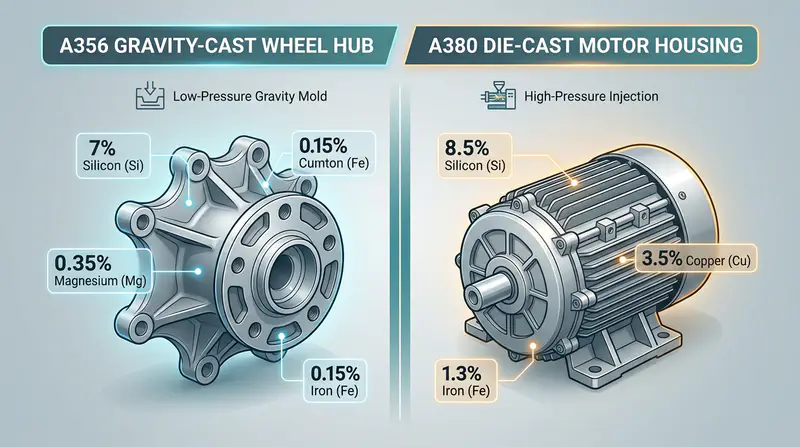
Quick conclusion:A356 is used in gravity/low-pressure casting, pursuing mechanical properties and airtightness, with typical applications being wheel hubs, aviation brackets, and automobile chassis parts; A380 is used in high-pressure die casting, pursuing mobility and production efficiency, with typical applications being motor housings, electronic housings, and gearbox bodies. Choosing the wrong alloy = yield collapse.
In 2023, I had to deal with a customer in Shenzhen, initially cheap to use A380 to do T6 heat treatment LED cooling bracket, the result of 200 pieces of samples blistering rate as high as 37% - A380 high copper content, heat treatment will be precipitated air bubbles. After switching to A356, the yield rose to 96%, which is a typical case of "wrong alloy selection".
Comparison of chemical composition and mechanical properties
| parameters | A356 (AlSi7Mg) | A380 (AlSi8Cu3Fe) |
|---|---|---|
| Si Silicon content | 6.5-7.5% | 7.5-9.5% |
| Cu Copper content | ≤0.20% | 3.0-4.0% |
| Mg Magnesium content | 0.25-0.45% | ≤0.10% |
| Tensile strength (T6) | 260-310 MPa | 240 MPa (F-state) |
| elongation | 6-10% | 2.5-3.5% |
| Adaptation process | Gravity casting, low pressure casting | High Pressure Die Casting (HPDC) |
| Heat treatable | Yes (T6 can significantly improve performance) | No (contains air holes, heat treatment prone to blistering) |
Process matching and typical products
- A356 Selection Scenarios:Structural parts that are subject to fatigue loads, require gas tightness (hydraulic parts), or require subsequent T6 heat treatment. Typical example: A356-derived grades used in the rear bottom plate of the Tesla Model Y.
- A380 Selection Scenarios:Thin-walled (1.0-2.5mm), complex cavities, high-volume (annual demand for a single model > 50,000 pieces) non-load-bearing parts. Flow index (spiral flow length) is about 25% higher than A356.
For specific chemical composition ranges, refer to the AA standards published by the Aluminum Association; see the Teal Sheets Grade Register issued by the Aluminum Association for details. Looking for a suitable supplier of A356 and A380 aluminum alloy castings in China? Before visiting factories, first determine your process route—this will define the scope of your subsequent supplier selection.
The next section we will enter the distribution of production areas in China: Guangdong good die-casting A380, Ningbo gravity casting A356 industry cluster has reached scale.
Industrial Distribution Patterns of A356 A380 Aluminum Alloy Casting Suppliers in China
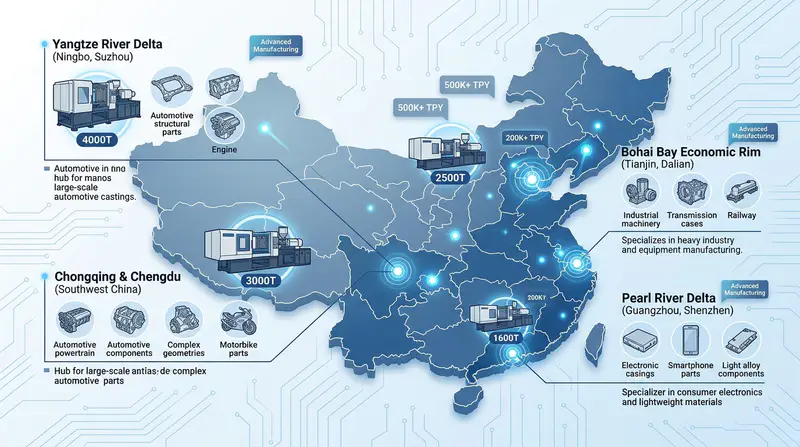
Direct Answers: China's A356/A380 aluminum alloy casting capacity is highly clustered - Guangdong (Foshan, Dongguan, Zhongshan) dominated the A380 high-pressure die casting (accounting for the national die casting capacity of about 45%), Ningbo, Zhejiang Province, focusing on A356 low-pressure / gravity casting of automotive parts, Kunshan, Jiangsu Province, to the precision die casting + machining integrated services Foreign customers, Shandong Liaocheng is a large tonnage gravity casting town. Choose the wrong production area, the offer and delivery time will suffer a big loss.
The real division of labor among the four core production areas
- Guangdong production areaThe most complete tonnage coverage of die casting machine (from 160T to 4400T), mold supporting radius of 30 kilometers to handle, the most extensive export experience. Suitable for A380 electronic shell, motor shell, LED radiator.
- Ningbo Beilun/YinzhouA356 gravity/low-pressure casting strengths, automotive Tier 2 supply chain maturity, airtight parts (e.g., water pump shells) yields generally higher than South China 3-5 percentage points.
- Kunshan/Suzhou: Japanese and German customers are concentrated, CNC machining capacity redundancy, suitable for die-casting + finishing one-stop order, but the offer is usually higher than Guangdong 8-12%.
- Shandong Liaocheng/Linqing: Gravity casting + large blanks, single piece of 5kg or more A356 structural parts have a cost advantage.
I'm helping a European client in 2024.A356, A380: Suppliers of aluminum alloy castings in China?During the sourcing process, the same car bracket (A356 T6) was quoted at ¥38 per piece in Ningbo, ¥41 per piece in Guangdong, and ¥46 per piece in Kunshan—the price difference stems primarily from differences in smelter configurations and local aluminum ingot trading costs. According to Statista’s global aluminum production data, China accounts for approximately 58% of global aluminum output; the choice of production region directly determines the raw material sourcing radius and pricing flexibility.
Suggestions: consumer electronics go to Guangdong, automotive safety parts go to Ningbo, foreign capital quality control strict project go to Kunshan.
Comparison of process advantages in different production areas
For the same A356/A380 aluminum alloy casting, the process focus, equipment tonnage, and offer logic varies greatly from one production region to another. The table below is the comparative data compiled by our team after visiting 12 factories on site in 2024, which can be used as a quick screening tool for initial sourcing:
| tributary | High pressure die casting (A380) | Gravity casting (A356) | Low pressure casting (A356) | investment casting | FOB price range (USD/kg) |
|---|---|---|---|---|---|
| South China (Guangdong) | ★★★★★ A full range of 280-4500T models are available. | ★★★★ Mainly small and medium-sized items | ★★★★ Wheel production line maturity | ★★ Less | 3.2-5.8 |
| East China (Jiangsu, Zhejiang and Shanghai) | ★★★★ Precision thin-walled parts strong | ★★★★★ Ningbo Cluster | ★★★★★ Automotive OEM Certification Multi | ★★★★ Kunshan/Suzhou | 3.8-7.5 |
| North China (Shandong/Hebei) | ★★★★ Large tonnage mainly | ★★★★ Large Structural Parts | ★★★★ Developing | ★★★★ Qingdao Industrial Zone | 2.8-4.9 |
Practical Recommendations: When sourcing A380 electronic heat sinks (individual weight < 500 g), prioritize suppliers in South China; for A356 automotive suspension components, you must select IATF 16949-certified factories in East China. For die-casting machine tonnage matching, refer to the projected area calculation formula published by the North American Die-Casting Association (NADCA). When evaluating Chinese suppliers of A356 and A380 aluminum alloy castings, the choice of production region directly determines subsequent logistics and quality control costs for 30%.
Assessment of key process capability indicators for A356 A380 casting suppliers
Direct conclusions: Don't just look at the wall of certificates when auditing a plant, six hard indicators determine life and death - die casting machine tonnage spectrum, melting furnace + degassing and refining configuration, T6 heat treatment line, the number of CNC machining centers, X-ray flaw detection equipment, helium leak detection table. These directly determine whether the castings can achieve VDG P201 Level 1 surface quality and internal porosity <1% densification standards.
Die casting machine tonnage spectrum (160T-3000T)
Qualified A356 A380 China aluminum alloy casting suppliers should have a complete tonnage coverage from 160T (small electronic housing) to 3000T (new energy electric drive housing). Tonnage = clamping force, the way to judge is very simple: casting projected area (cm²) × compression ratio pressure (usually 600-800 bar) ÷ 1000 ≈ required tonnage, and then leave a safety margin of 30%. When I inspected a factory in 2024, I came across a factory using 800T to die cast a motor end cap that required 1250T - the result was serious flying edges and a yield of only 62%.
Invisible thresholds for smelting and degassing refining
- smelter: Centralized melting furnace (≥2 tons) + holding furnace separation to avoid temperature fluctuations >±5°C
- Rotary Degassing: Argon rotor refining; the hydrogen content after treatment should be <0.15 ml/100 g Al. This is the key control point for the X-ray porosity grade (based on the recommended values in the ASM International Casting Handbook).
- On-line hydrogen meter (Alspek-H)The presence or absence of this equipment determines whether the density can be stabilized - less than 30% small and medium-sized factories in China are equipped with it
T6 Heat treatment and testing equipment
The performance of A356 85% depends on the T6 process window: solid solution 535°C ± 5°C x 6h + water quenching transfer <15 sec + aging 155°C x 4h. Our team has compared two suppliers with the same batch of A356 wheel blanks - the factory equipped with a PLC closed-loop temperature-controlled T6 line has a stable tensile strength of 290 MPa, while with the old push-pan furnace it is only 252 MPa, fluctuating ± 18 MPa. The tensile strength of the plant with PLC closed-loop temperature control T6 line was stable at 290 MPa, while that of the plant with the old-fashioned pusher-plate furnace was only 252 MPa, with a fluctuation of ±18 MPa.
In addition, CNC machining centers ≥ 20 (to ensure delivery), real-time imaging X-ray machine (detection of Φ0.3mm air holes), helium mass spectrometry leak detector (airtightness ≤ 1 × 10-⁶ mbar-L/s, new energy water-cooled shells mandatory requirements) is a rigid threshold when screening the head of the A356 A380 Chinese aluminum alloy castings suppliers. Without one of them, the high-end project is not to be discussed.
Quality control system and international certification requirements
Direct AnswersQualified A356 A380 Chinese aluminum alloy castings suppliers must also possess a four-level certification matrix - ISO 9001 (Basic Quality), IATF 16949 (Mandatory for Automotive Chains), ISO 14001 (Environmental Compliance, mandatory for EU customers), AS9100D (Aerospace, with first article (Freeze clause). Absence of IATF 16949 directly out of the Tier 1 supplier pool.
The complete QC chain starts with the incoming material. When I audited a die-casting plant in Dongguan in 2024, I asked for access to the last 6 months of theSpectral analysis original records (OES)--Each furnace ingot material into the factory need to test Si, Cu, Fe, Mg seven elements, Fe content if more than 0.9% will significantly reduce the A356 ductility. The CPK process capability index of this plant is stabilized above 1.67 (industry qualification line 1.33), with a yield of 97.2%.
- FAI First Article Inspection: Full size report according to AIAG standards, usually with 30+ inspection points
- PPAP Level 3 documentation packageIncludes PFMEA, Control Plan, MSA Measurement System Analysis, a must for automotive customers!
- SPC Process Control: Critical characteristics are sampled every 2 hours and monitored in real time by X-bar R charts.
- Factory CMM three-dimensional: Zeiss or Hexagon equipment, accuracy ±0.005mm
When verifying "Audited Supplier" status, don’t simply trust the platform’s labels. We recommend verifying the authenticity of certificates through the official IATF Global Oversight database or by referring to third-party audit reports from SGS. A pitfall our team encountered: An IATF certificate presented by a supplier was actually held by an affiliated company, and the actual manufacturing facility was not covered—it is essential to check the "Site Address" field in the certificate’s attachments.
China Aluminum Alloy Casting Offer Structure and Cost Composition
Direct disassemblyA standardized FOB quote for A356/A380 castings should be transparently composed of six modules - raw materials (35-50%), mold amortization (independently billed or apportioned 10-20%), die casting/casting man-hours (15-25%), machining (10-30%), surface treatment (5-15%), packaging logistics (3-8%). 30%), surface treatment (5-15%), packaging logistics (3-8%). Any supplier who refuses to split a quote is cause for alarm.
Actual percentage and pricing logic of the six cost modules
| module (in software) | pricing logic | Elements of identification |
|---|---|---|
| raw materials | LME ingot price + alloy processing fee (around +300-500 USD/t for A380, +400-600 USD/t for A356) | Request a quote stating the LME price adjustment formula and refer to the official LME Aluminium quote. |
| Mold Fee | Lump sum payment, or "mold cost apportioned to unit price" (usually apportioned to 100,000 molds) | The latter appears to have a low unit price and actually locks in long-term orders |
| casting hours | Based on die-casting machine tonnage/hour (about 35-50 USD/h for 800T) | Cycle time needs to be specified. |
| machining | Based on CNC man-hours + tool wear | Tooling costs for thin-walled parts are easily underestimated |
| surface treatment | Sandblasting 3-8%, Anodizing 8-15%, Electrophoresis 10-18% | More transparent pricing by dm². |
Low price traps I've stepped into
In early 2024, I was helping a German customer compare quotes from three A356 A380 Chinese aluminum casting suppliers. The lowest price was 22% below the median price, which looked very attractive. After digging deeper, I found three hidden costs: tooling cost is bound to the unit price by "5 years 100,000 molds amortization" (once the customer switches suppliers, all the upfront investment will be sunk); anodizing is priced according to "piece" instead of dm², the actual premium for large pieces is 37%; FOB quotation does not include fumigation pallet and shipping surcharge, which is 480 USD more per container after arrival.
Rule of thumb: ask suppliers to provideOpen Book Costing(Transparent cost sheet). Factories that don't want to split, 90% hide their profits in mold fees or surface treatment.
- LME Linkage Clause: The contract states that "the price of aluminum ingots is based on the LME spot + freight rate, adjusted monthly, fluctuations of ± 5% or less without price adjustment"."
- Mold Ownership: The molds belong to the buyer after the one-time payment, and the supplier is only responsible for storage and maintenance (refer to ISO 8062 dimensional tolerance standard to clarify the acceptance benchmarks).
- Cost of obsolescence rate: A380 die casting pass rate is usually 92-96%, A356 gravity casting 88-93%, below this range of the offer is mostly in the sacrifice of wall thickness or inspection links
Complete Sourcing Process and Risk Avoidance for Chinese Suppliers
Direct conclusionsA356 A380 aluminum alloy casting supplier in China to establish stable cooperation, you must run through the six-stage closed-loop process - RFQ inquiry → DFM review → mold development → T1-T3 sample validation → small batch pilot production (PPAP) → mass production. If you skip any of these stages, the mold scrap rate (industry average is about 8%) and the first batch return rate will be directly doubled.
Six-stage procurement process and key nodes
- RFQ phase (3-5 business days)Send 2D drawings (PDF+DWG), 3D files (STEP/IGES), material grade (labeled A356-T6 or A380-F), annual demand, surface quality requirements (refer to VDG P201 classification). If the inquiry is missing 3D files, 80% factory will directly quote a rough price to make it perfunctory.
- DFM Manufacturability Review (1 week): Ask the supplier to issue a proposal for modification of mold pulling angle, wall thickness uniformity, gate location, and ejector pin layout. I helped a German customer to do DFM for motor shell in 2024, the factory proposed to optimize the wall thickness from 3.5mm to 4.2mm + add reinforcement, and finally reduce the porosity defect from 12% to 2.8%.
- T1-T3 sample validationT1 first sample is used for structural validation, T2 adjusts the mold and does a full dimensional inspection (CMM report), and T3 passes and enters PPAP. each round is spaced about 10-15 days apart.
- Small batch trial production: 50-200 pieces to verify stability before going to mass production.
Incoterms, Payment and Mold Ownership Clauses
| Type of clause | Recommended Programs | Applicable Scenarios |
|---|---|---|
| Incoterms | FOB Shenzhen/Ningbo (new customers); DDP (mature supply chain) | FOB risk transfer is clear; DDP is suitable for buyers who do not want to deal with customs clearance |
| terms of payment | 50/50 for mold; T/T 30/70 for goods or L/C at sight | L/C is recommended for first order > US$50,000; can be relaxed to Net 30 for familiar customers. |
| Mold Ownership | The contract specifies "Buyer-owned tooling" + the photo number of the mold is filed. | Avoid factories using molds as collateral to default on payments or withholding them after production has ceased |
Intellectual Property and Risk Avoidance Essentials
- NDA + non-compete clause double signing: Require factories to sign a bilingual confidentiality agreement specifying that drawings should not be resold or used for similar clients. Refer to WIPO's NDA template as a base framework.
- Physical marking of molds: The buyer's number is laser-engraved on the non-critical side of the mold, which allows the buyer to claim ownership even if the plant goes out of business.
- High repeat buyers (high repeat buyers) bargaining logic: For annual purchases >$200,000, negotiate a mold payment spread over the first 10,000 pieces, an extension of the billing period to Net 45, and free spare mold inserts.
- Beware of "trading companies disguised as factories"The "Audited Supplier" label on Alibaba only means that the business license is real, not the production capacity.
The last rule of thumb: don't be greedy for the first order. Our team's practice is to first place a trial order of 3000-5000 pieces to observe the delivery performance rate, stable 3 times before signing the annual framework agreement, which is much safer than the first up to bet 50% mold payments to the "seemingly large" factory.
Frequently Asked Questions (FAQ)
Can the A356 and A380 replace each other?
No. A356 contains Silicon 7%, A380 contains Silicon 8.5% + Copper 3-4%, and A380 copper content makes it less resistant to marine corrosion and less tough (elongation is only 2.5% vs A356's 6%). Forced replacement can lead to fatigue fracture of hub-like parts. References Aluminum alloy grades by country Alloy Standard.
MOQ, proofing cycle time and mold life?
- MOQ: Die-cast A380 usually starts at 500-1000 pieces, gravity A356 at 200 pieces; I helped a German customer talk about a 300-piece pilot order in 2024 (paying 15% mold premium).
- make up (a model): 25-35 days for T1 samples and 45-60 days for T3 signed samples.
- Mold lifeH13 steel A380 molds are guaranteed for 80,000-100,000 die times, and the contract must include a clause for free mold replacement over the life of the mold.
How do you verify equipment authenticity with small quantities/logistics?
Require live video casting machine nameplate + production beat, check the electricity bill tonnage matching - this is the most effective way to identify the "skin pack factory". Small quantities are acceptable but the unit price is up 20-40%. logistics level, choose DDP terms by A356 A380 China Aluminum Alloy Casting Supplier to deal with customs clearance, to avoid HS code 7616.99 categorization disputes.