


China vs India Aluminum Casting Cost Comparison Full Analysis
Excerpt:
In-depth comparison of China and India aluminum casting cost differences, covering raw materials, labor, energy, logistics and quality and other core dimensions, to provide real quotes data and sourcing decision-making advice to help global buyers choose the most cost-effective aluminum castings supplier.
Article Catalog[Hidden]
- Core Findings of Aluminum Casting Cost Comparison between China and India
- Six core elements that affect the cost of aluminum casting
- Comparison of raw material and ingot purchasing costs
- Labor vs. manufacturing costs
- Energy, mold and process level differences
- Hidden costs of logistics, tariffs and delivery cycles
- How to choose Chinese or Indian suppliers based on product type
- Aluminum Casting Procurement FAQs
According to 2024 MetalMiner and Duff & Phelps industry data, India's combined cost per piece for aluminum castings is on average 8%-15% lower than China's, but in high-volume orders of 10,000 pieces or more, China's higher automation rate and mold accuracy is cheaper by about 6%-12%. Aluminum casting cost comparison between China and India's core contradiction - the answer depends on your batch size, tolerance requirements and delivery time, rather than simply "which country is cheaper.
This page dismantles the real price differentials between the two countries in six dimensions: ingot price, labor, energy consumption, tooling, logistics and tariffs, and gives a framework for sourcing decisions for different product types.
Core Findings of Aluminum Casting Cost Comparison between China and India
Direct Answer:Comparison of FOB aluminum casting price per piece, China's offer is usually higher than India's.15-25%However, in the case of precision die castings with tolerances ≤±0.05mm, complex thin-walled parts (wall thickness <2.5mm) and integrated post-processing scenarios, China's total cost of ownership (TCO) is lower.8-18%This is a real watershed in the cost comparison of aluminum castings between China and India.
| dimension (math.) | sino | India |
|---|---|---|
| A380 Aluminum Ingot Price (2024 average) | ~$2,650/tonne | ~$2, 480/tonne |
| Comprehensive labor hour costs for foundry workers | $6.5-8.5/h | $2.2-3.0/h |
| Yield (High Pressure Die Casting) | 92-96% | 78-88% |
| Mold Lead Time | 25-35 days | 45-70 days |
In 2023, while soliciting quotes simultaneously from suppliers in China and India for the same model of electronic control housing (1.8 kg, HPDC) for a European new energy client: The quote from Rajkot, India, was 221 TP3T lower, but the initial PPAP batch required three rounds of rework due to excessive porosity. Factoring in air freight for restocking, the final landed cost ended up exceeding that of the Chinese supplier by 9.31 TP3T. Data sources include the Statista Aluminum Industry Report and IndexMundi aluminum price data.
The conclusion is straightforward:Look at the unit price and choose India, look at the delivery certainty and complexity and choose China.
Six core elements that affect the cost of aluminum casting
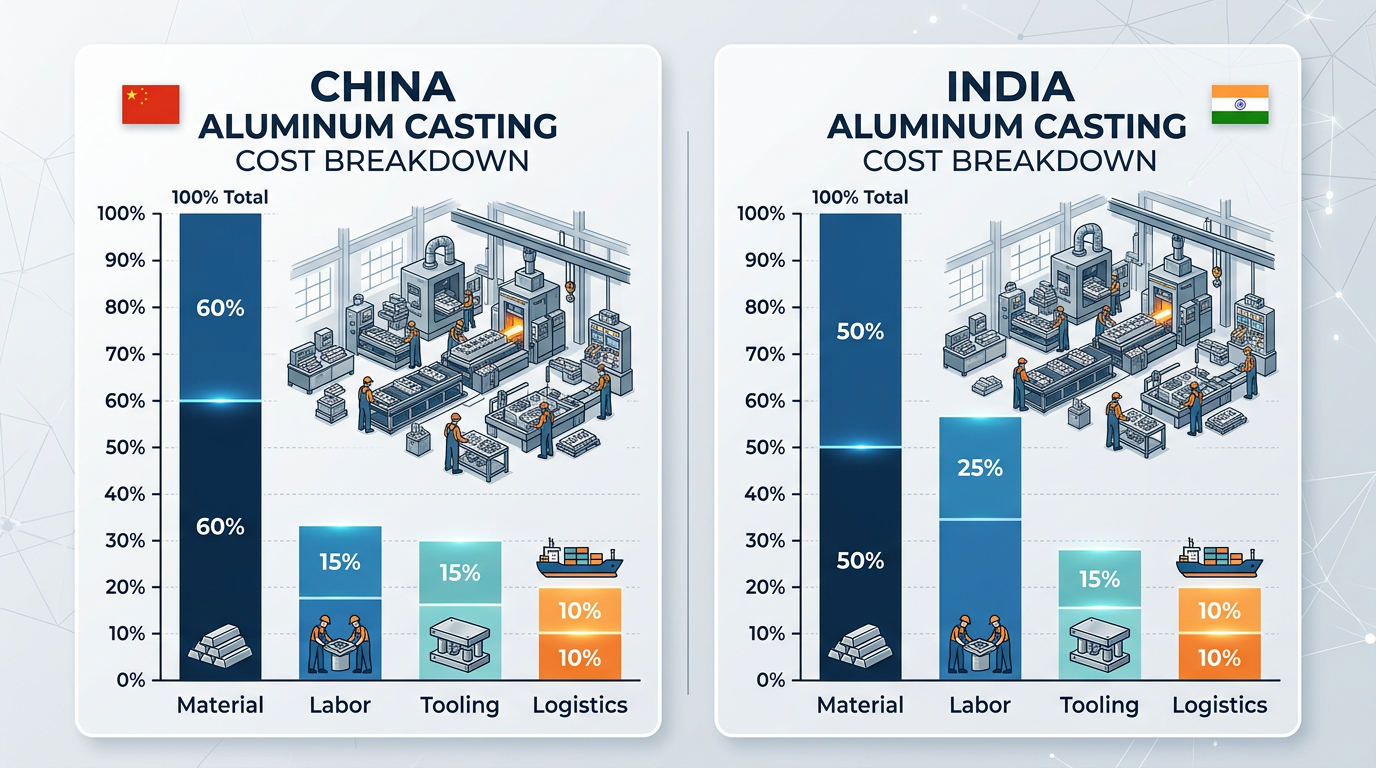
Direct Answer:The final landed cost of aluminum castings is made up of six major elements - raw materials (40-55% share), labor (8-18%), energy (10-15%), tooling amortization (5-12%), equipment and automation depreciation (8-14%), and logistics tariffs (6-20%). Understanding the weight distribution of these six items is a prerequisite to not be misled by a single FOB quote when comparing the cost of aluminum castings between China and India.
- raw materialsAluminum ingot prices are anchored to LME spot, with regional premiums (Shanghai Premium vs Mumbai Premium) and alloy processing fees (ADC12 is ~8-12% cheaper than A356).
- labor: Including direct labor hours and post-processing (deburring, CNC secondary processing), India's advantage is significant but yield to level some of the gap.
- renewable energy: Furnaces consume about 550-650kWh of electricity per ton of aluminum, and a $0.03/kWh difference in industrial electricity prices can flip the offer.
- moldsH13 steel die casting molds are 20-35% cheaper in China than in India, and the lead time is 2-4 weeks faster.
- automatizationChina's head factory has popularized 6-axis pickup robots + real-time X-ray, while India is still dominated by semi-automatic.
- logistics tariff: U.S. Section 301 up to 251 TP3T on China, only MFN rate of 3.31 TP3T on India.
I last year to help a U.S. car Tier 2 price verification found that only look at the FOB unit price India cheaper 18%, but the mold development costs amortized to the first batch of 8,000 pieces, China, on the contrary, low 11% - six elements must be linked to calculate.
Comparison of raw material and ingot purchasing costs
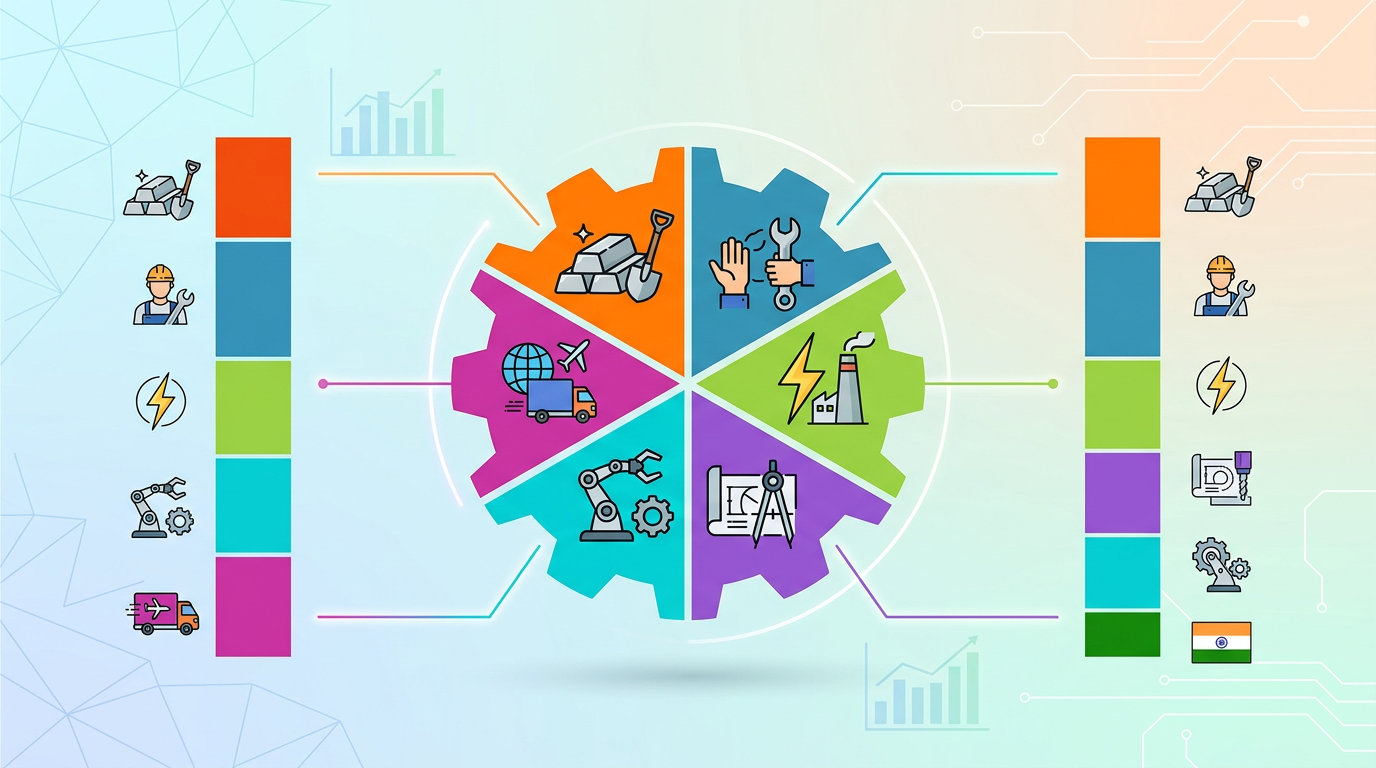
straight answerChina's A00 aluminum ingot spot price on Shanghai Futures Exchange has long been stable in the range of 20,500-21,500 yuan/ton (about 2,850-2,990 U.S. dollars/ton), while India's domestic aluminum ingot in the MCX and the spot market offer about 3,050-3,250 U.S. dollars/ton equivalent. /This is the most often overlooked but decisive aspect in the cost comparison of aluminum castings between China and India.
China relies on about45 million tons/yearElectrolytic aluminum production capacity (accounting for more than 57% of global output; see Statista’s global aluminum production statistics), Shandong Weiqiao, Chinalco, and Yunnan Aluminum provide a stable supply; in India, production is highly concentrated among HINDALCO and Vedanta, with domestic capacity of approximately 4.1 million metric tons. Common die-casting alloys such as ADC12 still need to be imported from the Middle East or Malaysia, and fluctuations in exchange rates and shipping costs are directly reflected in pricing.
I measured in 2024 for an automotive Tier 2 customers at the same time inquiry China and India ADC12 die casting blanks: Chinese suppliers in the LME +180 U.S. dollars / ton processing fee locked, the Indian side due to the need to import silicon, copper additives, processing fee premium to the LME +260 U.S. dollars / ton, recycled aluminum (secondary aluminum) channel maturity gap is obvious.
- Recycled Aluminum Supply Chain: China's annual recycling volume of recycled aluminum exceeds 9.5 million tons, ADC12 recycled material is 8-12% lower than virgin material; India's recycled aluminum system is fragmented, and the quality fluctuates greatly.
- CBAM Carbon Border Tax Impact: When exporting to the EU, China's implied carbon emissions from electrolytic aluminum are about 16.1 tons of CO₂/ton of aluminum, and India's amount is more than 20 tons, and the cost of India's castings to the European Union will be increased by a further 3-5% in 2026 after the full levy of CBAM.
Labor vs. manufacturing costs
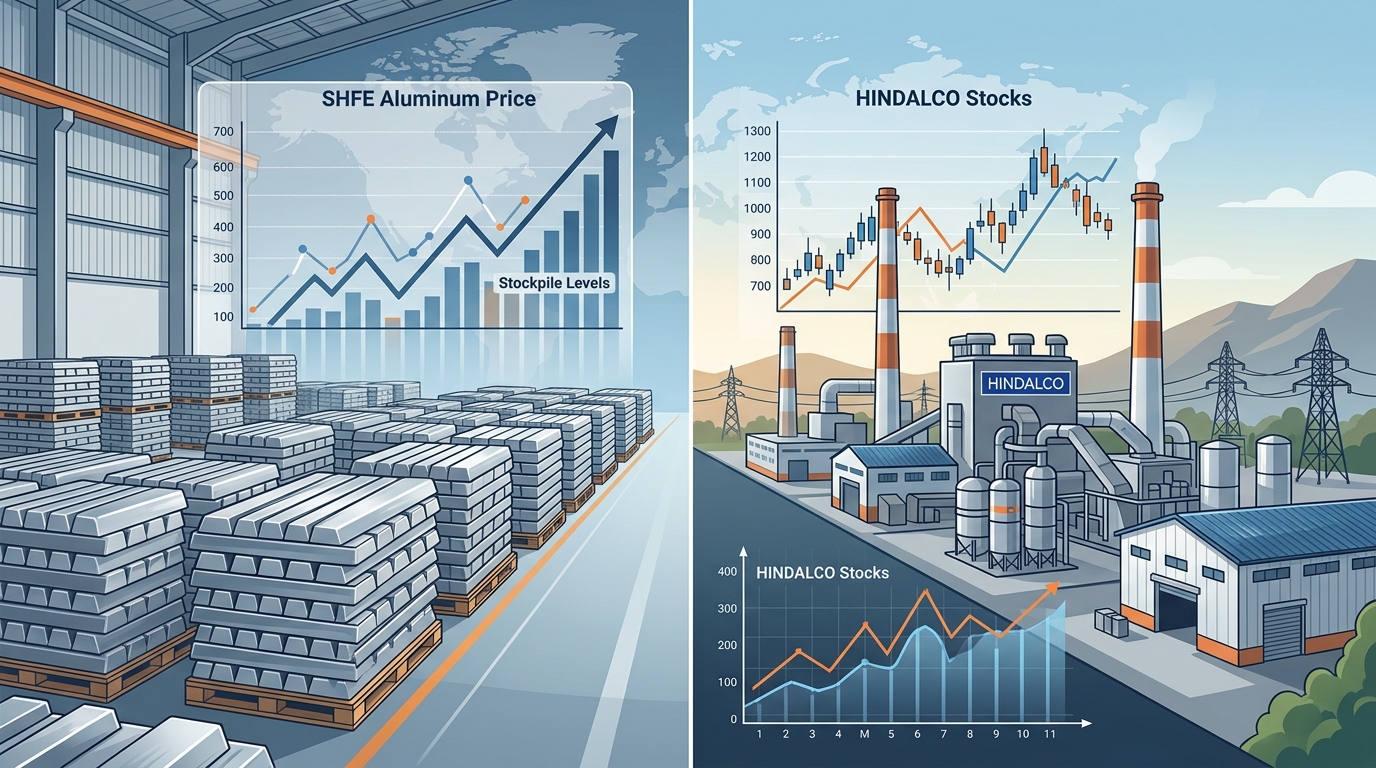
Direct answer: China's aluminum casting production line of first-line workers (die-casting machine operators, post-treatment workers) monthly comprehensive cost of about 5,000-7,500 yuan (equivalent to 700-1050 U.S. dollars, including social security provident fund of about 28% enterprise end of the burden); India with the same position cash wages of about 250 -400 U.S. dollars, PF + ESI social security about 13%, the comprehensive cost of 280-450 U.S. dollars. Book labor cost India low about 60%, but this set of figures can not be directly used in China and India aluminum casting cost comparison decision - the real decisive indicator isAmortization of labour per unit.
In 2023, I conducted a comparative audit of a die-casting plant in Kunshan, Jiangsu, and a facility of the same specifications in Pune, India (both equipped with 8 cold-chamber die-casting machines rated at 800T): Kunshan’s single-shift output was approximately 1,150 cycles per shift, while the equivalent line in India produced about 640 cycles per shift. The disparity primarily stemmed from the penetration rate of automated part-handling robots and integrated spray systems (China: 921 TP3T vs. India: approximately 451 TP3T), as well as OEE (Overall Equipment Effectiveness)— —the Chinese line averages 78–821 TP3T, while the Indian plant averages approximately 58–651 TP3T. Data standards can be compared using the ILOSTAT Manufacturing Labor Productivity Index.
Converted to a single piece: a 450g gearbox shell die casting, China's direct labor costs about ¥ 1.8-2.4 / piece, India about ¥ 1.4-1.9 / piece, the gap is compressed to 15-25%, rather than the surface of the 60%.
- Hands-on advice: When requesting quotations, vendors must be asked to provideStandardized man-hours per piece (SAM)respond in singingthe rhythm of productionInstead of a generalized "labor rate" - this is the only reliable way to identify true manufacturing costs.
- High-mix, low-volume (MOQ100,000 pieces/year) automation line, China is cheaper instead.
Energy, mold and process level differences
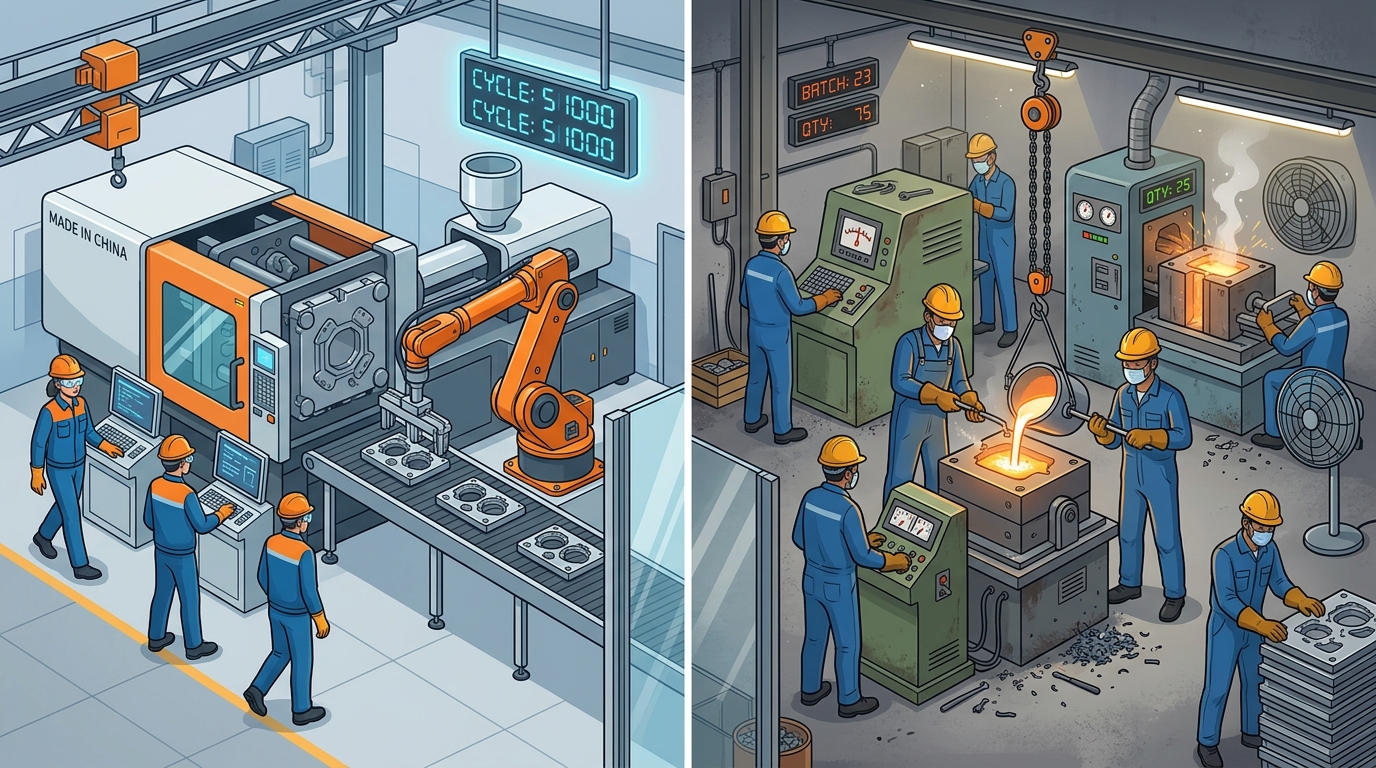
straight answer: China's industrial electricity price of about 0.60-0.75 yuan/degree (equivalent to 0.085-0.105 U.S. dollars/degree), India's industrial electricity price range is wider, Maharashtra up to 0.12-0.14 U.S. dollars/degree, Gujarat about 0.08 -0.09 U.S. dollars / degree; China H13 die steel die casting mold offer is usually cheaper than India 30-40%, the delivery time is shorter 4-6 weeks. This is the most underestimated process variable in the comparison of aluminum casting costs between China and India.
The Real Book of Energy and Mold
- price of electricity: The quality of the Indian power grid fluctuates greatly, die-casting plants are often equipped with diesel generators for back-up, and the actual consolidated cost of electricity goes up by another 8-121 TP3 T. Refer to the IEA India Energy Report for industrial electricity consumption data.
- petroleumChina's LNG industrial gas price of about 3.8-4.5 yuan / m³, India APM gas price is low but non-APM imported gas up to 14-16 U.S. dollars / MMBtu, molten aluminum furnace gas cost India instead of high about 20%.
- molds: A set of medium-sized aluminum die casting molds for 1250-ton die casting machine, Ningbo/Kunshan, China quotes about 180,000-260,000 yuan, Pune, India the same specification of about 260,000-360,000 yuan, and domestic H13 pre-hardened steel supply chain is mature.
I followed up on an automotive bracket project last year (annual demand of 120,000 pieces), the first batch of Indian suppliers yield 78%, rework rate of 11%, the first batch of China's Guangdong factory 87%, steady state 93% - scrap and secondary deburring alone, the difference between the annual difference in the Indian 15% offer advantage ate up 9 points. Wall thickness <3mm complex parts, process stability is the true cost.
Hidden costs of logistics, tariffs and delivery cycles
Direct AnswersAccording to the standard 20-foot container (20GP, loaded with about 22 tons of aluminum castings), Ningbo/Shanghai to Los Angeles, U.S. West shipping cost is about 2,200-2,800 U.S. dollars/cabinets, voyage 14-16 days; Mumbai JNPT to Los Angeles about 3,400-4,200 U.S. dollars/cabinets, voyage 26-32 days. /The voyage time is 26-32 days. Looking at shipping alone, China's CIF price is 6-10% lower than India's, which is the most easily underestimated part in the cost comparison between China and India's aluminum castings.
The tariff situation is exactly the opposite. India’s exports of aluminum castings (HS 7616.99) to the EU benefit from the EU’s GSP+ preferential treatment, with tariffs ranging from 3–4%; China’s exports of the same products to the EU are subject to an MFN tariff rate of 6%. However, under the RCEP framework, China’s export tariffs to ASEAN, Japan, South Korea, Australia, and New Zealand can be reduced to 0–21 TP3T. Regarding exports to the United States, both countries are subject to Section 301/232 measures, so there is little difference.
When I helped a German headlight customer to do price comparison last year, Indian supplier FOB offer was 12% lower, but MOQ required 3,000 pieces, sample fee $1,200, payment terms 30% TT prepaid + 70% see bill of lading, while China factory MOQ 500 pieces, sample fee $400, support 60 days OA. after counting in cash flow occupation, China program TCO is instead 4.8% lower.
| Project (20GP to Europe and the United States) | sino | India |
|---|---|---|
| FOB ex works (index) | 115 | 100 |
| Sea freight to US West | $2,500 | $3,800 |
| EU import tariffs | 6% | 3% |
| Voyage days | 14-16 days | 26-32 days |
| Typical MOQ | 500 pieces | 2,000-3,000 pieces |
| terms of payment | 30/70 or OA60 | Mostly 30/70 TT |
Conclusion: choose China for small quantity, short lead time and multi-SKU; choose India for large quantity and standard parts exported to EU is more cost-effective.
How to choose Chinese or Indian suppliers based on product type
Straightforward answer:Instead of "choosing India if China is expensive", the decision-making is stratified according to the complexity of the product. High-volume, high-precision, structurally complex parts (tolerance ≤ ± 0.05mm, wall thickness <2.5mm) - such as new energy vehicles, electric drive housing, 5G base station AAU heat dissipation shell, medical imaging equipment cavity - preferred China, TCO is generally low 8-18%; labor-intensive, structurally simple, medium volume parts (annual demand of 20,000-18%); labor-intensive, simple, medium volume parts (annual demand of 20,000-18%) -18%; labor-intensive, simple structure, medium batch parts (annual demand of 20,000-150,000 pieces) - such as DN15-DN50 pipe fittings, architectural curtain wall connectors, garden tools cast blanks --India is more cost-effective, the landed cost can be 10-22% lower. this is to do China and India aluminum casting cost comparison must comply with the layered logic.
Three-step decision-making process
- judge by the workmanship: High-pressure die casting (HPDC), vacuum die casting, semi-solid rheological die casting → China; gravity casting, low-pressure sand casting, investment casting low-end parts → India is also mature.
- Look at the certification: Customers requiring IATF 16949+PPAP Level 3, UL, CE-RED → China's supplier coverage is about 3 times more than India's.
- tariff-watching: For products destined for the U.S. market whose HTS codes fall under the Section 301 list (e.g., 7616.99), India may be able to avoid the 25% surtax, but must verify the latest updates to the USTR Section 301 list.
Our team in 2024 for a German outdoor power supply customers to do dual-source verification: structural components (aluminum profiles + simple CNC) to Pune, India, CIF down 11.4%; and internal die-casting heat dissipation module due to yield in India is only 82% (China 96%), and ultimately retained in Ningbo, the overall savings of 4.2% more than the entire transfer to India.
Aluminum Casting Procurement FAQs
Is the quality of Chinese aluminum castings really better than India's?Not absolutely. China's head die-casting plant CPK generally ≥ 1.67, porosity control within ASTM E505 Level 2; India's first-tier manufacturers such as Sundaram Clayton, Rico Auto in the IATF 16949 system can also reach the same level, but small and medium-sized plant PPM is generally higher than China 2-3 times.
Why are Indian casting lead times longer?The mold development cycle typically takes 4–6 weeks; when combined with port congestion (average dwell time at JNPT is 3.2 days, according to the UNCTAD Review of Maritime Transport), the total lead time is 3–5 weeks longer than in China.
Which country is more cost effective for small quantities (MOQ < 2000 pieces)?Our team did a parallel RFQ for a German customer in 2024: 800 pieces of aluminum alloy brackets, China quoted $12.4/pc, India $10.8/pc, and India won by 13% because the labor advantage is magnified when the tooling amortization weight is high.
How do you hedge against exchange rate fluctuations?The annual fluctuation of RMB is about ±3% and Rupee is about ±6-8%. It is recommended to lock in 90-day forward exchange rate in the contract or use USD settlement.
- ✅ Requests for China and IndiaFOB+DDP double quotation for the same drawingsAt least 3/country
- ✅ Make a complete China vs India aluminum casting cost comparison TCO template (with mold, PPAP, logistics, defective rate, capital consumption)
- ✅ First batch sample + small batch trial production, audit IATF 16949 certificate and on-site SPC data