Current Position:HomeBlogA360.0 Comprehensive Guide to Die-Cast Aluminum Alloys: Composition, Performance Enhancement Pathways and Industry Applications
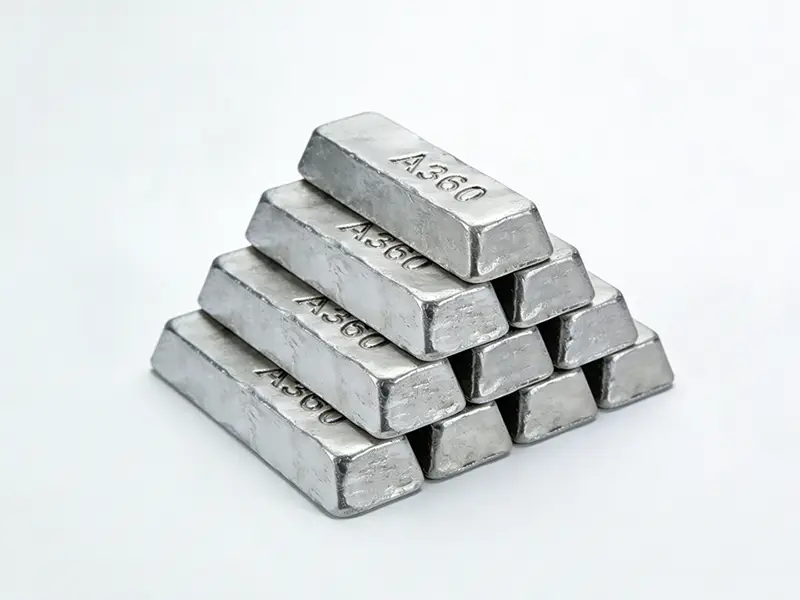
As a key member of the die-cast aluminum alloy family of ASTM standards.A360.0 by means ofCombination of excellent casting fluidity, good corrosion resistance and balanced mechanical propertiesand is widely recognized. The alloy maintains good die casting manufacturability byMedium level of silicon and magnesiumThe balance of strength and toughness has been achieved, making it particularly suitable for the production ofThin-walled complex die castings requiring good air tightness, corrosion resistance and medium strength.The company is a major player in the consumer electronics, automotive and general industrial sectors.
A360.0 Corresponding Standards and Grades
ASTM Standard Grades: In accordance with ASTM B85, the grades are A360.0The “.0” suffix refers specifically to cast products. The ".0" suffix refers specifically to cast products.
Grade Meaning: In the ASTM system, the A3xx.x series represents cast aluminum alloys in which silicon is the primary alloying element and 60 is the specific number.
Core features: Compared to the more common A380/A383, the A360.0'sVery low copper (Cu) content(math.) genusMagnesium (Mg) content was significantlyThis gives itsExcellent corrosion resistancerespond in singingPotential for strengthening by heat treatment.
Heat treatment has a significant strengthening effect, T6 state strength rivals or even exceeds the A380.
Yield strength (Rp0.2)
130-170 MPa
230-275 MPa
The yield strength increase is huge.
Elongation (A)
2.5-4.0%
3.0-5.0%
Highlighting Advantages: Outstanding toughness (elongation) among aluminum alloys of equal strength.
Brinell hardness (HB)
70-75
85-95
The hardness is significantly increased.
heat conductivity
Approx. 113 W/(m-K)
--
Good.
corrosion resistance
talented
talented
Core AdvantagesIt is far superior to A380/A383 with high copper content.
Performance Enhancement Path and Core Benefits The unique value of A360.0 lies in the malleability and balance of its performance:
Heat Treatment Strengthening Capability: Thanks to its well-defined magnesium (Mg) content, A360.0 is one of the fewPossible and suitable for T5 (artificial aging) or T6 (solution + aging) heat treatmentone of the commercially available die-cast aluminum alloys. This provides designers with a flexible path for performance upgrades.
Excellent corrosion resistance: The very low copper (Cu) content is the fundamental reason why its corrosion resistance, especially to stress corrosion, far exceeds that of the A380/A383 series of alloys, making it ideal for use in wet environments or on parts requiring surface preparation.
Good toughness: The lower copper and iron content reduces the amount of brittle intermetallic compounds, allowing for better impact absorption and ductility while maintaining adequate strength.
Corresponding international grades As a die casting alloy with unique properties, it has a wide range of counterparts in national standards:
American Standard:A360.0 (ASTM B85)
Chinese national standard:: In conjunction with the YL104 (YZAlSi10Mg) or some specific grades are close in performance, but not exactly equivalent.
EU standard:EN AC-51400 或 EN AC-45200 (EN 1706, depending on compositional nuances)
Japanese Standard:ADC5 (JIS H 5302, nearest corresponding grade)
Canadian Standard:S5C (CSA)
A360.0 in the die casting industry based on itsCorrosion resistance, heat treatable, good toughnessfeatures, A360.0 is widely used in the following areas:
Highly demanding housings and structural components (mainstream applications)
Auto Parts: Engine cylinder head covers, intake manifolds, oil sumps, gearbox housings (good oil resistance and possible strength requirements).
Outdoor equipment: Garden tool housings, marine instrument housings, structural parts for outdoor lamps (excellent weather resistance).
Hydraulic and pneumatic systems: Valve body, pump casing, compressed air reservoir (good air tightness and pressure resistance).
Consumer Electronics & Appliances
High-end electrical housings: Power tool housings, vacuum cleaner bodies, food processor parts (taking into account strength, appearance and safety).
Racks and housings for electronic equipment: Server components, communication equipment housings (good electromagnetic shielding and heat dissipation).
Aerospace and military (specialized applications)
Instrument housings and brackets: Non-load-bearing structural components with high requirements for weight, corrosion resistance and reliability.
Cameras and Optical Equipment: High dimensional stability and lightweight components are required.
A360.0 Aluminum Alloy Frequently Asked Questions
Q1: What is the most important difference between A360.0 and A380.0? How to choose?
The core difference:Copper (Cu) content and corrosion resistanceA360.0 contains very low Cu (<0.6%).Excellent corrosion resistance(math.) genusheat treatable, good toughness; A380.0 contains high Cu (3-4%).High strength in cast formLibyan Arab JamahiriyaPoor corrosion resistance(math.) genusUsually without solution treatment (T6).
Selection Guide:
Option A360.0: When parts are requiredExcellent corrosion resistance, good toughness, or need to be further enhanced by heat treatmentTime. Suitable for outdoor, humid environments or parts that require surface treatment such as anodizing.
Select A380.0: When pursuingHighest cast strength and productivityIf the work environment is dry, or if corrosion resistance is not a primary concern.
Q2: Is it risky to perform T6 heat treatment on A360.0?
The risk is much lower than that of A380.0. Due to the relatively low gas content and dense organization of A360.0, the T6 treatment (solution quenching) is performedLess tendency to Blistering. However, the heat treatment of any die casting requires a tightly controlled process, and it is usually recommended that the T5 (artificial aging) test be carried out first, with a preference for the safer T5 if the strength is sufficient.
Q3: What is the surface treatment performance of A360.0?
terrific. This is one of its core strengths.
anodic oxidation: can getHomogeneous, dense, highly decorativeIt is one of the grades with the best anodic oxidation performance in die-casting aluminum alloys, with good color consistency.
livery (on airline or company vehicle): Strong coating adhesion.
electroplated: The substrate is well adapted.
Q4: Why does A360.0 have good casting fluidity?
Thanks mainly to itsSilicon (Si) Content of 9-10%The alloys have a low shrinkage rate and a low tendency to thermal cracking, and are located near the eutectic point, which gives the alloys excellent fluidity and the ability to fill thin walls.
Q5: What is the machining performance of A360.0?
processing performancefavorable. Due to its moderate hardness and uniform distribution of the silicon phase, the cutting resistance is less than that of peritectic alloys. Good surfaces can be achieved with standard carbide tools. Its good toughness also makes chip disposal relatively easy.