


ZL108 Cast Aluminum Alloy: How Phosphorus Metamorphism and T6 Heat Treatment Shape Top Piston Materials
As an outstanding representative of cast aluminum alloys for pistons, theZL108 (ZAlSi12Cu2Mg1) by means ofExcellent high-temperature strength, low coefficient of thermal expansion and excellent wear and heat resistanceand is well known. The alloy is a typicalEutectic aluminum-silicon alloysThe piston is optimized for piston parts subjected to severe alternating thermal and mechanical loads in the engine cylinder through complex alloying design and rigorous heat treatment, achieving a precise balance between high-temperature power performance and durability.
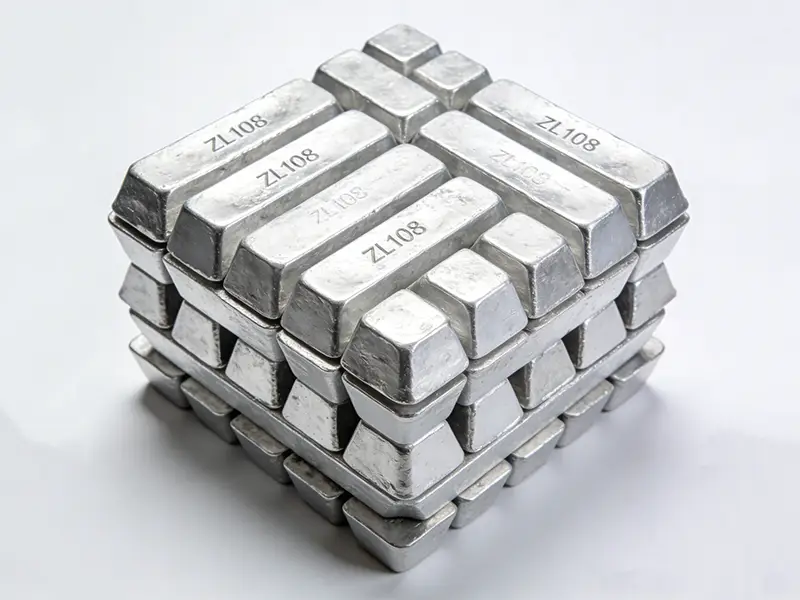
The national grade for ZL108 is ZAlSi12Cu2Mg1.
- National Standard Grade: According to GB/T 1173, its grade isZAlSi12Cu2Mg1. The name directly reflects its core alloy system: silicon (Si), copper (Cu), and magnesium (Mg).
- Industry/Enterprise Code:ZL108 is the designation commonly used for this material in the field of engine design and manufacturing.
- typical situation: it almost always starts withT6 condition (solid solution treatment + full artificial aging) Use to obtain the best overall performance, especially at high temperatures.
ZL108 Aluminum Alloy Composition Table
| elemental | Content range (wt%) | functional role |
|---|---|---|
| Silicon (Si) | 11.0-13.0 | Hypereutectic content.. Provides low thermal expansion and high wear resistance, but the incipient silicon phase needs to be refined by phosphorus (P) metamorphism. |
| Copper (Cu) | 1.0-2.0 | Main high-temperature strengthening elements. Formation of heat-resistant Al₂Cu phases significantly improves high-temperature strength and hardness. |
| Magnesium (Mg) | 0.4-1.0 | Key Enhancement Elements. The Mg₂Si phase is formed, which together with Cu provides room and high temperature strength. |
| Manganese (Mn) | 0.3-0.9 | Improves heat resistance, forms heat-resistant phases, and mitigates the harmful effects of iron (Fe). |
| Nickel (Ni) | 0.3-0.9 | Important heat-resistant elements. Forms a stable heat-resistant phase to enhance high-temperature creep resistance. |
| Titanium (Ti) | ≤0.20 | Grain refiner. |
| Aluminum (Al) | tolerance (i.e. allowed error) | Substrate material. |
ZL108 Physical and Mechanical Properties Parameter Table (metal mold casting, typical value for T6 state)
| Performance indicators | Numerical range | Core Strengths Explained |
|---|---|---|
| intensity | 2.68-2.70 g/cm³ | -- |
| Room temperature tensile strength (Rm) | 250-280 MPa | High strength level to meet piston structural loading requirements. |
| High temperature tensile strength (250°C) | ≥ 120 MPa | Core Advantages, maintains sufficient strength at high temperatures to prevent cracking or deformation of the top of the piston. |
| Elongation (A) | ≤ 1.0% | Poor plasticity is inherent in its highly strengthened, per-eutectic organization. |
| Brinell hardness (HB) | 100-130 | high stiffnessThe product is designed to ensure excellent abrasion resistance. |
| Coefficient of linear expansion (20-200°C) | 18.5-20.0 × 10-⁶/°C | Core AdvantagesIt is lower than most aluminum alloys, and it matches better with cylinder liner, which is good for controlling cylinder clearance. |
| volumetric stability | 优 | The T6 treatment results in minimal dimensional changes under long-term use. |
Performance Enhancement Paths and Technology Keys
The realization of the ZL108's performance relies on a combination of sophisticated and interlocking processes:
- Precise control of alloy composition: The contents of Si, Cu, Mg and Ni need to be precisely matched to form an optimal combination of heat-resistant phases. It must be strictly controlledPhosphorus (P) Deterioration Treatmentin order to refine the eutectic organization of thenascent silicon phaseThis is a prerequisite for good mechanical properties and machinability.
- Proprietary heat treatment system (T6):
- solid solution treatment: Typically performed at 505±5°C to allow for full dissolution of the soluble fortified phase.
- artificial time limit: Prolonged aging at higher temperatures (e.g. 200-220°C) for the formation of stable reinforcing phases.Specifically optimized for high temperature performance and tissue stability.
- Advanced Casting Process: AdoptionMetal type gravity casting或Low-pressure casting, in order to obtain a dense, uniform cast state organization. Good casting process is the basis for subsequent heat treatment and performance.
Corresponding international grades
As a classic piston alloy, it has its counterpart in national standards:
- Chinese national standard:ZAlSi12Cu2Mg1 (GB/T 1173)
- American Standard:A332.0 (ASTM, very close)
- EU standard:EN AC-48000 (EN 1706)
- Japanese Standard:AC9A 或 AC9B (JIS)
Application of ZL108 in the foundry industry
Its applications are highly specialized, focusing almost exclusively on theCore hot end components for internal combustion engines:
- Pistons (absolute mainstream applications)
- Diesel Engine Pistons: Pistons for medium- and heavy-duty trucks, construction machinery, and marine diesel engines (utilizing their excellent high-temperature strength and wear resistance).
- High Performance Gasoline Engine Pistons: Pistons for large displacement, high boost, high power density gasoline engines.
- Modified & Racing Pistons: Where there are extreme requirements for heat resistance and strength.
- Other heat-resistant and wear-resistant parts
- Engine rotor: Rotating parts of certain specialized engines.
- Compressor pistons: High pressure air compressor.
- Brake Caliper Pistons(in a few high-performance requirements).
ZL108 Aluminum Alloy Frequently Asked Questions
Q1: What is the biggest technical difficulty of ZL108?
- Casting and Deterioration. Due to its hypereutectic composition, the melt precipitates coarsePrimary silicon crystals, which severely cuts into the matrix, leading to dramatic performance degradation and machining difficulties. This must be achieved by precisePhosphorus (P) Deterioration Treatment(e.g., by adding Cu-P intermediate alloys) to refine the primary silicon, which is ZL108 production in theCore technology threshold.
Q2: Why is the elongation of ZL108 so low?
- This is the first time it has been awardedHigh strength, high hardness, low coefficient of expansionThe inevitable price to pay. The per-eutectic silicon phase and the large number of heat-resistant intermetallics (containing Cu, Mg, Ni), while providing the desired high-temperature properties, also significantly reduce the plasticity and toughness of the material.
Q3:What surface treatment is required for ZL108 piston?
- To further enhance performance, ZL108 pistons are often given a combination of surface treatments:
- anodic oxidation: Forms a hard aluminum oxide film on the top ring groove of the piston or on the surface of the combustion chamber to increaseHeat, wear and abrasion resistance.
- Graphite Coating: Spray solid lubricant on the piston skirt to improve wear and friction reduction.
- electroplated: e.g. tinned to facilitate initial break-in.
Q4: How does ZL108 compare to common piston materials such as ZL109 or eutectic alloys?
- ZL108 (per eutectic):Higher Si content (11-13%)(math.) genusLowest coefficient of thermal expansion and best abrasion resistance, but the casting and machining is the most difficult and costly. Suitable forThe heat load is the most severeThe occasion.
- ZL109 (eutectic/sub-eutectic) and similar alloys: Slightly lower Si content (8-11%), better casting performance, better machinability, better overall mechanical properties (especially toughness), is the most widely used piston material.Coefficient of thermal expansion and abrasion resistance slightly inferior to ZL108.
Q5: What are the special requirements for machining ZL108?
- because ofHigh hardness with hard silicon phase, with poor cutting and machinability, is known as “Hard-to-cut aluminum alloys”。
- cutters: must be usedPCD (Polycrystalline Diamond) Cutting Toolsor quality coated carbide cutters.
- parameters: High cutting speeds and small feeds are used.
- hardened: Diamond wheels are the only cost-effective choice for areas such as ring grooves.