


A comprehensive guide to ADC3 (Al-Si-Mg) die-cast aluminum alloys: low-silicon design, heat treatment potential and high-end application scenarios
As part of the Japanese Industrial Standards (JIS)High strength, high thermal conductivityrepresentative of die-cast aluminum alloys.ADC3 by means ofOutstanding castability, good mechanical strength and excellent thermal/electrical conductivityis known for. The alloy is passedUnique “Low Silicon, Medium Magnesium” Composition SystemThe new aluminum die casting system provides a better overall performance balance than traditional die casting aluminum (e.g. ADC12) while maintaining good die casting manufacturability, making it particularly suitable for the production ofThin-walled parts requiring good heat dissipation, electromagnetic shielding and medium structural strength., favored in the field of communications, electronics and electrical equipment.
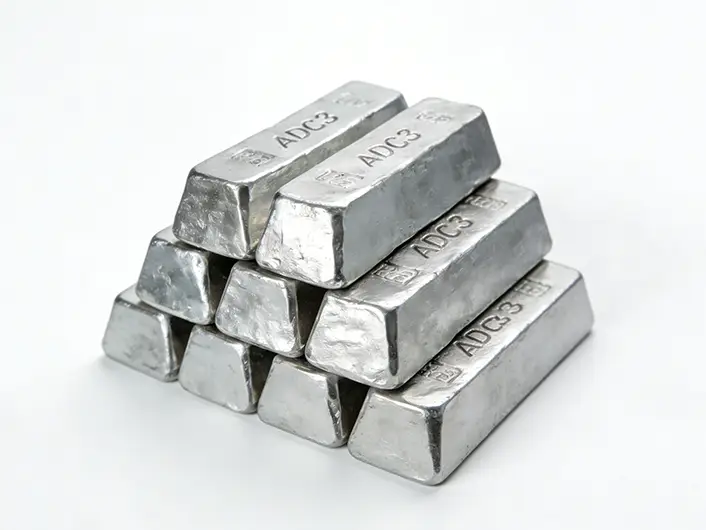
ADC3 Standards and Grades
- JIS Standard Grades: According to the Japanese Industrial Standard JIS H 5302, the grade is ADC3.
- Grade Meaning: “ADC” is the abbreviation for “Aluminum Die Casting” and “3” stands for alloys with specific compositions and properties in the series. No.
- Core features: Its distinguishing features areSilicon (Si) content significantly lower than ADC10/12The product also containsSizable magnesium (Mg)This gives it a combination of good flowability, heat treatability, and thermal/electrical conductivity close to that of pure aluminum.
ADC3 Aluminum Alloy Composition Table (based on JIS H 5302 typical requirements)
| elemental | Content range (wt%) | functional role |
|---|---|---|
| Silicon (Si) | 4.0-6.0 | Low to medium silicon content.. Ensures basic casting fluidity while minimizing damage to thermal/electrical conductivity. |
| Magnesium (Mg) | 0.30-0.60 | Core Strengthening Elements. The formation of the Mg₂Si phase gives the alloy theExplicit heat treatment enhancement capabilities. |
| Iron (Fe) | ≤ 0.8 | Prevents mold sticking during die casting and needs to be controlled to maintain toughness. |
| Copper (Cu) | ≤ 0.20 | very low level. Ensures excellent corrosion resistance and high thermal/electrical conductivity at the expense of some cast strength. |
| Manganese (Mn) | ≤ 0.30 | Neutralizes the harmful effects of iron. |
| Zinc (Zn) | ≤ 0.10 | Impurity elements, strictly controlled. |
| Titanium (Ti) | ≤ 0.20 | Grain refiner to improve organization. |
| Aluminum (Al) | tolerance (i.e. allowed error) | High purity matrix, the basis for its excellent thermal/electrical conductivity. |
ADC3 Physical and Mechanical Properties Parameter Table (die-cast state, typical values)
| Performance indicators | Numerical range (die-cast - F-state) | Comparative Analysis (vs ADC12) & Core Strengths |
|---|---|---|
| intensity | Approx. 2.70 g/cm³ | Similar to ADC12. |
| Tensile strength (Rm) | 220-260 MPa | Below ADC12However, it can be upgraded to 280-320 MPa by T5/T6 heat treatment, and the strength is restored to the same level. |
| Yield strength (Rp0.2) | 120-150 MPa | Can be significantly enhanced by heat treatment. |
| Elongation (A) | 4.0-7.0% | Significantly higher than ADC12 (~2%)show thatExcellent toughness and impact resistance. |
| Brinell hardness (HB) | 60-70 | Slightly lower than ADC12, but easier to cut and machine. |
| heat conductivity | Approx. 180-200 W/(m-K) | Core Advantages: Much higher than ADC12 (~96 W/(m-K)) for excellent heat dissipation. |
| conductivity | Approx. 50-55% IACS | Core AdvantagesHigher EMI shielding performance: Much higher than ADC12 (~25% IACS). |
| corrosion resistance | talented | Far superior to copper-containing ADC12, approaching pure aluminum levels. |
Performance Enhancement Path and Core Benefits
ADC3 was designed with the concept of “Thermal/electrical properties oriented, strength compensated by heat treatment”:
- Excellent thermal/electrical properties: The compositional design of low silicon (Si) and very low copper (Cu) minimizes the scattering of electrons and phonons (thermal vibrational quanta) transport by solid solution atoms and intermetallic compounds, resulting in thermal and electrical conductivity that is among the highest in die-cast aluminum alloys.
- Clear potential for heat treatment enhancement: The well-defined magnesium (Mg) content allows for the passage ofT5 (artificial aging) or T6 (solution + aging) heat treatment, raising the mechanical strength to a level comparable to that of ADC12 while retaining the benefits of its high toughness.
- Good processability and toughness: The silicon content is low but still sufficient to ensure good die casting fluidity. The low content of brittle phases gives it much better elongation and impact resistance than ADC12.
Corresponding international grades
As an alloy that seeks specific properties (high thermal conductivity), its international counterparts are as follows:
- Japanese Standard:ADC3 (JIS H 5302)
- American Standard: Closest A360.0, but A360.0 has a higher Si content (9-10%) and slightly less thermal conductivity than ADC3.
- Chinese national standard:: In conjunction with the YL302 (YZAlSi5Mg) or some customized grades are close in performance philosophy.
- EU standard:EN AC-51000 (AlMg5Si2Mn) has similarities in performance orientation (high strength and toughness, corrosion resistance), but with different compositional systems.
ADC3 in the die casting industry
based on itsHigh thermal/electrical conductivity, good toughness, corrosion resistancecharacteristics of the ADC3, the ADC3 is mainly used in the following high-performance areas:
- Heat dissipation and thermal management components (core applications)
- LED lighting: Radiator housing for high power LED street lights, floodlights, stage lights.
- power electronics: Inverter housings, power module substrates, inverter housings (both structural components and heat dissipation paths).
- communications equipment: 5G base station antenna housing, RF unit housing, server heat sink.
- Demanding housings and structural components
- automotive electronics: Engine control unit (ECU) housing, on-board charger housing, power distribution unit (PDU) housing.
- power tool: High-power motor housings, battery pack housings (good heat dissipation and electromagnetic compatibility).
- optical instrument: Projector, camera lens barrel (good dimensional stability and heat dissipation).
- Electromagnetic compatibility (EMC) sensitive components
- Utilizing its high conductivity asElectromagnetic shielding enclosureIt is used for precision measuring instruments, medical equipment and other equipment sensitive to electromagnetic interference.
ADC3 Aluminum Alloy Frequently Asked Questions
Q1: What is the biggest advantage of ADC3? Under what circumstances should it be preferred?
- greatest strength: inEnsure good die castability and basic structural strengthThe premise of providingTop thermal and electrical conductivity in die-cast aluminum alloys.
- Preferred scenario: When the part'sHeat dissipation requirements (or electromagnetic shielding requirements) are the primary or critical design constraintsFor example, a part that is both a housing and a major heat sink. For example, a part that is both a housing and a major heat sink.
Q2: Is the casting performance of ADC3 worse than ADC12?
- Yes, but the gap is manageable. Due to its low silicon content, theMobility is theoretically inferior to ADC12This means that the production of ADC3 parts may require higher mold temperatures or more optimized sprue system design or slightly higher injection speeds. This means that the production of ADC3 parts may require higher mold temperatures, a more optimized design of the sprue system or a slightly higher injection rate to ensure perfect filling. However, for most regular thin-walled parts, the process can be adapted for stable production.
Q3: What is the effect of anodizing ADC3?
- great result. Thanks to its low copper, low silicon and high purity matrix, the anodizing performance of ADC3 is one of the best in die-cast aluminum. It is possible to obtainColorless and transparent, uniform and dense, high hardnessThe oxidized film is ideally suited for highly decorative and weather resistant surface finishes.
Q4: What are the similarities and differences between ADC3 and A360.0?
- common ground: BothContaining magnesium, heat treatable, good corrosion resistance, excellent anodizing performance.
- point of difference:ADC3 has significantly lower silicon content (4-6%) than A360.0 (9-10%). This makes the ADC3Better thermal/electrical conductivity and toughnessLibyan Arab JamahiriyaSlightly lower casting fluidity and slightly lower strength in cast formA360.0 is more balanced and versatile in terms of castability and cast strength.
Q5: What are the characteristics when processing ADC3?
- given itsLower hardness, good toughnessCutting and machinabilityterrific. Low tool wear, easy to obtain a clean surface, and easy to dispose of continuous chips. It is a “good machining” material.