


ADC1 Die-Cast Aluminum Alloy: A High-Silicon General Purpose Benchmark, Explaining the Balance Between Processing Excellence and Economy
As part of the Japanese Industrial Standards (JIS)High Silicon Content General Purposebenchmarks for die-cast aluminum alloys.ADC1 by means ofExcellent casting fluidity, good dimensional stability and economyand is one of the most widely used die casting materials. The alloy is a typicalNear-eutectic aluminum-silicon alloysBy means of theHigh silicon (Si) with the right amount of copper (Cu)The die casting process is a unique process that provides reliable mechanical properties while optimizing die casting productivity and part qualification to the maximum extent possible, and is a key component in the production ofHigh volume, medium strength, complex shape thin-walled partsof the industry's mainstay.
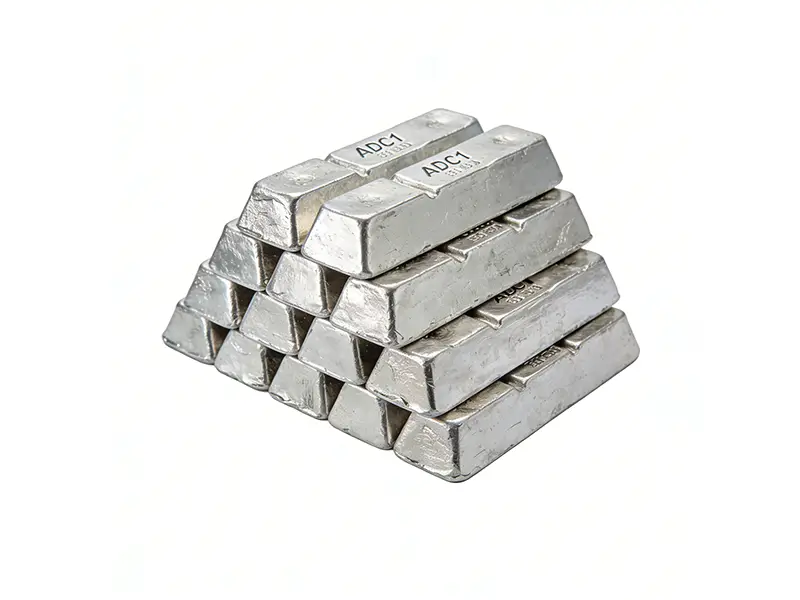
ADC1 Standards and Grades
- JIS Standard Grades: According to the Japanese Industrial Standard JIS H 5302, the grade is ADC1.
- Grade Meaning: “ADC” stands for “Aluminum Die Casting” and “1” denotes one of the basic or early general alloys defined in the standard.
- Core features: balanced silicon (Si) and copper (Cu) content, without magnesium (Mg).Cannot be strengthened by heat treatmentThe performance is entirely dependent on the as-cast organization, with an emphasis on process stability and cost-effectiveness.
ADC1 Aluminum Alloy Composition Table (based on JIS H 5302 typical requirements)
| elemental | Content range (wt%) | functional role |
|---|---|---|
| Silicon (Si) | 11.0-13.0 | core elementIt provides excellent casting fluidity, low shrinkage and good resistance to hot cracking. |
| Copper (Cu) | 0.5-1.5 | Primary Strengthening Element.. Strengthening by solid solution enhances strength and hardness in the as-cast state, but reduces corrosion resistance. |
| Iron (Fe) | ≤ 1.3 | necessary element. Prevents molten aluminum from sticking to the die during die casting (anti-sticking), but excessive amounts reduce toughness. |
| Manganese (Mn) | ≤ 0.3 | Neutralizes some of the harmful effects of iron and forms a hard phase. |
| Magnesium (Mg) | ≤ 0.3 | tight control(a) The alloy is a non-heat-treatable alloy. Present as an impurity at very low levels to maintain the non-heat treatable properties of the alloy and good castability. |
| Zinc (Zn) | ≤ 1.0 | Trace amounts with low impact on performance. |
| Nickel (Ni) | ≤ 0.5 | Optional, sometimes used to improve high temperature performance. |
| Aluminum (Al) | tolerance (i.e. allowed error) | Substrate material. |
ADC1 Physical and Mechanical Properties Parameter Table (Die-Cast State, Typical Values)
| Performance indicators | Numerical range | Comparative analysis and positioning |
|---|---|---|
| intensity | 2.66-2.68 g/cm³ | Typical die-cast aluminum density. |
| Tensile strength (Rm) | 230-280 MPa | Good cast strengthIt meets the requirements of most general purpose structural components. |
| Yield strength (Rp0.2) | 130-160 MPa | Provide a reliable load-bearing foundation. |
| Elongation (A) | 1.5-3.0% | Average plasticity, is typical of most high-silicon die-cast aluminum. |
| Brinell hardness (HB) | 70-85 | Medium to high hardnessIt provides good abrasion resistance. |
| heat conductivity | Approx. 100-110 W/(m-K) | Medium, high silicon content negatively affects thermal conductivity. |
| conductivity | Approx. 30-35% IACS | Medium. |
| corrosion resistance | general | The presence of copper (Cu) makes it less corrosion resistant than lower copper alloys (e.g. ADC3, ADC5). |
| Casting mobility | excellent | Core AdvantagesIt is suitable for the production of complex thin-walled parts. |
Performance Characteristics and Limitations
ADC1 represents the most classic and mature technology line of die-cast aluminum alloys:
- Not heat treatable: Since its magnesium (Mg) content is strictly controlled at very low levels, theUnable to effectively increase strength by aging heat treatment such as T5/T6.. The performance enhancement mainly relies on optimizing die casting process parameters (e.g., increasing the injection rate, improving cooling) to obtain a denser as-cast organization.
- Balance of strength and craftsmanshipThe following: Silicon (Si) ensures fluidity, copper (Cu) provides base strength, and iron (Fe) guarantees production feasibility, resulting in a stable formulation that is highly optimized for high-pressure die casting processes.
- Economy is king: In all ADC families, the ADC1 typically has aOptimized material costs and highest production stability, is the first choice for realizing large-scale, low-cost manufacturing.
Corresponding international grades
As a general-purpose die-casting alloy, it has a wide range of counterparts worldwide:
- Japanese Standard:ADC1 (JIS H 5302)
- American Standard:A413.0 (ASTM B85) is very close and is its main counterpart.
- Chinese national standard:: In conjunction with the YL102 (YZAlSi12) 或 YL113 (YZAlSi11Cu3) There is a crossover in composition and properties, and the choice needs to be focused on the specific composition.
- EU standard:EN AC-47100 (EN 1706) or EN AC-44000, depending specifically on the Cu and Fe content.
- Korean Standard:ADC10 (KS, note: JIS's ADC10 contains higher Cu, similar to China's YL113).
ADC1 in the die casting industry
based on itsExcellent processability, reliable economy and adequate mechanical propertiesThe ADC1 is widely used in almost all die casting applications:
- General purpose machinery and equipment housings (largest application)
- power tool: Housing and internal structural parts for electric drills, angle grinders, jigsaws.
- Small engine components: Housings, cylinders, covers for lawn mowers, generators.
- Pump and valve housings: Housing for all types of small pumps and pneumatic valve bodies.
- Auto Parts
- Shell type: Gearbox housing, clutch housing, steering housing (non-critical bearing parts).
- Stands and brackets: Engine accessory brackets, sensor brackets, harness mounts.
- interior components: Door lock housings, window crank housings.
- Home Appliances and Electronics
- major consumer electronics: Washing machine counterweight block, air conditioner outdoor unit frame, vacuum cleaner main body.
- small household electric appliance: Food processor base, electric toothbrush handle structural member.
- Daily Goods & Hardware
- Furniture Hardware: Complex door handles, hinges.
- sports facility: Adjustable parts of some fitness equipment.
ADC1 Aluminum Alloy Frequently Asked Questions
Q1: What is the main difference between ADC1, ADC10 and ADC12?
- This is the most common confusion in the JIS standard.
- ADC1:High silicon (~12%), low to medium copper (0.5-1.5%), magnesium free.Best castability, lowest cost, not heat treatableMedium intensity.
- ADC10:High silicon (~10%), high copper (2.0-4.0%), magnesium free.Highest strength in cast stateThe corrosion resistance is poor and cannot be heat-treated.
- ADC12:High silicon (~10%), high copper (1.5-3.5%), with small amounts of copper and magnesium. It is an improved version of the ADC10 with the most balanced performance, themost widely used, sometimes available for T5 processing.
- simple memory: The QuestBest castability and lowest costSelect ADC1; pursueMaximum cast strengthSelect ADC10; pursueBest overall performance and market versatilitySelect ADC12.
Q2: What do I need to pay attention to when processing ADC1?
- processabilitypassable. Due to its high silicon (hard point) content and certain hardness, it causes abrasive wear on the tool.
- Recommended for coated carbide tools.
- adoptionHigher cutting speedsrespond in singingModerate feedTo avoid low-speed cutting that leads to chip tumors and poor surface finish.
Q3: How is the corrosion resistance of ADC1? Can it be used outdoors?
- corrosion resistancemoderate. It is not as corrosion resistant as low copper ADC3, ADC5 or A360.0 due to the presence of 0.5-1.51 TP3T copper.
- When used outdoors or in wet environmentsEffective surface treatment is necessaryThe anodizing effect is not as uniform and beautiful as that of low-copper alloys, such as spraying, electrophoresis, or anodizing.
- For parts with stringent salt spray testing requirements, choose carefully or ensure that the coating system is complete.
Q4: Why can't ADC1 be heat treated?
- Because it lacks the ability to form major reinforcing phasesMg₂SibasicMagnesium (Mg) Element. Although copper (Cu) has a certain solid solution strengthening effect, but can not produce significant precipitation strengthening effect through aging treatment. Solution treatment similar to T6 is very likely to lead to the expansion of internal pores in the casting and “blistering”.
Q5: Under what circumstances should ADC1 be preferred over ADC12?
- When the following is satisfiedAll conditionsThe ADC1 is a more cost-effective choice when
- part structureExtremely complex or thin wall thicknessdirect comparisonCasting capacityThe requirements are extremely high.
- thorough analysis of the partMedium or low mechanical strength requirements, the strength of ADC1 is sufficient.
- Cost-sensitive production, the need to minimize material costs.
- No or only simple surface treatment (e.g., natural color coating) is required.