
Welcome to the official website of Ningbo Hexin! Tel: +86 18312962656 E-mail: hexinmosu@163.com

Aluminum Die Casting FactoryCreate the ultimate user experience with technology services
Global Service Hotline+86 18312962656

Die casting mold manufacturing

Die casting mold manufacturing is through precision machining and heat treatment process, the high performance mold steel manufacturing into able to withstand high pressure, high speed metal liquid impact and integrated complex core extraction and cooling system of hot work mold.

What is (High Pressure Die Casting, Gravity Casting, Low Pressure Casting) Pressure Mold Making?

High-pressure die casting, gravity casting and low-pressure casting pressure mold manufacturing is essentially the process of tailoring high-precision metal cavity tooling for different casting processes according to the power and manner of filling the cavity with liquid metal. Among them.High Pressure Die CastingMolds need to withstand extremely high injection pressures and high-speed filling, usually using high-strength hot work mold steel, and designed with precise ejector, core extraction and cooling systems to safeguard the life and heat dissipation under millisecond filling;Gravitational castingThe mold relies on the self-weight filling of the liquid metal, the structure is relatively simplified, focusing on reasonable exhaust and sequential solidification design, and a wider choice of materials;Low-pressure castingThe molds are tightly integrated with a sealed and insulated pouring system, where the workpiece is smoothly filled from the bottom up under low pressure gas, and the mold design puts special emphasis on vertically oriented solidification and shrinkage channels. In spite of the different power sources, all three types of molds are designed for high accuracy in cavity dimensions, excellent release angles and coating treatments to ensure that the castings are densely organized and clearly defined under pressure, low pressure or no pressure at all.


1. Design and Review3D/2D graphic design
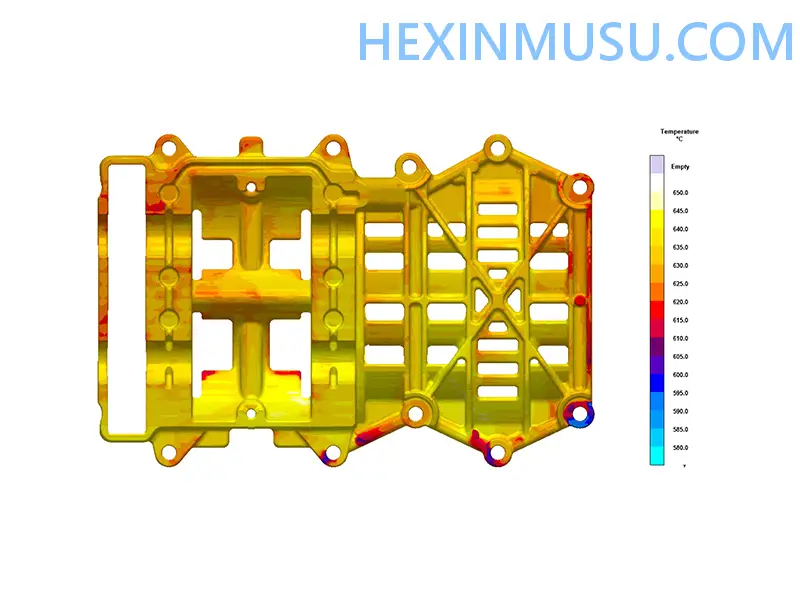
Die casting mold manufacturing begins with product drawing analysis and mold flow review. Engineers first check the wall thickness, mold release slope, and sharp angle structure of the die casting, and identify potential risks of shrinkage, trapped air, and poor filling. Subsequently, mold flow analysis is conducted to simulate in software the whole process of filling the cavity with aluminum or zinc liquid at a high speed of tens of meters per second, to predict the location of trapped air and solidification sequence, and to optimize the location of the gate, the cross-sectional area of the cross sprue and the layout of the overflow channel accordingly. In the structural design stage, the parting surface is determined, the pouring/discharge system is designed, the cooling water channel is arranged, and the calculation of the slide core extraction and ejection mechanism is completed. The final output of 3D model and 2D parts drawing provides accurate basis for subsequent material preparation and machining.

cae temperature simulation

2. Materials and roughingCore Roughening

The core of this stage is to obtain qualified mold blanks. The mold frame is usually purchased in standard specifications, while the die nut (cavity/core), which is in direct contact with high-temperature metal liquid, needs to be made of hot-work mold steel such as H13, SKD61 or 8407. In order to improve the denseness and isotropy of the internal organization of the steel, the blank must be forged in three directions, which is a key pre-process to prevent early cracking of the mold. Rough machining is carried out on an ordinary milling machine or roughing frame machine to quickly remove a large amount of residual material, leaving 0.5-1mm finishing allowance on one side. Subsequently, vacuum heat treatment: quenching + high temperature tempering, so that the hardness of the mold kernel to reach HRC 48-52. heat treatment will inevitably bring deformation and oxide skin, so ranked before the finishing process, which is the iron law of the mold manufacturing process.

cae temperature simulation

3. Finishing and special machiningPrecision milling after heat treatment

The mold kernel is strengthened by heat treatment and then enters the finishing stage. High-speed CNC carries out precision milling of parting surfaces, cavity contours, slide grooves, etc., and the cutting allowance is uniformly controlled at 0.1-0.2mm. for the deep grooves, narrow slits, concave texts or sharp corners that cannot be accessed by the CNC tool, EDM is used: a graphite or copper electrode is used to pulse-discharge in kerosene medium to replicate the shape of the electrode in reverse, and the dimensional accuracy is up to ±0.005mm. ejector pin holes, tilt-top holes, and gate-sleeve mounting holes are completed by slow-feed wire-cutting. At the end of this stage, surface nitriding (gas nitrocarburizing or ion nitriding) is applied to form a hardened layer of several microns to tens of microns to improve the mold's resistance to Al/Zn fusion wear. High-end molds can be further friction-reduced with an optional PVD coating.

cae temperature simulation

4. Assembly and commissioningMold Fit Mold

The parts are processed, transferred to the clamp assembly process. The first task is to research with (fly mold): in the mold kernel parting surface coated with red Dan, and the other side of the mold pressure, observe the distribution density of the contact patch, repeatedly scrape repair until the parting surface fit rate of 85% or more, this is to prevent die-casting edge phi feng fundamental protection. Subsequently assembled ejector plate, reset lever, spring, installation of slider and oblique guide column, connected to the hydraulic core cylinder, set up the cooling water circuit and one by one pressure leakage test. Test mold is this stage of the test link: mold lifting to the die casting machine, debugging high-speed / low-speed switching point, boost pressure, spray time, mold temperature and so on dozens of parameters. When the first complete casting out of the mold, design ideas for the first time into the real thing.

cae temperature simulation

5. Acceptance and deliveryInspection of dimensions, pre-delivery maintenance
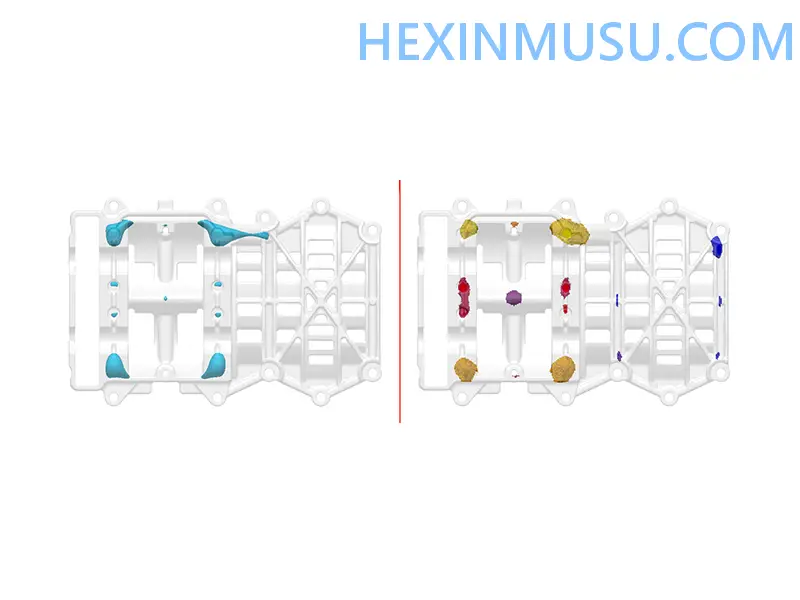
The trial mold piece enters the inspection room after removing the sprue and sandblasting. Coordinate measuring machine conducts full-size scanning of key installation dimensions, assembly hole spacing, and form and position tolerance, and generates FAI (First Article Inspection Report). At the same time, we provide mold material certification, heat treatment curve records, and hardness test data. Customers usually request to bring the sample parts back to the factory for small-lot assembly trial production, to examine the castings in the machining and assembly conditions of the actual matching effect. If the appearance of texture is required, etching/peeling treatment will be carried out after passing the mold test to avoid the texture surface from wearing out during repeated debugging. Before delivery, the molds are thoroughly treated against rust, the cavities are cleaned of oil, the spare parts package (ejector pins, seals, reset springs) is attached according to the agreement, and the molds are shipped in boxes with certificates of conformity and inspection reports.

cae shrinkage analysis view
Telephone

Service hotline:
+86 18312962656

whatsapp
wechat
Connection

Email:hexinmosu@163.com