
LM6 Comprehensive Guide to High Silicon Cast Aluminum Alloys: Compositional Philosophy, Heat Treatment Response and High End Applications
Date: 2026-02-03 Categories: Blog Views: 91
As part of the British Standards (BS) and Commonwealth system of High Silicon Aluminum Silicon Casting Alloys The classic brand name of theLM6 by means ofExcellent casting fluidity, great air tightness and excellent corrosion resistanceand widely recognized. The alloy is typicallySub-eutectic aluminum-silicon alloysin order toHigh purity base with moderate magnesium contentCharacterized by significant reinforcement by heat treatment, it is a key component in the manufacture ofComplex thin-walled, high-pressure gas-tight or high-quality castings requiring high corrosion resistance.It is the benchmark material in the marine, chemical and high-performance engineering fields.
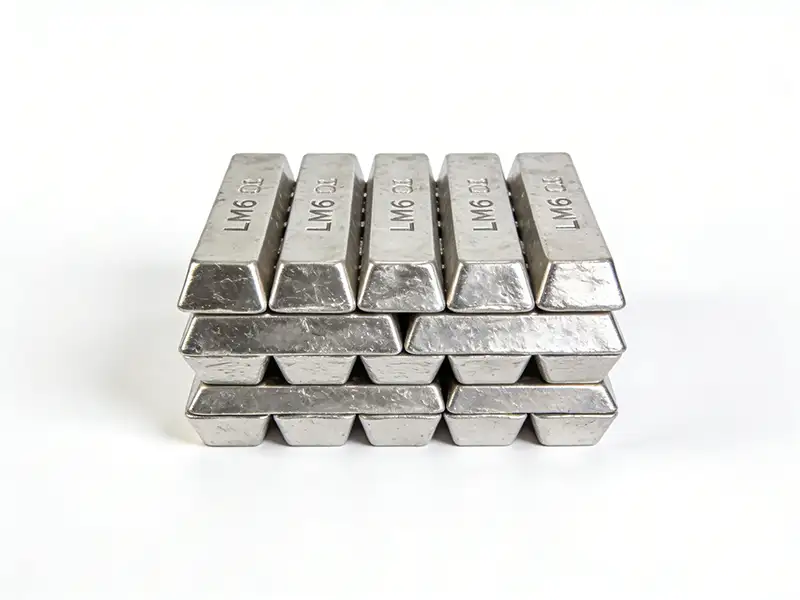
Standards and grades for LM6
- British/Commonwealth Standard Grades: According to British Standard BS 1490, the grades are LM6LM“ stands for ”Light Metal“. ”LM" stands for "Light Metal".
- Grade Meaning: The classic high-silicon grades of the LM series correspond to the internationally recognized Al-Si-Mg casting alloys.
- Core features:High silicon contentto ensure castability.Clear magnesium contentto provide heat treatment strengthening capabilities.Strict control of impurities (iron, copper) for top corrosion resistance. It represents the pursuit of “High Integrity Castings” The technical route.
LM6 Aluminum Alloy Composition Table (based on BS 1490 typical requirements)
| elemental | Content range (wt%) | functional role |
|---|---|---|
| Silicon (Si) | 10.0-13.0 | core elementIt offers unmatched casting fluidity, low shrinkage and resistance to hot cracking. |
| Magnesium (Mg) | 0.10-0.35 or higher | Key Enhancement Elements. The formation of the Mg₂Si phase makes the alloyHigh strength can be obtained by T6 heat treatment. is the key to distinguishing it from simple silica-aluminum mines such as LM20. |
| Iron (Fe) | ≤ 0.60 | Tightly controlled impurities. Low iron content is a prerequisite for high elongation and excellent corrosion resistance. |
| Copper (Cu) | ≤ 0.10 | Tightly controlled impuritiesIt is a very low copper content. The extremely low copper content ensures that in harsh environments such as seawater theTop corrosion resistance. |
| Manganese (Mn) | ≤ 0.50 | Partial neutralization of iron. |
| Zinc (Zn) | ≤ 0.10 | Strict control. |
| Titanium (Ti) | ≤ 0.20 | Grain refiner. |
| Aluminum (Al) | tolerance (i.e. allowed error) | High purity matrix. |
LM6 Physical and Mechanical Properties Parameter Table (sand/metal mold casting, typical values)
| Performance indicators | Cast (F) | T6 heat treatment state | Performance Positioning and Benefits |
|---|---|---|---|
| intensity | 2.66 g/cm³ | -- | -- |
| Tensile strength (Rm) | 150-180 MPa | 230-280 MPa | Excellent strength after T6The copper-containing alloys of the Cu alloys are very similar or superior to those of many copper-containing alloys. |
| Yield strength (Rp0.2) | 70-90 MPa | 180-220 MPa | Significantly improved by heat treatment. |
| Elongation (A) | 6.0-10.0% | 2.0-5.0% | Highlighting Advantages: Whether in the cast or T6 state, theExcellent plasticity (toughness), far exceeding Al-Si-Cu alloys of the same strength level. |
| Brinell hardness (HB) | 50-55 | 70-85 | -- |
| fatigue strength | favorable | talented | Dense organization and high toughness result in excellent fatigue resistance. |
| corrosion resistance | excellent | excellent | Core Advantages. It is the highest grade among cast aluminum alloys and is particularly resistant to seawater corrosion. |
| Casting mobility | excellent | -- | Core AdvantagesThe casting is suitable for the most complex castings. |
| airtight | excellent | -- | Good solidification characteristics, suitable for pressure castings. |
Performance Characteristics and Design Philosophy
The design philosophy of the LM6 is “Pure, strong and corrosion-resistant.” :
- pure substrate: ByStrict restrictions on iron (Fe) and copper (Cu) and other impurities, obtained close to the theoretical optimum ofCorrosion resistance and toughness. This makes them more costly than general-purpose alloys, but provides for applications where reliability is critical.
- Heat Treatment Flexibility: The well-defined magnesium (Mg) content makes its properties adjustable. It can be used either as a highly plastic cast material or through theT6 Heat TreatmentTransformation into high-strength structural materials provides freedom of design.
- Unrivaled craftsmanship: Extremely high silicon content ensures the highest castability of any heat-treatable aluminum alloy, enabling it to handle complex structures that are difficult to form with other high-strength alloys.
Corresponding international grades
As a classic alloy, it has a wide range of counterparts around the world:
- UK/International Standards:LM6 (BS 1490) and in the ISO standard as Al-Si10Mg.
- American Standard:A360.0 Close performance in die casting;356.0 Composition is similar in sand/metal mold casting, but the Si range is usually slightly lower (6.5-7.51 TP3T).
- Chinese national standard:ZL101A 或 ZL104, but LM6 has a higher Si content and castability is usually superior.
- EU standard:EN AC-43400 或 EN AC-45000 (EN 1706).
- French standards:A-S12G
- German Standard:G-AlSi10Mg
LM6 in the foundry industry
based on itsHigh integrity, corrosion resistance and toughness at the same timefeatures, the LM6 is widely used where reliability is paramount:
- Marine and Offshore Engineering (iconic applications)
- Marine components: Outboard housings, pump/valve housings, marine instrument mounts, deck fittings.
- Desalination and Chemical: Corrosion-resistant pump bodies, valve bodies, and line fittings.
- Aerospace and high-end equipment
- Aircraft structural parts: Complex supports, housings, and components of maneuvering systems that are not load-bearing or sub-load-bearing.
- High Performance Vehicles: Racing suspension parts, intake manifold, oil pan (metal mold casting T6 state).
- High-pressure and gas-tightness requirements
- hydraulic system: Valve blocks, accumulator housings, high-pressure cylinders (utilizing their superior gas-tightness and weldability).
- Compressor components: Air or refrigeration compressor blocks, end caps.
- High quality art and architectural castings
- Sculptures and decorative pieces requiring high surface detail and weather resistance.
LM6 Aluminum Alloy Frequently Asked Questions
Q1: What is the difference between LM6 and LM25?
- This is the most common comparison in the British Standard.
- LM6:High Silicon (10-13%Si), Low Iron and Copper, Contains Magnesium.Excellent castability, corrosion resistance and toughness, which can be strengthened by heat treatment.
- LM25:Medium Silicon (6.5-7.51 TP3TSi, similar to US 356.0), low Fe-Cu, Mg-containing.Strength (especially after T6) usually slightly higher than LM6, elongation slightly lower, casting fluidity is inferior to LM6.
- selection: The QuestExtreme castability, corrosion resistance and toughnessSelect LM6; pursueMaximum strength and hardnessLM25 can be selected when the structure permits.
Q2: Can LM6 be used for die casting?
- Yes, but not the most typical process. It is more commonly found inSand casting, metal-type (gravity/low-pressure) casting and investment castingBecause of its magnesium content and low iron characteristics. Because of its magnesium content and low iron characteristics, used in die casting need to pay attention to anti-sticking mold problems, and its excellent performance in the slow solidification process can be more reflected. When die casting its grade may correspond to GD-AlSi10Mg.
Q3: What is the welding and repair performance of LM6?
- Excellent performance. The low impurity content gives it a low tendency to weld hot cracks. The ability to obtain strong, dense welds, both in TIG (TIG/MIG) and filler welds, is an important advantage for its use in high-integrity castings.
Q4: Why is the corrosion resistance of LM6 so outstanding?
- The root cause is its “High purity.” :Very low copper (Cu) contentEliminates the main cathodic phase of galvanic corrosion;Low iron (Fe) contentThe possibility of forming harmful hard and brittle iron-rich phases is reduced. This enables the formation of a uniform, stable protective film of aluminum oxide on the surface.
Q5: Is it possible to replace LM6 with a cheaper alloy in cost-sensitive projects?
- Careful assessment is required. If the application utilizes only the LM6High castabilityAnd forLow corrosion resistance and toughness requirementsIn the case of a high iron or copper content, a common Al-Si alloy (e.g. LM2, LM4) may be considered as an alternative. However, if the application environmentWet, corrosive, or parts subjected to shock loadsThe substitution may lead to early failure, which may result in maintenance and replacement costs that are much higher than the material savings.LM6 is a material designed for total life cycle cost optimization.