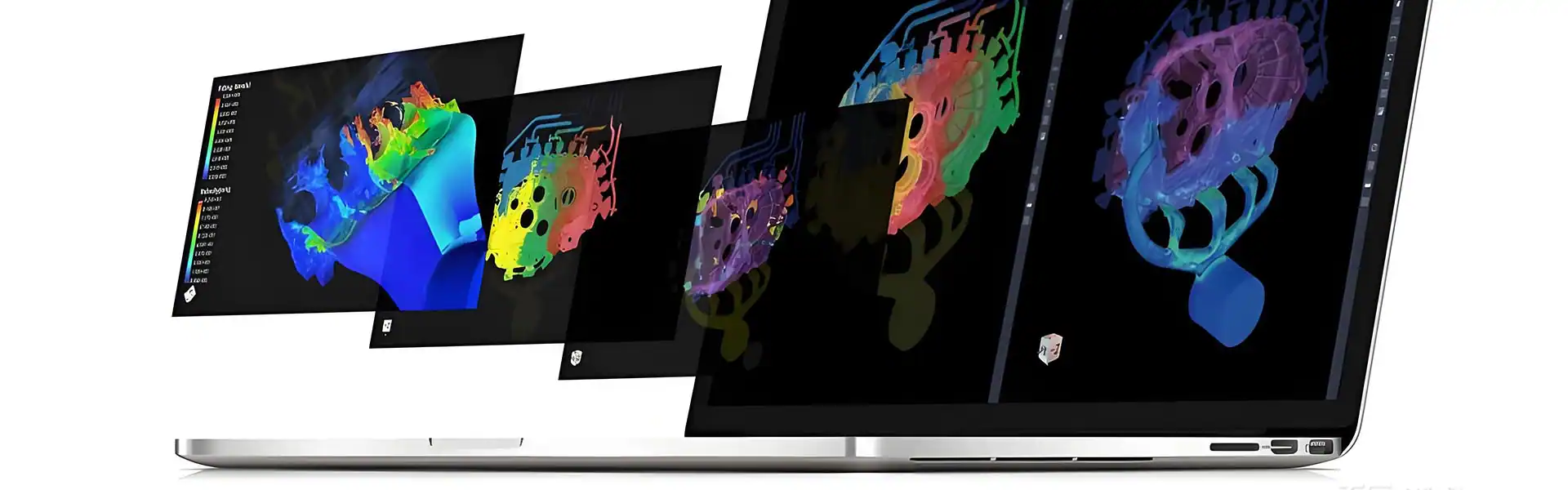
In die casting, low-pressure casting and gravity casting (including sand/metal type), CAE simulation is used as the core digital tool for coupled numerical simulation of the whole casting process by constructing a three-dimensional model covering the mold, casting and sprue system. Its common core analysis module includes:Charging process simulation(Analyze liquid metal flow patterns, predict cold segregation and gas wrapping),Solidification process simulation(analyzing temperature field and solidification sequence, predicting shrinkage) andStress/deformation simulation(Prediction of thermal stresses, residual stresses and deformations). For process characterizationDie casting CAE focuses on high-speed mold filling and air roll analysis, mold heat balance and cooling optimization.;Low-pressure casting CAE focuses on precise control of air pressure field, sequential solidification and shrinkage simulation.;Gravity casting CAE focusing on natural flow regime under gravity, solidification paths and riser make-up efficiency assessmentThe fundamental role is to scientifically predict defects and optimize process parameters and mold design. The fundamental role is to scientifically predict defects, optimize process parameters and mold design to significantly improve casting quality, shorten development cycles and reduce trial and error costs.
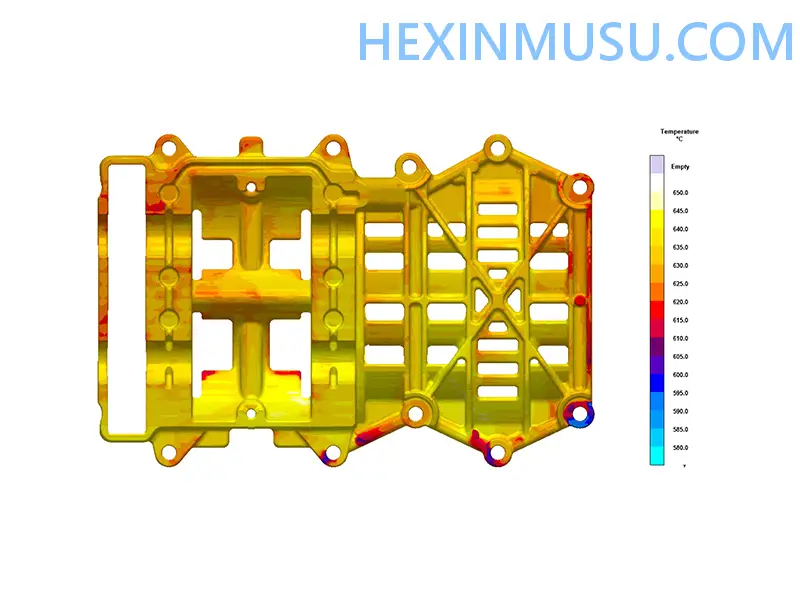
temperature simulationCAE Simulation Aluminum Casting Temperature Simulation
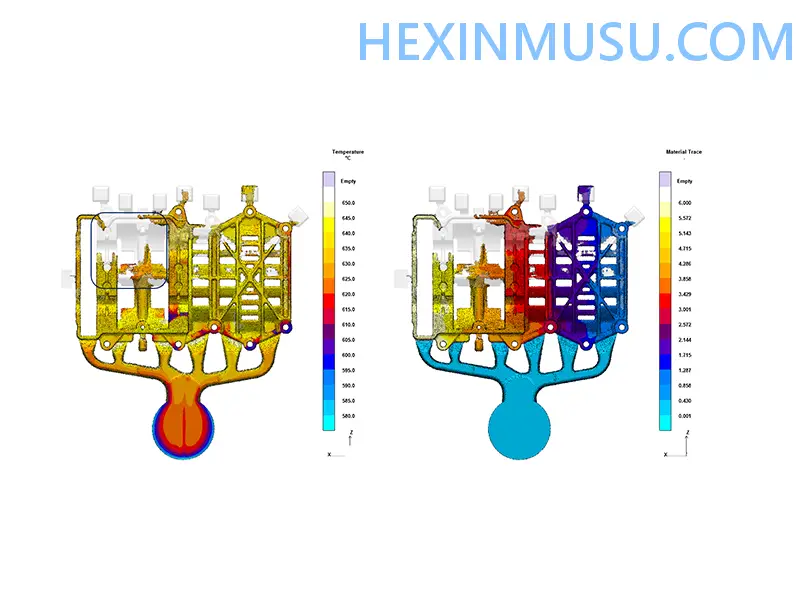
Filling flow simulationCAE Simulation of Aluminum Casting Filling Flow Simulation
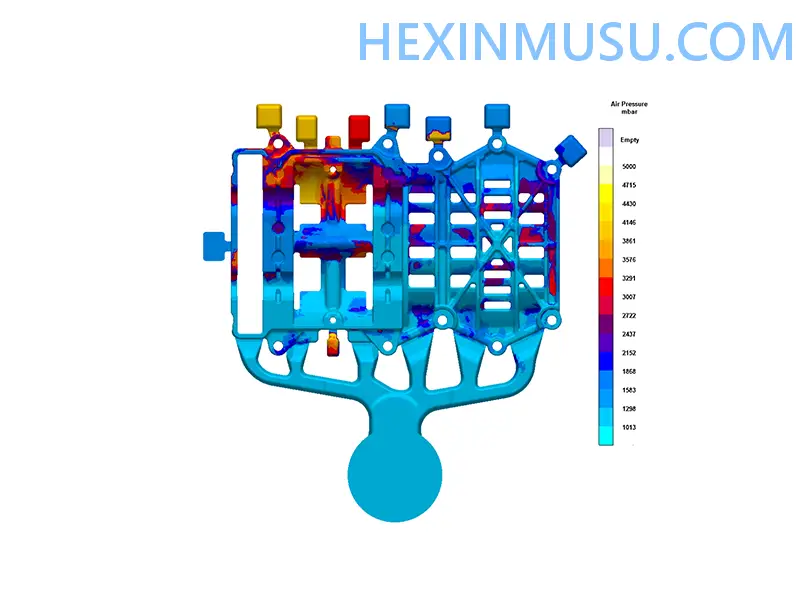
Barometric Pressure Simulation AnalysisCAE Simulation of Aluminum Casting Volume Gas Simulation Analysis
Shrinkage simulationCAE simulation of aluminum casting shrinkage simulation
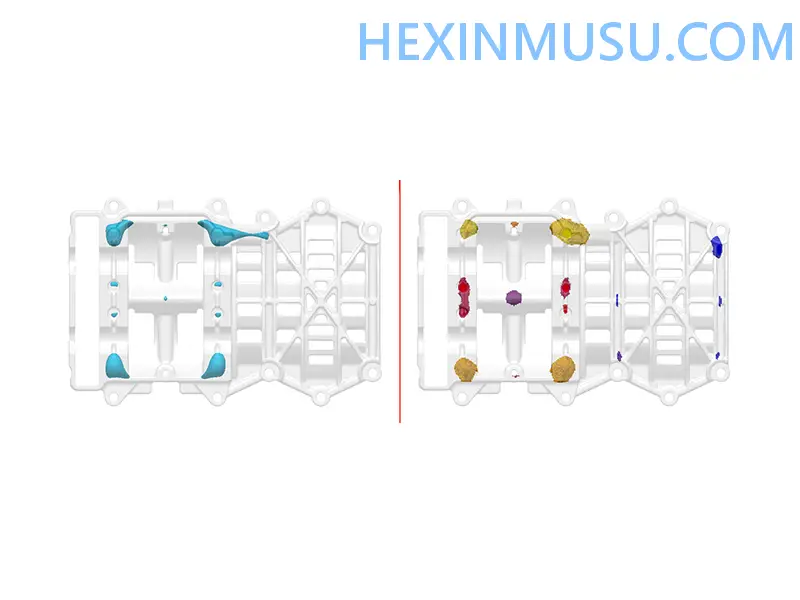
CAE Simulation and Analysis for Casting
He Xin Molding incorporated this into the mold development phaseCAE (Computer-Aided Engineering) Casting Simulation Analysis...by constructing a 3D numerical model that encompasses the mold, castings, and gating system, a multi-physics coupled simulation of the entire casting process is performed. The core value of CAE simulation lies inPredict defects and optimize process parameters before mold machining, reducing the 4 to 6 rounds of trial molding and mold modification required by the traditional trial-and-error method to Within 2 rounds, the development cycle for a single mold has been shortened by more than 30%, and trial mold costs have been reduced by approximately 40%.
He Xin's CAE simulation capabilities cover three processes: high-pressure die casting, low-pressure casting, and gravity casting. Leveraging leading simulation platforms such as ProCAST, MAGMASOFT, Flow-3D, and AnyCasting, the company can performMolding Flow Simulation, Solidification and Cooling Analysis, Gas Trapping Prediction, Cavitation and Porosity Assessment, Thermal Stress and Deformation CalculationsFive core analysis modules. Simulation results directly guide the design of the gating system, the layout of cooling channels, venting strategies, and the setting of process parameters, facilitating a shift in mold development from a "trial-and-error" approach to a "data-driven" one.
Four Core Simulation and Analysis Modules
CAE Simulation for CastingFilling → Solidification → Defects → StressFour physical processes are carried out, with data coupling between the various modules, collectively forming a comprehensive digital verification system for the casting process:
Filling Flow Simulation
Based on CFD (Computational Fluid Dynamics), this method solves the Navier-Stokes equations to simulate the flow path, filling velocity distribution, and free-surface morphology of molten metal within the gating system and mold cavity. It can predict filling defects such as cold shuts, underfill, and flow marks, and outputs data on filling time, flow velocity fields, and temperature fields to guide the optimization of gate location and cross-sectional area.
Solidification and Cooling Analysis
Couples the solution of the heat transfer equation with the release of latent heat of solidification to calculate the temperature-time curves, solidification sequence, and solid fraction distribution for various regions of the casting. Identify isolated liquid zones and hot spots, predict the tendency for shrinkage cavities and porosity, and quantify the probability of defects using the Niyama criterion or the solid fraction gradient method to guide the layout of risers and chill blocks.
Gas Inclusion and Oxidation-Induced Slag Inclusion
The multiphase flow (VOF method) is used to track the interface between molten aluminum and gas, simulating the entrainment, fragmentation, coalescence, and rise of gas during the mold filling process. Quantitative outputs—including the location of entrained gas, gas volume fraction, and retention probability—guide the optimization of vent channel and vent plug layouts, as well as adjustments to the pouring rate curve.
Stress and Strain
By coupling the temperature field with the mechanical field, this method calculates the thermal stress distribution, residual stress levels, and deformation of castings during solidification and cooling. It predicts the risk of hot cracking (based on the Hot Cracking Sensitivity Index, HCS) and dimensional deviations, providing a basis for designing mold counter-deformation compensation and establishing heat treatment processes.
Key Focus Areas of CAE Simulation for Three Casting Processes
The mechanisms of mold filling and defect patterns vary significantly across different casting processes, and the focus and key criteria of CAE simulations differ accordingly:
Die Casting CAE Simulation
Low-Pressure Die Casting CAE Simulation
Gravity Casting CAE Simulation
CAE Simulation Software Toolchain
Based on different casting processes and analysis requirements, He Xin has selected several specialized CAE simulation software packages, each with its own focus, which complement one another:
| Software Name | Core Advantages | Applicable Processes | Key Features | Grid Type |
|---|---|---|---|---|
| MAGMASOFT | High accuracy in solidification and stress analysis, with precise simulation of the mold temperature field | Die Casting, Low-Pressure Casting, Gravity Casting | Multi-cycle thermal equilibrium analysis, microstructure prediction | FDM (Finite Difference Method) |
| ProCAST | Strong multiphysics coupling capabilities and accurate radiation and heat transfer calculations | Low-pressure, gravity (including sand molds) | Hot Cracking Prediction, Grain Structure Simulation, and Deformation Compensation | FEM (Finite Element Method) |
| Flow-3D | Highest accuracy in free-surface tracking; leading high-speed filling simulation | Die casting | TruVOF Method, Quantitative Analysis of Volatile Gases, Oxidation Film Tracking | FVM + FAVOR |
| AnyCasting | Easy to use, fast computation, and suitable for rapid iteration | Gravity, Low Pressure | Gate Optimization Wizard, Parallel Comparison of Multiple Solutions | FDM (Finite Difference Method) |
Standard Process for CAE Simulation and Analysis
He Xin's CAE simulations follow standardizedFive-Step Analysis Process, to ensure the reproducibility of simulation results and their value as engineering guidance:
Geometric Preprocessing
Import the 3D models of the casting and mold, extract the fluid and solid domains for the gating system, casting, and mold, perform meshing (ensuring ≥3 mesh layers for thin-walled parts), and set the interfacial heat transfer coefficient (casting-mold: 500–2000 W/m²·K).
Materials and Boundary Conditions
Select an aluminum alloy grade (A356 / A380 / ZL101, etc.), set the thermal properties (liquidus temperature, solidus temperature, latent heat, viscosity curve), and configure the pouring temperature, mold preheating temperature, and filling rate/pressure curve.
Solve the problem
Launch the multiphysics coupling solver to sequentially calculate the filling flow field, temperature field, and solidification process. Typical solution times: 2–4 hours for die-casting filling analysis and 4–8 hours for low-pressure casting solidification analysis (depending on the number of mesh elements and hardware configuration).
Post-processing of Results
Visualize the filling sequence, temperature field, solidification rate distribution, locations of shrinkage cavities and porosity, volume fraction of entrapped gas, and stress distribution. Extract key criteria values (Niyama number, residual gas volume fraction, and thermal cracking susceptibility index) to generate defect prediction reports.
Iterative Process Optimization
Adjust the pouring system parameters (gate area, overflow channel position), cooling parameters (coolant flow rate, coolant temperature), or process parameters (pouring temperature, filling rate) based on the simulation results, and rerun the simulation to verify the changes until the predicted defects meet quality requirements.
Key Simulation Parameters and Boundary Conditions
The accuracy of CAE simulations depends heavily onThe Rationality of Boundary Condition Setting. The following are the key simulation parameters calibrated by He Xin based on actual production data to ensure that deviations between the simulation results and the physical test mold are kept within an acceptable range:
| Parameter Categories | Parameter Name | Typical Values / Range | Impact on Simulation Accuracy |
|---|---|---|---|
| Thermal Properties | A356 Liquidus Temperature | 615°C | Factors Affecting the Determination of the Onset of Setting |
| Thermal Properties | A356 Solidus Line Temperature | 555°C | Factors Affecting the Setting Point and the Closure Time of the Shrinkage Channels |
| Thermal Properties | Latent Heat of Solidification (A356) | 389 kJ/kg | Effects on Setting Time and Temperature Field Calculations |
| Interface | Heat Transfer Coefficient for Castings and Molds | 500–2,000 W/m²·K | Directly affects the cooling rate and solidification sequence |
| Interface | Molds—Cooling Water Heat Transfer Coefficient | 3,000–8,000 W/m²·K | Factors Affecting the Thermal Equilibrium of a Mold |
| arts and crafts | Pouring Temperature (A356) | 700–740°C | Factors Affecting Filling Capacity and Solidification Time |
| arts and crafts | Mold Preheating Temperature | 180–250°C (die casting) / 150–200°C (low-pressure) | Factors Affecting Filling Completeness and Solidification Rate |
| arts and crafts | Die-Casting Filling Rate | 50–100 m/s (internal gate) | Factors Affecting Air Volume and Surface Quality |
| arts and crafts | Low-Pressure Hold Pressure | 0.1–0.3 MPa | Factors Affecting Shrinkage Compensation Efficiency and the Tendency for Shrinkage Voids |
| Criteria | Niyama Threshold | < 0.8–1.0 √K·s/mm | Shrinkage determination threshold; values below this threshold indicate a risk of shrinkage |
| Criteria | Residual Gas Volume Fraction | < 2% (Safety Component) | Quantitative Measures of Porosity Defects |
| Criteria | Heat Cracking Sensitivity Index (HCS) | < 1.0 (Low Risk) | Thermal Cracking Risk Assessment Thresholds |
Frequently Asked Questions About CAE Simulation Technology
Need support for CAE simulation and analysis in casting?
Send us your product drawings and manufacturing requirements, and Hexin’s engineers will conduct CAE simulation analysis concurrently during the mold design phase and provide a detailed defect prediction report and recommendations for process optimization—the simulation costs are included in the mold development service at no additional charge.
Submit your drawings to receive a simulation analysis proposal →