
The Complete Guide to Shot Peening Aluminum Products: Processes, Advantages and FAQs
Date: 2026-02-28 Categories: Blog Views: 73
exist aluminum In die-casting industry, surface treatment is one of the key links to determine the final quality of the product. As an efficient and environmentally friendly surface treatment process, shot blasting is widely used in automotive parts, 3C electronic shells, hardware accessories and other fields. It not only removes the oxide skin and burrs on the surface of die castings, but also improves the metal organization and fatigue strength. This article will take you a comprehensive understanding of the aluminum alloy shot blasting process principles, advantages, equipment selection and common problem solutions to help you make more professional decisions in production and procurement.
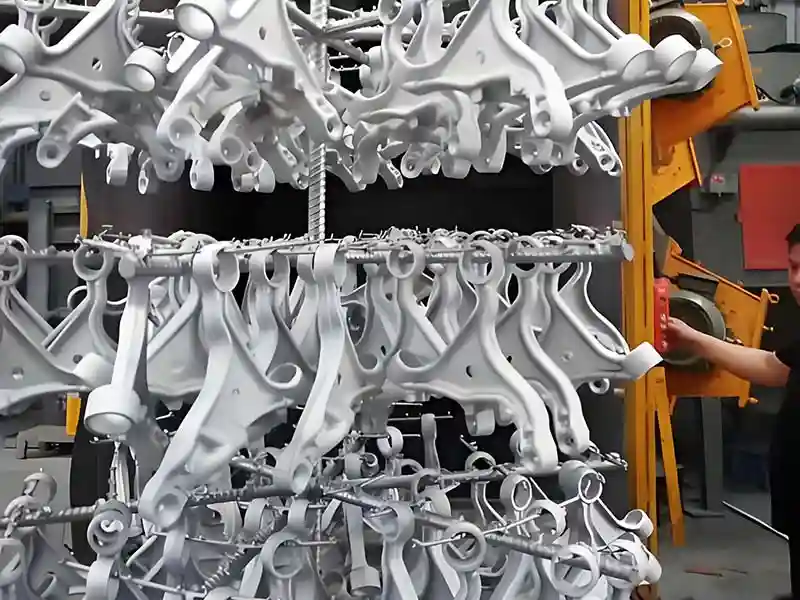
Shot Blasting Showcase
1. What is Aluminum Alloy Shot Peening? Process Principle Analysis
Shot peening is a physical surface treatment technology that utilizes a stream of high-speed moving projectiles to impact the surface of the workpiece to achieve cleaning, strengthening or decorative purposes.
1.1 Principle of operation
The core equipment of shot blasting is the shot blasting machine (or head), which consists of a high-speed rotating impeller and directional sleeve. When the projectile falls into the high-speed rotating impeller blades through the feed tube, it is accelerated to 60-100 m/s under the action of centrifugal force (adjusted according to the equipment), and directed to the surface of the workpiece at a certain angle. After the impact of the projectile on the workpiece, two main effects are produced:
- Cutting/scouring effect: The kinetic energy of the projectile is converted into cutting energy, removing oxidized skin, residual mold release agent, flying edge burrs and small scratches on the surface of the workpiece, revealing a clean metal substrate.
- plastic deformation effect: The impact of the projectile causes small plastic deformations on the surface of the workpiece, forming a compressive stress layer with a slight increase in surface hardness (work hardening). This compressive stress effectively counteracts the tensile stress inside the workpiece, significantly increasing the fatigue strength.
1.2 Key process parameters
- Throwing speed: Directly affects cleaning efficiency and surface roughness. For aluminum alloys, too high a speed will lead to surface over-throwing (skinning, deformation), while too low a speed will not allow effective cleaning. The usual recommended range is 40-70 m/s.
- projectile flow: Mass of projectile thrown per unit time. Too large a flow may cause the projectiles to interfere with each other and reduce efficiency; too small a flow will not provide sufficient coverage.
- throw angle: Usually 45°-90°. Vertical impact cleaning is more efficient, but may produce deeper craters; tilted angle results in more uniform roughness.
- Throw time/coverage: Usually measured as a multiple of the “time required to completely cover the original surface” (e.g. 200% coverage). This can be determined by fluorescent tracer or magnification.
1.3 Differences from sandblasting
- shot peening: Utilizing mechanical centrifugal force to eject the projectile, high efficiency, low energy consumption, suitable for high-volume, large-area treatment, but the ability to cover complex internal cavities is limited.
- sandblast: Using compressed air to spray abrasive, high precision, good flexibility, suitable for localized, shaped parts or fine processing, but low efficiency, high energy consumption, dust.
2. Five core advantages of aluminum alloy product blasting
Shot peening of aluminum alloy die castings not only improves the appearance quality, but also fundamentally improves the physical properties and service life of the product.
2.1 Efficient surface cleaning
Die casting process residual mold release agent, oil, oxide skin, as well as sprues, flying edge and other burrs, must be cleaned before subsequent spraying, plating or anodizing. Shot blasting can be completed in a few minutes the workload of hours of manual grinding, and clean up more uniform, no dead ends. For example, the inner wall of the oil passage of the water jacket of an automobile engine block can effectively remove the sintered sand and oxidized layer through shot blasting to ensure the cleanliness of the oil passage.
2.2 Eliminate residual stresses and improve fatigue life
Die casting in the solidification and cooling process, due to uneven wall thickness or mold temperature differences, the internal tensile stress will remain. Under the action of alternating loads, these tensile stresses can easily become the source of fatigue cracks. The surface compressive stress layer (usually 0.1-0.5 mm in depth) introduced by shot peening can effectively counteract the tensile stresses and increase the fatigue life by several times or even an order of magnitude. This effect is particularly significant on safety components such as aluminum alloy wheels and suspension arms.
2.3 Enhancement of coating adhesion
Smooth die-cast surfaces are not favorable for mechanical occlusion of coatings. The uniform microscopic craters (roughness Ra 1.6~6.3 μm) formed after shot blasting greatly increase the specific surface area, which enables paint, powder or electrophoresis layers to be firmly embedded in the craters, and the adhesion is improved from class 0 to class 1 or higher, effectively preventing blistering and peeling of the coating.
2.4 Concealment of minor casting defects
Die casting process inevitably appear slight flow marks, cold segregation, water lines and other appearance defects, these defects are very conspicuous in the light. After shot blasting, the fine craters make the light diffuse reflection, visually mask these defects, significantly improve the product appearance pass rate. For aluminum alloy parts used directly without spraying, this advantage is particularly important.
2.5 Enhancement of decorative effect
The uniform shot peening surface presents a delicate matte texture or a diffuse reflection effect like the twinkling of stars, which greatly enhances the product's sense of class. For example, high-end audio panels, mechanical keyboard shells, drone fuselage, etc., often use the shot peening surface as the final decorative surface, without additional spraying to obtain excellent visual effects.
3. Aluminum alloy die casting shot blasting process points and equipment selection
Selection of suitable equipment and process parameters is a prerequisite for obtaining ideal shot blasting results.
3.1 Main types of equipment
| Equipment type | Working Principle | Applicable products | vantage | drawbacks |
|---|---|---|---|---|
| Hanger Type Shot Blasting Machine | The workpiece is suspended from a hook, rotates and receives projections. | Large and medium-sized workpieces: cylinder block, cylinder head, hub, housing | Complex shapes can be handled and workpieces can be turned evenly without collision | Relatively low efficiency, not suitable for very small parts |
| Crawler Type Abrator | The workpiece is tumbled in the rubber tracks and the blast machine blasts it from above and below. | Small and medium-sized workpieces: hardware, fasteners, communication housings | High efficiency, batch processing, rubber tracks to reduce collisions | Easy to produce stacked parts, thin-walled parts need to control the time |
| Pass Through Machines | Continuous passage of the workpieces through the ejection zone by means of a conveyor belt | Flat parts, profiles: radiators, plates, frames | Highly automated and extremely efficient | Large investment in equipment, only suitable for regular pieces |
| Rotary Table Machine | The workpiece is placed on a rotating table and the blast machine blasts sideways or over the top. | Precision parts and thin-walled parts that are afraid of collision | Fixed workpiece, no collision, high precision | Inefficient, usually single or small batches |
3.2 Core process parameter control
- Projectile material and grain size:
- Steel shot: diameter 0.3-1.5 mm, high cleaning efficiency, but easy to embed iron filings, suitable for subsequent spraying parts.
- Glass pills: diameter 0.1-0.5 mm, no iron pollution, bright white surface, suitable for anodized parts and appearance parts.
- Aluminum shot: 0.5-2.0 mm diameter, for superfinishing or to avoid contamination by foreign metals.
- Stainless steel shot: long life, no rust, but high cost.
- Throwing speed and time:
- The recommended blasting speed for aluminum alloys is 40-70 m/s. It can be controlled by adjusting the current of the blast wheel or by a frequency converter.
- The ejection time needs to be determined from the specimen. Typically, about 2-5 minutes for moderately complex parts, 1-2 minutes for thin-walled parts, and 5-10 minutes for large parts. This can be verified by “coverage”, i.e. 2-3 times the time required for the original surface to be completely covered.
- Projectile consumption and replenishment:
- The projectile will wear out and break during ejection and needs to be replenished regularly. Consumption is generally 0.5-2 kg per square meter of surface (depending on the material and strength). Broken projectiles need to be removed by wind or magnetic separator in time to avoid scratching the workpiece.
4. Professional die-casting and shot blasting processing, choose Ningbo Hexin Die Casting Factory
Experience and equipment are indispensable in the complex process of surface treatment of aluminum alloys.We are for Ningbo Hexin Die Casting FactoryWe have advanced hook and crawler type shot blasting equipment, combined with many years of die casting experience, can not only accurately control the parameters of the shot blasting to eliminate stress and improve surface adhesion, but also effectively avoid the common defects such as skinning and sand holes. We provide one-stop service from die casting to shot blasting post-treatment to ensure that every product delivered to you has excellent appearance quality and structural strength. We strictly follow the ISO quality management system and conduct random inspection of roughness and coverage of each batch to ensure process stability. We are committed to providing you with optimized surface treatment solutions for both large orders and trial samples.
5. Aluminum alloy shot blasting common defects and solutions
In actual production, shot blasting link often appear a variety of quality problems, the following in-depth analysis of high-frequency pain points:
| Faqs | Detailed reasons | Measures for prevention and resolution |
|---|---|---|
| Skinning and peeling of the surface | 1. Cold segregation, delamination or insufficient density (internal porosity, shrinkage) in the die casting itself. 2. Excessive blasting time or high blasting speeds, resulting in overblasted surfaces and destruction of the substrate. 3. The projectile is broken with angles and cut too deep. | 1. Optimize the die-casting process, increase the die temperature, two fast position, reduce the cold separation. 2. Determine the optimum blasting time by means of a test sample and reduce the speed using a frequency converter. 3. Regularly clean broken projectiles and use high sphericity projectiles. |
| Sand holes (pits) after blasting | 1. Welding slag and iron filings inside the equipment are mixed into the projectile system and thrown to the workpiece with the projectile. 2. The particle size of the projectile is too large and the impact energy is too concentrated. 3. The surface of the workpiece has projections (e.g., residual sprues) that leave craters when knocked out by the projectile. | 1. Thoroughly clean the equipment before blasting, install high-efficiency separators, and discharge slag regularly. 2. Selection of the right size of projectile (usually 0.3-0.8 mm for small parts and 0.8-1.5 mm for large parts). 3. Enhance the inspection of the previous process to ensure that sprues and flying edges have been removed. |
| Dark, yellowish or black spots on the surface | 1. Steel shot was used and iron filings were embedded in the aluminum surface, resulting in yellowing or rusty black spots after oxidation. 2. Oil or moisture in the projectile, contaminating the surface. 3. Failure to clean or pack in time after blasting, surface oxidation and discoloration. | 1. For subsequent anodizing or high appearance requirements, change to glass shot or stainless steel shot. 2. Regularly check the cleanliness of the projectile to avoid mixing oil and water, and dry the projectile if necessary. 3. Timely rustproofing or transfer to the next process after blasting to shorten the storage time. |
| Workpiece deformation | 1. Plastic deformation of thin-walled parts (wall thickness <1.5 mm) under the impact of high-speed projectiles. 2. Workpieces collide with each other in a belt blast machine resulting in deformation. 3. Excessive blasting time and cumulative impact energy. | 1. Reduce the speed of ejection and use small diameter, lightweight projectiles (e.g. glass). 2. Use hook or turntable type to avoid collision; or add bulkheads in tracked machines. 3. Strictly control the blasting time, through the test piece to determine the minimum effective time. |
| Uneven cleaning (shaded surface) | 1. Unreasonable arrangement of blast wheels with blind spots. 2. Workpiece rotates too slowly on hook or tracks do not roll sufficiently. 3. Complex internal cavities cannot be covered by projectiles. | 1. Optimize the angle and number of blast wheels and perform computer simulations if necessary. 2. Adjust the speed of the hook or the tumbling speed of the crawler to ensure that all surfaces are evenly shot. 3. For internal cavities, sandblasting may be used to supplement the treatment, or special tooling may be designed to guide the projectile. |
| Surface roughness does not meet the requirements | 1. The pellet size is too large or too small. 2. The velocity of the projectile is too high or too low. 3. Blasting time is too long or too short. | 1. According to the roughness required by the product drawings to select the appropriate grain size of the projectile. 2. Adjust the ejection speed and measure the feedback in real time by means of a roughness meter. 3. Identify the optimal time window through a time gradient test. |
6. Selection of blast media: steel shot vs. glass shot vs. aluminum shot
The physical properties and application scenarios of different media vary significantly, and proper selection is the basis for quality assurance.
| Media Type | durometer | Density (g/cm³) | geometry | Applicable Scenarios | vantage | drawbacks | (manufacturing, production etc) costs |
|---|---|---|---|---|---|---|---|
| cast steel shot | HRC 40-50 | 7.8 | ball-shaped | Clean burrs, oxidized skin, strengthen the stress | High cleaning efficiency, long life, low cost | Easily embedded iron filings leading to gray surface and subsequent risk of rusting | lower (one's head) |
| Stainless Steel Pills | HRC 45-55 | 7.8 | ball-shaped | Highly demanding reinforcement, no iron contamination occasions | Extremely long life, no rust, no iron contamination | high cost | your (honorific) |
| glass pills | HV 500-700 | 2.5 | ball-shaped | Exterior parts, anodizing pre-treatment, finish machining | Bright white surface, no metal embedded, not easy to damage the substrate | Fragile and fast consuming | moderate |
| aluminum shot | HV 30-50 | 2.7 | Spherical/Cylindrical | Soft metal cleaning to avoid contact with dissimilar metals | Same material, no pollution | Low kinetic energy, poor cleaning efficiency, short life span | moderate |
| ceramic pill | HV 700+ | 3.8 | ball-shaped | Shot Peening, Aerospace | High hardness, long life, no pollution | high cost | your (honorific) |
Recommendations for selection:
- Pre-spray treatment: Cast steel shot can be used, which is highly efficient and the subsequent coating can cover the traces of iron filings. It is recommended to add a magnetic separation process after blasting to remove the residual iron chips on the surface.
- Anodizing pre-treatment: Glass shot, ceramic shot or stainless steel shot must be used, and cast steel shot is strictly prohibited, otherwise the oxidization will appear black spots that cannot be removed.
- Exterior Decorative Surfaces: Preferred glass shot or fine grain stainless steel shot for a uniform matte finish.
- stress enhancement: Stainless steel or ceramic balls are selected according to the strengthening requirements and need to be tested for strength by means of an Almen test piece.
7. Safety and environmental considerations
Aluminum alloy blasting will produce aluminum powder, which is a conductive flammable and explosive dust, with high safety risks, the following measures must be strictly implemented:
- Explosion-proof dust removal system: Shot blasting equipment must be equipped with explosion-proof dust collector in accordance with GB 15577 "Dust Explosion Safety Regulations". Dust removal piping should be equipped with explosion relief ports and explosion-proof valves, and the fan motor needs to be explosion-proof. Regularly clean the aluminum powder in the dust collector to prevent accumulation.
- equipment grounding: The entire equipment, including the blast machine, piping, workpiece spreaders need to be reliably grounded to prevent static buildup and sparks.
- flameproof: Electrical components such as motors, lighting, control cabinets, etc. inside the equipment should be of explosion-proof type and conform to the corresponding explosion-proof level.
- On-site management: The shot blasting operation area should be away from open flames and heat sources, and smoking and fire operations are prohibited. The site should be equipped with a sufficient amount of dry powder or special metal fire extinguishers, water is strictly prohibited.
- personal protection: Operators must wear dust masks (N95 or above), impact goggles, noise-proof earplugs or ear muffs, and anti-static coveralls and gloves.
- Waste disposal: The collected aluminum powder is hazardous waste (code HW09 or HW49), which should be handed over to qualified units for treatment, and dumping is strictly prohibited.
8. Frequently Asked Questions (FAQ)
Q1: Which is better for my aluminum products, shot peening or sandblasting?
A: It depends on your product shape, batch size and surface requirements. If yours is a large batch of regular or moderately complex parts, and the main purpose is cleaning and peening, shot blasting is a more cost-effective choice. If your product has complex internal cavities, deep holes, or requires localized fine finishing (e.g., engraving, deburring), airblasting is more flexible. Many manufacturers will combine the two: shot blasting for the overall treatment and sandblasting for localized additions.
Q2: Can aluminum alloy be anodized directly after blasting?
A: Yes, but you must use projectiles with no iron media (e.g. glass shot, ceramic shot, stainless steel shot). If steel shot blasting is used, iron filings will be embedded in the aluminum surface, and during the anodizing process, the iron impurities will dissolve and cause black spots, flow marks, or reduced corrosion resistance in the oxide film. Therefore, it is important to ensure that the blasting media is free of iron contamination before anodizing.
Q3: How can I tell if the blasting process is achieving the desired results?
A: It is usually assessed in three ways:
- exterior condition: Uniform color, no local shiny or black, no skinning or sanding visible to the naked eye.
- roughness: Measure Ra and Rz values using a roughness meter to ensure compliance with the drawings (general Ra 1.6-6.3 μm).
- site coverage: The original surface should be completely covered by craters when viewed with a magnifying glass of 10x or greater, or verified by fluorescent tracer.
- Enhanced effect: For stress-reinforced parts, the arc height can be tested with an Almen test piece to ensure that the specified strength is achieved.
Q4: What should I do if a die casting is deformed after blasting?
A: First analyze the cause of deformation:
- If the thin-walled part itself is not rigid enough, the blasting speed should be reduced, smaller and lighter projectiles (e.g. glass shot) should be used, and the blasting time should be shortened.
- If mutual collisions in a tracked blast machine are the cause, consider switching to a hook or turntable type, or adding a soft spacer to the tracked machine.
- If the blasting time is too long, the minimum effective time should be re-established by test.
- If necessary, special fixtures can be designed to fix the workpiece before blasting to avoid direct impact on thin-walled areas.
Q5: Does shot peening affect the dimensional accuracy of aluminum alloy products?
A: For general fit dimensions, the thickness of material removed by shot peening is extremely small (usually a few microns to tens of microns) and the effect is negligible. However, for precision parts (e.g., hydraulic valve spools, precision gears) or thin-walled parts, excessive shot peening may result in dimensional overshooting. Therefore, for high-precision parts, it is necessary to strictly control the blasting time and carry out dimensional inspection during the process validation stage.
Q6: How to measure and control the surface roughness after blasting?
A: A common measurement tool is a contact roughness meter (e.g. handheld roughness meter), which measures Ra and Rz values according to ISO 4287. A representative area (e.g. front, side) needs to be selected for measurement, avoiding edges and dead ends. Methods of controlling roughness include: adjustment of projectile grit size (the larger the grit the greater the roughness), blast speed (the higher the speed the greater the roughness), blast angle (vertical incidence roughness is maximized), and blast time (too much time may reduce roughness as pits are flattened by the secondary impacts).
Q7: Do I need to do rust prevention treatment on aluminum alloy parts after blasting?
A: Aluminum alloy itself has good corrosion resistance, but the surface is fresh and active after blasting, and may still oxidize and discolor in a humid environment. If it will be sprayed or anodized in a short period of time (e.g. within 24 hours), it can be left untreated for the time being, but it should be stored in a dry and ventilated place. If it is to be stored for a long time or used directly, it is recommended to be passivated or coated with anti-rust oil.
reach a verdict
Aluminum alloy shot blasting is a comprehensive surface treatment technology that integrates cleaning, peening and decoration. Through scientific process design, accurate equipment selection, strict media management and standardized safety operations, shot blasting can significantly improve the quality and added value of aluminum alloy die castings, reduce scrap rate and extend product life. With the manufacturing industry on product quality and environmental protection requirements continue to improve, shot blasting process is moving towards automation, intelligence, green direction.
In practical application, due to the soft material and many varieties of aluminum alloys, the debugging and optimization of the shot blasting process requires a wealth of experience. Whether it is the trial production of new products, or the stable production of batch orders, it is crucial to choose a processing partner with professional technology and strict quality control. We hope this article can provide you with valuable reference in the selection and application of aluminum alloy shot blasting.