Comprehensive Analysis of Aluminum PVD Coating: The Ultimate Surface Treatment Technology to Enhance the Performance and Appearance of Die Castings
Date: 2026-02-26 Categories: Blog Views: 101
Excerpt:
Want to give aluminum alloy die casting a high hardness, wear-resistant and corrosion-resistant and colorful surface? This article is an in-depth analysis of the principle, advantages, process and application of PVD coating, and provide you with professional technical consulting and sampling services.
aluminum Die castings are widely used in automotive, electronics, hardware and other fields due to their light weight, high strength and easy molding. However, under harsh usage environments, aluminum alloy surfaces may be challenged by wear, corrosion, or lack of aesthetics. Especially in applications such as automotive powertrains and consumer electronics housings, products not only have to withstand mechanical friction, but also need to have excellent weather resistance and decorative effects. Traditional surface treatments such as anodizing or electroplating have gradually shown their limitations in terms of hardness, environmental protection or color diversity, and PVD coating, as a green and high-performance surface treatment technology, is becoming a key means to enhance the added value of aluminum alloy die castings. This article will bring you a comprehensive understanding of how PVD coating can inject new competitiveness into your products from the dual dimensions of functionality and aesthetics.
1. What is PVD coating?
Definitions and Principles
Physical Vapor Deposition (PVD) is a technique in which solid materials are vaporized into atoms, molecules or ions in a vacuum environment and deposited on the surface of a substrate to form a thin film. The process is usually carried out under a high vacuum of 10-³ Pa or more to ensure the purity and denseness of the deposited layer. Depending on how the target material is vaporized, PVD is divided into three main categories:
- evaporative coating: Evaporation of the target material by resistance heating or electron beam bombardment, suitable for deposition of aluminum, silver and other low melting point metal films.
- sputtering: Utilizing the ions generated by glow discharge to bombard the target, the target is atomically sputtered out and deposited on the substrate. This method has good film uniformity and is suitable for large-area coating.
- electric arc ion plating: The target material is directly evaporated and highly ionized by vacuum arc, with high deposition rate and strong film bonding, commonly used in tool plating and decorative plating.
PVD vs. other surface treatments
Compared with electroplating, PVD films are denser and have stronger bonding strength, and there is no harmful wastewater discharge, which is compliant with environmental directives such as RoHS and REACH. Compared with chemical plating, PVD can deposit a variety of functional films (e.g. TiN, CrN, DLC) with rich colors and higher hardness. Compared to anodizing, PVD provides higher hardness and wear resistance, especially for moving parts and exterior parts. In addition, the low temperature of the PVD process (usually 150-400°C) does not cause changes in the organization of the aluminum alloy matrix, which makes it particularly suitable for surface strengthening of precision die castings.
2. Core advantages of PVD coating on aluminum alloys
Excellent mechanical properties
PVD coatings are usually composed of nitrides, carbides or cermets and can reach a hardness of more than 2000 HV, far exceeding that of anodized coatings (about 300-500 HV). For example, titanium nitride (TiN) layers have a hardness of about 2300 HV, which significantly improves the scratch and wear resistance of aluminum alloy surfaces. Diamond-like (DLC) coatings have a coefficient of friction as low as 0.1, making them suitable for sliding parts such as pistons and gears, reducing energy consumption and extending life.
Excellent corrosion resistance
The dense ceramic film layer protects the aluminum alloy substrate by effectively blocking water vapor, salt spray and chemical agents in the environment. PVD-treated aluminum alloy parts can withstand neutral salt spray tests for hundreds of hours without corrosion spots, far exceeding the resistance time of untreated parts. This characteristic makes PVD coatings particularly suitable for outdoor hardware, automotive chassis parts and offshore components.
green cleaning
PVD is a dry process, with no wastewater or exhaust gas emissions, and no need to dispose of heavy metal-containing waste liquids, which is in line with increasingly stringent global environmental regulations. Adopting PVD technology can help enterprises avoid environmental risks and enhance the green image of their brands at the same time.
Gorgeous decorative effect
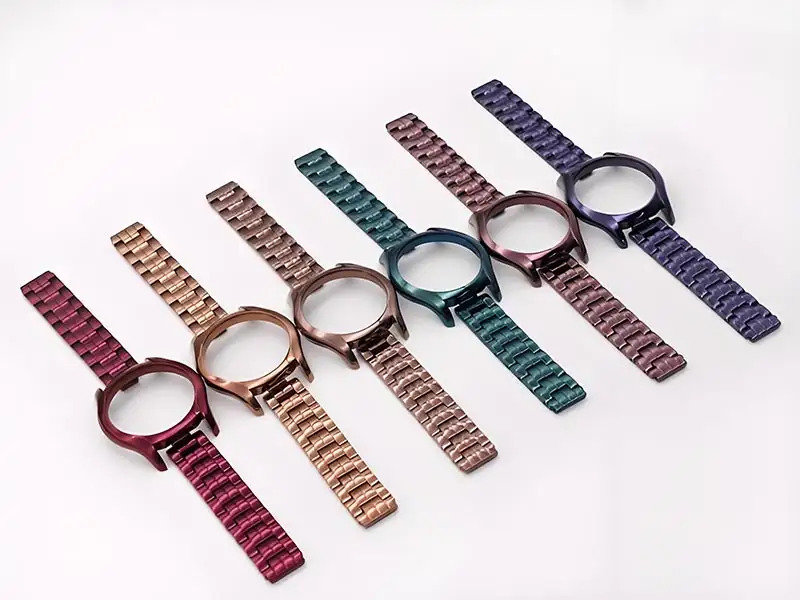
By adjusting the film layer material and process parameters, PVD can present a variety of metallic luster such as rose gold, gunmetal, bright silver, black, blue, etc., and the color is long-lasting and resistant to UV irradiation. Compared with spraying or electrophoresis, PVD film layer has a metallic texture and high surface hardness, which is not easy to scratch, making it an ideal choice for high-end consumer products and automotive interiors.
Dimensional accuracy maintained
PVD layer thicknesses are typically in the micron range (0.1-5 μm), which is much smaller than machining tolerances, and therefore will not affect the assembly dimensions of precision parts. For parts with tight tolerances, the thickness of the coating can be allowed for in the design, or the final dimensions can be qualified by precisely controlling the deposition time.
3. PVD Coating Process Flow Details
Pre-treatment (cleaning and activation)
Pre-treatment is a key step in determining the adhesion of the PVD film layer. First of all, the use of multi-tank ultrasonic cleaning to thoroughly remove oil, fingerprints and cutting fluid residues on the surface of the die casting; subsequently, the removal of the natural oxide film by alkaline or acid degreasing; finally, plasma cleaning, the use of high-energy ions bombardment of the surface, to remove the adsorbed atomic level contaminants, and produce surface activation energy, to provide a clean substrate for the subsequent coating. For aluminum alloys, special attention needs to be paid to the removal of the natural oxide film (Al₂O₃), which is dense and chemically inert, and will seriously affect the film bonding force if not thoroughly removed.
Vacuum pumping and heating
The cleaned and dried workpieces are put into the PVD vacuum chamber, the vacuum system is started and pumped to a high vacuum (above 10-³ Pa). At the same time, heat the workpiece to the set temperature (usually 150-400°C) by radiant heating or baking. The temperature selection needs to be adjusted according to the aluminum alloy grade to avoid softening of the material due to over-aging. Heating helps to remove adsorbed gases on the surface and promotes the diffusion of atoms in the film layer to enhance bonding.
ion bombardment cleaning
An inert gas (e.g. argon) is introduced and high voltage is applied to generate a glow discharge, which uses argon ions to bombard the surface of the workpiece, further removing microscopic contaminants and activating surface atoms. This process also provides a uniform temperature of the workpiece in preparation for deposition.
Deposition of Coating
The target material (e.g., titanium, chromium, graphite, etc.) is selected according to the target film layer, and the atoms of the target material are dissociated by means of electric arc or sputtering. Under the action of negative bias pressure applied to the workpiece, the dissociated metal ions are attracted to the workpiece surface for deposition. Reaction gases (e.g., nitrogen, acetylene, oxygen) can be introduced at the same time to form compound films (e.g., TiN, CrN, TiCN, DLC, Al₂O₃, etc.). The deposition process requires precise control of gas flow, bias pressure, temperature and time to obtain the desired thickness, hardness and color.
Post-processing (optional)
Surface cleaning is carried out as required to remove any microscopic particles that may be present; for parts requiring a low coefficient of friction, a nano-lubrication layer can be applied; and for decorative parts, light polishing can be carried out to enhance gloss. All post-treatments need to ensure that the PVD film layer is not damaged.
4. Typical application of PVD coating on aluminum alloy die castings
automobile industry
Aluminum alloy die castings play an important role in automotive lightweighting. Interior parts such as gearshift paddles, steering wheel trims, instrument panel frames, etc. are coated with PVD to achieve a luxurious metallic texture and upgrade the whole car. Engine pistons, shock absorber piston rods, transmission valve bodies and other moving parts are coated with wear-resistant film layers (e.g. DLC or CrN), which can significantly reduce friction loss and improve fuel economy. In addition, the turbocharger impeller is treated with PVD, which enhances the high-temperature oxidation resistance and improves reliability.
consumer electronics product
Aluminum alloy parts such as cell phone middle frames, laptop casings, smart watch cases, etc. are widely used with PVD coating. By adjusting the film layer, a variety of colors such as matte black, bright silver, rose gold, etc. can be realized, while giving the surface anti-fingerprint and scratch-resistant properties. 5G era, the metal shell of the signal shielding problem can be alleviated through the optimized design of the PVD layer, and the ceramic texture of the film layer can be comparable to the appearance of glass.
High-end hardware
Sanitary ware such as faucets, showerheads, and shower fittings, which are exposed to water and detergents for a long period of time, need to have excellent corrosion resistance, and PVD coating (e.g., gunmetal-colored CrN, gold TiN) is not only resistant to salt spray, but also has a high hardness on the surface, which is not easy to be scratched by hard objects. Door locks, handles, furniture pulls, etc. are treated with PVD, the color is long-lasting and enhances the premium of the products.
medical equipment
Surgical instruments, dental tools, implants, etc. require a high degree of biocompatibility and sterilization resistance. PVD-coated TiN or ZrN layers are biocompatible, inhibit bacterial adhesion, and can withstand high-temperature and high-pressure steam sterilization to extend the life of the instruments.
5. Why choose a professional PVD coating service?
PVD coating is extremely demanding in terms of equipment, process and experience. Differences in the chemical composition of different aluminum alloy grades (e.g. ADC12, A380, 6061, 7075) affect the growth behavior and bonding of the film layer. Die-cast aluminum alloys with high silicon content (e.g. ADC12) require special treatment in pre-treatment to avoid film layer defects caused by silicon segregation. In addition, uniform coating of complex shaped workpieces requires reasonable fixture design and electric field simulation to ensure consistent film thickness.
We provide you with professional PVD coating solutions under strict control from pre-process evaluation, sample proofing to mass production. We have advanced PVD coating equipment with precise temperature control and bias system to meet the stringent standards of automotive and electronic industries. Our technical team optimizes the coating parameters for different aluminum alloy grades to ensure excellent film adhesion and uniform color, and ensures the stability and reliability of each batch of products through adhesion tests (scratching and indentation methods), hardness tests, and salt spray tests.
Contact us today for a custom PVD coating solution for your aluminum die castings! Ningbo Hexin Die Casting Factory You are welcome to send your design drawings or samples to our factory, our engineers will provide you with free process evaluation and sampling services to help you enhance the competitiveness of your products. You can contact us through the official website online or call our service hotline.
6. Frequently Asked Questions (FAQ)
- Q: How is the adhesion of PVD coating on aluminum alloy ensured?
A: Adhesion is the key to the PVD process. We ensure that the film layer forms a metallurgical bond with the aluminum alloy substrate and the adhesion meets ASTM or ISO standards through rigorous ion bombardment cleaning, appropriate substrate temperature, and optimized transition layer design (e.g., deposition of a pure metal layer first). - Q: What colors can I make with PVD coating?
A: By adjusting the film material, gas flow and process parameters, you can achieve rich colors, such as gold (TiN), rose gold (ZrN), gunmetal (CrN), black (TiAlN/CrAlN or DLC), and silver white (Cr). We can provide color swatches for you to choose from. - Q: Does PVD coating affect the dimensional accuracy of die castings?
A: The thickness of PVD layer is extremely thin (usually 0.2~5 micron), which is much smaller than the tolerance range of machining, so it will not affect the assembly dimensions of precision parts. For parts with strict tolerance requirements, we can make reservation design before plating. - Q: How does the cost of PVD coating compare to electroplating?
A: Although PVD has a higher investment in single equipment, the comprehensive cost is often lower than traditional electroplating in mass production due to its environmental friendliness, excellent film layer performance and no wastewater treatment cost. Specifics need to be evaluated based on the shape of the workpiece, the type of film layer and the batch size. - Q: Which aluminum alloy grades are suitable for PVD coating?
A: Most die cast aluminum alloys (e.g. ADC12, A380, AlSi series) and deformed aluminum alloys (e.g. 6061, 7075) can be PVD coated. However, die castings with high silicon content may require special pre-treatment, and we have proven process solutions for different alloys.
concluding remarks
PVD coating is redefining the surface performance and aesthetic standards of aluminum alloy die castings. As a trusted die casting and surface treatment partner, Ningbo Hexin Die Casting combines advanced technology with extensive experience to provide you with comprehensive support from design to finished product. Act now and let us help your products stand out!